Is a Boiler the Same as a Hot Water Heater? A Practical Comparison
Explore the key differences between boilers and hot water heaters, including function, efficiency, installation, and maintenance to help homeowners and facility managers decide which system best fits their needs.


Boiler and hot water heater are not the same. A boiler heats water to support space heating or steam production, while a hot water heater stores and heats water for domestic use. They differ in purpose, installation, energy sources, and maintenance needs. Understanding these differences helps homeowners and facility managers choose the right system for comfort, efficiency, and cost control.
What each system is and does
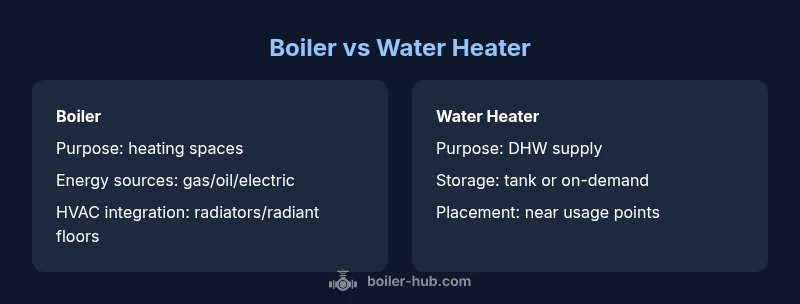
According to Boiler Hub, the terms boiler and hot water heater are often confused, but they describe two distinct pieces of equipment with different jobs. A boiler is designed to heat water (or produce steam) to power space heating systems, such as radiators, baseboard convectors, or radiant floors. A hot water heater, by contrast, is built to deliver domestic hot water for taps, showers, dishwashers, and washing machines. In many homes, these systems are paired: the boiler handles space heating, while the water heater provides DHW. The separation matters because the equipment, controls, venting requirements, and service needs vary accordingly. Beyond function, you’ll notice differences in location, fuel options, and how each unit interacts with the home’s overall energy strategy. This clarity helps prevent mismatched equipment, oversized installations, and inefficient operation. In short, boilers heat for comfort; water heaters supply your daily hot water.
Core functions and design intent
A boiler’s primary task is to heat water or produce steam that travels through a building’s heating loop. It may operate with radiators, underfloor heating, or a combination of both. A hot water heater’s core duty is to keep a reservoir or flow system ready to deliver hot water at points of use. Boiler systems can be fuelled by gas, oil, electricity, or other sources, and may include efficiency-boosting technologies like condensing designs. Domestic water heaters often come in tanked or tankless varieties and may use gas, electricity, or solar-ready configurations. The key takeaway is purpose: heating for spaces versus providing hot taps. The Boiler Hub perspective emphasizes matching system type to the home’s heating load, water demand, and climate to optimize comfort and energy use.
How energy source, efficiency, and cost interact
Energy source matters: boilers and water heaters can share fuels (gas or electricity) but are optimized for different uses. Efficiency is highly dependent on the technology employed—condensing boilers, for example, reclaim heat from exhaust gases, while modern tankless water heaters minimize standby losses. The cost picture is also system-specific: boilers often require investment in radiators and controls, whereas water heaters focus on storage capacity and recovery rate. Boiler Hub analysis highlights that the long-term cost of ownership depends on usage patterns, system sizing, and maintenance quality. In practice, a larger home with a full hydronic heating setup may justify a high-efficiency boiler, while a smaller residence with modest DHW needs could rely on a well-chosen water heater. Understanding these dynamics helps set realistic budgets and expectations from the outset.
Space, location, and integration with HVAC
Where you place equipment matters for both performance and safety. Boilers typically live in dedicated mechanical rooms or basements and integrate with the home’s heating distribution, requiring venting and proper clearance. Water heaters are often located closer to kitchens or bathrooms for shorter hot-water runs and easier accessibility. Tanked water heaters store hot water, while tankless models heat on demand, influencing space requirements and installation complexity. Hybrid configurations—such as a boiler paired with an indirect-fired water heater—can optimize performance in larger homes, but they demand careful design. When planning placement, consider assembly size, proximity to living areas, fuel supply lines, and local codes. A sound layout minimizes heat loss, reduces piping length, and simplifies future service.
Tanked vs tankless: options and trade-offs
Tanked water heaters store a finite amount of hot water, providing rapid DHW delivery but carrying standby losses. Tankless units heat water on demand, delivering nearly unlimited hot water with smaller storage needs but potentially higher up-front costs and more complex venting. Boilers with indirect water heaters leverage the boiler’s heat to warm DHW, often delivering reliable supply with good energy efficiency, especially in winter. Hybrids and combination systems can simplify operations in homes with simultaneous space heating and DHW demands but require careful system sizing. The practical takeaway is to align the option with demand patterns: steady, high daily DHW needs may justify a tank with high recovery rates, while intermittent use can favor tankless.
Maintenance, safety, and common failure modes
Maintenance practices differ by system. Boilers require periodic service of burners, pumps, expansion tanks, and venting, plus boiler-specific safety checks. Water heaters demand regular anode inspections, flushing to reduce sediment buildup, and thermostat checks. Tankless water heaters emphasize descaling and venting maintenance, while hybrid systems require periodic verification of interlocking controls between the boiler and DHW heater. Safety concerns include pressure relief valves, proper venting to prevent carbon monoxide buildup, and adherence to local codes. Regular professional service reduces the risk of leaks, inefficient operation, and unexpected downtime.
How to choose the right system for your home or facility
Start by listing core needs: Do you require robust space heating, abundant DHW, or both? For large homes with extensive radiators, a high-efficiency boiler paired with an indirect water heater often delivers balanced comfort and DHW supply. For smaller households, a reliable tank water heater with adequate storage or a modern tankless model may suffice. When evaluating cost, consider not only purchase price but installation, venting, replacement intervals, fuel availability, and potential rebates. Consulting a Boiler Hub professional can help tailor a solution to your climate, usage patterns, and energy goals. The decision should align with your comfort priorities, long-term energy costs, and local codes.
Common myths and misperceptions
Many homeowners assume a boiler is interchangeable with a water heater, or that all modern boilers also heat domestic hot water automatically. In reality, systems vary widely in how they heat, store, and deliver water. Another myth is that tankless always saves energy; while it reduces standby losses, it can have higher operating costs if hot water is used heavily in quick succession. A final misconception is that more expensive equipment guarantees better reliability; proper sizing, installation, and maintenance are equally important. Understanding the fundamental roles helps demystify choices and guides smarter investments.
Comparison
| Feature | Boiler | Hot Water Heater (Tank) |
|---|---|---|
| Primary purpose | Heat spaces/produce steam for heating system | Provide domestic hot water for taps and appliances |
| Typical installation | Connected to heating loop; mechanical room or basement | Tank installed near usage points or in utility area |
| Energy sources | Gas, oil, electricity, or alternative fuels (with heating system) | Gas, electricity, or solar-ready configurations |
| Storage and output | No domestic storage; DHW can be indirect via coil or separate water heater | Stores heated water for immediate DHW use |
| Efficiency considerations | High-efficiency condensing options; performance tied to heating load | Tank standby losses; tankless variants reduce standby but may vary on flow rate |
| Maintenance focus | Burner/pump service, expansion tank, venting checks | Anode rod inspection, sediment flushing, thermostat checks |
| Best for | Homes with space heating needs or radiant systems | DHW-focused configurations; small to mid-size homes or apartments |
Advantages
- Clarifies system roles to prevent mismatched components
- Enables better integration with radiant and hydronic heating
- High-efficiency boiler options can reduce long-term energy use
- Indirect water heaters can boost DHW supply while preserving a boiler’s strengths
The Bad
- May require more complex installation and venting
- Upfront costs can be higher for boiler-plus-indirect configurations
- Tankless DHW or hybrid setups may have variable performance by climate and demand
Boiler vs water heater: not the same; choose based on primary needs.
If you need space heating plus reliable DHW, a boiler with an indirect water heater often provides balanced performance. For simple DHW needs or smaller homes, a well-chosen water heater may be more cost-effective and easier to install.
Questions & Answers
Is a boiler interchangeable with a hot water heater in most homes?
Not typically. Boilers and hot water heaters have different design intents and venting needs. In many homes, a boiler handles heating while a separate water heater provides DHW. Hybrid systems can integrate the two, but proper sizing and installation are essential.
Usually not interchangeable; a boiler heats the home, while a water heater supplies taps. Hybrid setups exist, but they require professional sizing and installation.
Can I replace a boiler with a water heater to save space or cost?
Only in limited scenarios. If you rely on space heating, a water heater won’t replace the boiler’s role without changing the entire heating system. For homes that only need domestic hot water, a tank or tankless water heater may be a sensible upgrade.
Replacing a boiler with a water heater isn’t usually feasible if you need space heating. If you only need hot water, a water heater can work well.
What is a combi boiler and how does it relate to this topic?
A combi boiler provides both space heating and domestic hot water from a single unit without a separate hot water storage tank. It’s a compact option for small to medium homes, but may struggle with high simultaneous DHW demands in larger homes.
A combi boiler heats space and water on demand from one unit, great for small homes but can be challenged by big DHW needs.
Do boilers require special venting or permits?
Yes. Most boilers require venting for exhaust and proper combustion air, plus adherence to local codes. New installations typically need permits and professional installation to ensure safety and efficiency.
Boilers usually need venting and permits; have a licensed pro install to stay safe and code-compliant.
Which is more energy-efficient, boilers or traditional water heaters?
Energy efficiency depends on the model and system design. Condensing boilers often achieve high efficiency, and tankless water heaters minimize standby losses. The best choice depends on your heating load, usage pattern, and climate.
Efficiency depends on the model; condensing boilers and tankless heaters can be very efficient, chosen by how you use them.
Key Points
- Define your primary goal: space heating or domestic hot water
- Match system type to home size, climate, and usage patterns
- Consider hybrids only with careful design and professional sizing
- Plan for maintenance and venting from the outset
- Use a qualified pro to tailor the best combination for your home