Is a Combi Boiler Better Than a Tank? A Practical Comparison
A thorough, data-driven comparison of combi boilers vs traditional tank boilers. Learn how they work, where each shines, setup and running costs, and which option fits your home or facility needs best.


Combi boilers are often the better choice for smaller homes or apartments because they save space and provide on-demand hot water, but they aren’t universally superior. According to Boiler Hub, the best choice depends on your household size, hot-water peaks, and mains water pressure. For many families, a combi is ideal; for larger homes with high peak demand or limited mains pressure, a tank-based system can be the smarter option.
How a Combi Boiler Works
A combi (combination) boiler heats water directly from the mains whenever you turn on a hot tap. There is no separate hot water tank or cylinder; the unit provides heating and warm water on demand. This on-demand approach minimizes standby heat losses because water is heated only when needed. Modern combi boilers use a combination of a heat exchanger, a circulating pump, and a diverter valve to switch between space heating and domestic hot water. The performance you experience—flow rate and temperature stability—depends on the boiler size, the installation’s pipework, and the incoming mains pressure. According to Boiler Hub, the on-demand model suits homes with predictable hot-water patterns and moderate peak usage. For households that demand simultaneous showers and multiple outlets, flow rates can become a limiting factor unless you size the boiler appropriately.
How a Traditional Tank Boiler Works
A traditional tank boiler, often paired with a hot water cylinder, heats and stores a reserve of hot water for later use. The cylinder acts as a buffer, so you can draw hot water from the tank while the boiler refills. This arrangement can deliver higher peak flow since water is pre-warmed and available from the stored cylinder. However, you incur standby losses because the stored water loses heat when not in use. Tank systems also require more space for the cylinder and associated plumbing, and they can be more complex to install, especially in retrofit scenarios. The Boiler Hub team notes that cylinder size, insulation, and pipework quality significantly influence efficiency and long-term running costs.
Key Differences at a Glance
When deciding between a combi and a tank boiler, several factors matter most: space, hot-water demand, and mains pressure. Combi boilers excel in compact spaces and modest hot-water use, while tank systems tend to perform better under high simultaneous demand and when mains pressure is uneven. Both systems can be efficient if sized correctly and installed with quality components. It’s essential to consider how your household uses hot water, how much storage you need, and how much space you have for equipment and service access.
Space, Installation, and Aesthetics
A primary advantage of combi boilers is their space-saving profile. They’re typically wall-mounted and compact, making them ideal for flats, small kitchens, or utility rooms where space is at a premium. Tank boilers require a storage cylinder, which can take up a cupboard, airing cupboard, or dedicated boiler room. The extra footprint affects not only placement but also maintenance access and future expansion. A well-installed combi boiler also tends to simplify the overall plumbing layout, reducing pipe runs. In contrast, a tank system may offer easier expansion to serve distant outlets if you’re renovating an older property with existing plumbing laid out for a cylinder.
Water Demand and Flow Rate Considerations
Your peak water demand is a decisive factor. If multiple taps or showers are used at the same time, a combi boiler must deliver sufficient flow by drawing water on demand. This requires careful sizing and, in some cases, a high-flow model to avoid noticeable drops in temperature. A tank system leverages stored hot water, which can provide higher instantaneous flow at the tap even when multiple outlets are used, provided the cylinder is adequately sized. The choice should reflect typical daily patterns: a single bathroom with light usage may fare well with a combi; a family home with two or more bathrooms and frequent simultaneous use may benefit from a tank solution, particularly in areas with long heating seasons.
Efficiency and Running Costs
Both systems can be highly efficient when modern condensing boilers and correctly sized components are used. Combi boilers minimize standby losses by eliminating storage, which improves efficiency in many scenarios. Tank systems face standby losses from the cylinder and pipework, but they can maintain heat more steadily during high-demand periods, potentially reducing the need to reheat water constantly. Real-world efficiency hinges on boiler efficiency ratings, correct sizing, and installation quality. Boiler Hub analysis shows that matching the system to usage patterns is more impactful for energy savings than chasing small efficiency gains from marginally different models.
Reliability, Maintenance, and Lifespan
Maintenance needs differ between the two configurations. Combi boilers generally have fewer moving parts and compact layouts, which can simplify servicing. However, if a combi boiler fails, there is no stored hot water reserve, which can be inconvenient. Tank systems rely on a cylinder and associated components (expansion vessel, immersion heater options in some configurations), which may add to maintenance complexity but can provide a buffer if the boiler is temporarily offline. Proper servicing, including annual checks and vent/pressure testing, remains essential for both. The Boiler Hub Team emphasizes sticking to a regular service schedule to maximize lifespan and detect issues early.
Upfront Costs and Long-Term Value
Initial installation costs depend heavily on existing plumbing and space. In newer homes, a combi boiler may require less material and simpler routing, often leading to lower upfront costs. Tank systems, with the cylinder and additional storage components, can be more expensive upfront but may offer stronger performance in high-demand households. Total cost of ownership should consider not only installation but also running costs, maintenance, and potential replacement intervals. A careful lifecycle analysis can reveal which option yields lower costs over your expected usage horizon.
Replacement Considerations and Compatibility
If replacing an existing system, consider whether your current plumbing supports a straightforward upgrade to a combi or if a cylinder-compatible setup is required. Older homes with long pipe runs or limited mains pressure may see significant benefits from a tank-based approach, whereas newer, energy-efficient layouts are generally well-suited to combi installations. It’s essential to confirm compatibility with radiators, pump sizing, and any expansion vessel requirements. The objective is to preserve or improve heat delivery while minimizing disruption during retrofit.
Decision Guide: Matching Your Home to a Solution
For compact homes, apartments, or households with predictable, moderate hot-water use, a combi boiler often delivers the best balance of space, cost, and efficiency. For large families, homes with simultaneous hot-water demand, or properties with low mains pressure, a tank-based system can provide more reliable peak flow and backup hot water. If you’re upgrading in an area with variable water pressure, consider a consultative sizing assessment that uses your historical hot-water patterns and mains data to determine the right solution. Boiler Hub recommends a formal sizing calculation as a critical step in the decision process to ensure comfort and reliability.
Common Myths Debunked
Myth: “A combi boiler can never supply multiple showers at once.” Reality: Modern high-flow combi boilers can support simultaneous use, but flow rate is limited by boiler size and mains pressure. Myth: “Tank systems are always less efficient.” Reality: Cylinder insulation and smart controls can minimize losses, but standby heat loss remains a consideration. Myth: “Replacing a tank with a combi is a simple swap.” Reality: Retrofit often requires plumbing and venting refinements, plus space planning for the new unit. A professional assessment is essential to avoid surprises.
Implementation Checklist and Next Steps
- Gather your typical daily hot-water patterns and peak usage times.
- Have a licensed installer perform a sizing calculation (not just a rough estimate).
- Inspect mains water pressure and ensure it meets the minimum requirements for the chosen system.
- Plan for space, ventilation, and accessibility for servicing.
- Obtain quotes that itemize boiler, cylinder (if applicable), controls, and installation work; compare lifecycle costs, not just upfront price.
Comparison
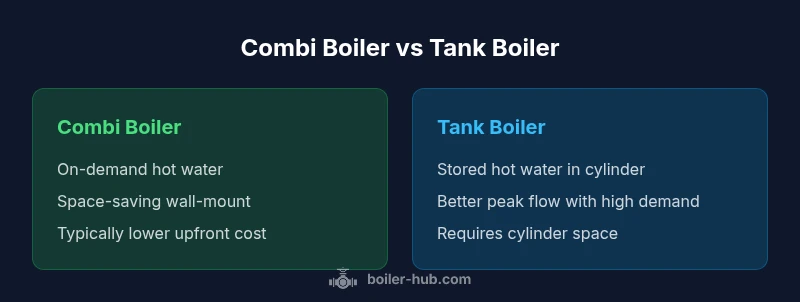
| Feature | Combi boiler | Regular (tank) boiler |
|---|---|---|
| Hot water delivery | On-demand hot water from mains | Stored hot water in a cylinder |
| Space requirements | Compact, wall-mounted | Cylinder storage space required |
| Pressure sensitivity / flow | Dependent on mains pressure; flow varies with demand | May deliver higher instantaneous flow from stored water |
| Installation complexity | Typically simpler with fewer components | More complex due to cylinder and additional plumbing |
| Efficiency / running costs | Low standby losses; efficient when sized well | Standby losses possible; efficiency depends on insulation |
| Best for | Small to mid-size homes, space-restricted | Larger homes with high hot-water demand |
Advantages
- Space-saving design ideal for compact homes
- Typically lower upfront installation cost in new builds
- On-demand hot water reduces standby heat losses
- Faster installation due to fewer components
- Lower likelihood of heat loss from stored water in everyday use
The Bad
- Flow rate depends on mains pressure and boiler size; peak demand can limit performance
- Not ideal for very large households with high simultaneous hot-water use
- No stored hot water reserve if the boiler stops working
- Cylinder-based systems may require more dedicated space and ventilation
Combi boilers are generally the better fit for space-conscious homes and moderate hot-water demand, while tank systems excel in large households or where mains pressure is a constraint.
For many homes, a combi boiler provides sufficient hot water with minimal space impact and lower upfront costs. In bigger homes or where water flow is a limiting factor, a tank system offers higher peak flow and reliability. A professional sizing assessment is essential to confirm the best choice.
Questions & Answers
What is the core difference between a combi boiler and a tank boiler?
A combi boiler heats water on demand with no storage tank, while a tank boiler uses a cylinder to store hot water for later use. The choice depends on space, usage patterns, and water pressure. Both options can be efficient with proper sizing and maintenance.
Combi boilers heat water as you need it, with no tank. Tank boilers store hot water in a cylinder for later use.
Is a combi boiler better for apartments or small homes?
Yes, combi boilers are typically a good fit for apartments and smaller homes due to space savings and straightforward installation. They also avoid standby losses from stored water. In high-demand scenarios, ensure proper sizing to maintain adequate flow.
Yes, for small homes a combi is usually the better choice, provided it’s properly sized.
Can I convert from a tank system to a combi boiler?
Conversion is possible but involves rewiring and replumbing to match the on-demand system and may require venting and pressure adjustments. A licensed heating engineer should assess plumbing layout, gas supply, and insulation.
You can convert, but you’ll need a professional assessment and installation.
How does mains pressure affect combi performance?
Combi boilers rely on adequate mains pressure to deliver hot water. If pressure is low, flow and temperature stability can suffer. A pressure-boosting solution or choosing a high-flow model may be necessary.
Mains pressure is critical for combis; low pressure means reduced flow.
Which is cheaper to install initially: combi or tank?
Installation costs depend on existing plumbing and space. Combis often have lower upfront costs in modern homes, but tank systems can be cheaper if a cylinder is already in place and the layout suits it.
Upfront cost varies; often combis are cheaper if space is tight.
What maintenance do combi vs. tank systems require?
Both require regular boiler servicing. Combi systems tend to have fewer components to service, while tank systems involve cylinder and expansion vessel checks. Regular inspection keeps efficiency high and extends lifespan.
Regular annual servicing is essential for both, with slightly different component checks.
Key Points
- Assess household size and peak usage before choosing
- Combi saves space but may limit flow at high demand
- Tank systems offer higher peak flow but require storage space
- Mains water pressure largely determines performance of a combi
- Regular servicing extends system life and maintains efficiency