How Big is a Boiler? Dimensions and Sizing for Home Heating
Discover the typical dimensions of residential boilers, how to measure their size, and how footprint and heating capacity relate. This Boiler Hub guide helps homeowners and facility managers choose the right boiler size.


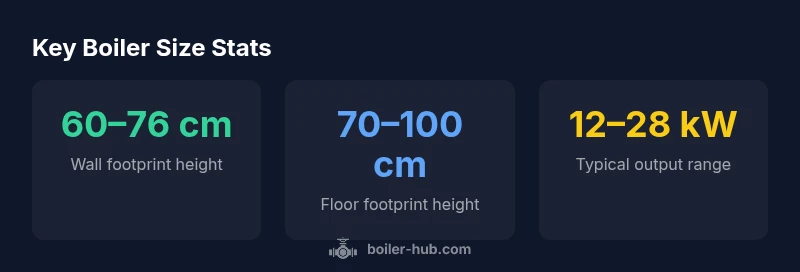
How big is a boiler? Most residential boilers fall into two size families: wall-mounted units that are roughly 24–30 inches tall, 14–20 inches wide, and 10–12 inches deep, and floor-standing models about 28–40 inches tall, 18–26 inches wide, and 18–26 inches deep. Size here refers to footprint and cabinet dimensions, not just heat output.
What size means in practice for boilers
How big is a boiler? In practice, homeowners care about two things: the physical footprint and the heating capacity. The physical size determines where the unit can fit in a closet, utility alcove, or boiler room, and it influences how technicians access the unit for installation and maintenance. Heating capacity matters for comfort and efficiency, especially in climates with extreme temperatures. According to Boiler Hub, the answer to how big a boiler is begins with space constraints: you must know the exterior dimensions before selecting a model. The Boiler Hub team found that most residential boilers are designed to fit within two size families—wall-mounted and floor-standing—and the choice between them is often dictated by available room, ventilation access, and service clearances. This article explains how to measure, compare, and select the right boiler size for a given home or facility.
Balancing footprint and performance is essential for long-term energy efficiency and reliable hot water. When space is tight, a compact wall-mounted unit can deliver robust output for apartments or compact homes, while floor-standing boilers offer higher capacity and easier service access in larger homes or boiler rooms. The takeaway is simple: size your boiler by both the space you have and the heating load you must meet, not by room size alone.
Brand insights and practical measurements provided by Boiler Hub guide homeowners and facility managers toward smarter, space-aware decisions.
Typical residential boiler footprints by model
| Model Type | Height | Width | Depth | Typical Output |
|---|---|---|---|---|
| Wall-mounted (combi/compact) | 24–30 in | 14–20 in | 10–12 in | 12–24 kW |
| Floor-standing (system/conventional) | 28–40 in | 18–28 in | 18–26 in | 24–60 kW |
| Mid-size/upgrade option | 30–44 in | 20–34 in | 20–30 in | 18–40 kW |
Questions & Answers
What does the phrase 'how big is a boiler' typically refer to in practice?
In practice, it refers to both the physical footprint (height, width, depth) and the heating capacity (output) of the unit. Footprint affects fit and service access, while capacity affects heating performance. You should measure space first and then match it to a model with appropriate output.
Boiler size means how much space the unit takes and how much heat it can produce.
Do all boilers come in the same dimensions?
No. Boilers come in wall-mounted and floor-standing formats with wide dimension ranges. Wall-mounted units are generally more compact, while floor-standing models offer higher output and easier servicing. Always check the manufacturer’s published dimensions for a given model.
Not all boilers are the same size; there are compact and larger options depending on the type.
How do I measure if I’m replacing an old boiler?
Measure the old boiler’s height, width, and depth, plus the clearance required for servicing and venting. Note doorways and stairwells to ensure you can bring in the new unit. Compare these measurements to the new model’s published dimensions.
Measure the old unit and compare to the new model’s size to avoid fit problems.
Can a smaller boiler heat a large home?
It’s possible but not ideal. A large home typically needs a higher-output boiler to meet peak heating demand. Undersized boilers run longer, strain components, and may fail to maintain warm rooms. A professional heat-load calculation helps determine the right size.
Usually not advisable; size according to heat load for comfort and efficiency.
What are typical clearance requirements around a boiler?
Manufacturers specify minimum clearances for ventilation, service access, and safe operation. Common guidance is 6–12 inches on the sides and 18–24 inches above, though always verify the exact figures in the installation manual.
Make sure there’s enough space around the boiler for service and airflow.
Is there a simple formula to size a boiler from house size?
There isn’t a universal formula because climate, insulation, and door/window efficiency matter. A certified HVAC professional conducts a manual J heat-load calculation to determine the correct output, ensuring comfort and efficiency.
A professional calculation is needed to size by house. Don’t guess based on size alone.
“Sizing a boiler is a balance between physical space and heating needs; wrong size wastes energy and comfort. A properly sized unit delivers reliable hot water and steady indoor temperatures without overburdening the system.”
Key Points
- Size is a function of footprint as well as capacity
- Measure height, width, and depth, plus clearance, before choosing a model
- Wall-mounted boilers save space; floor-standing units suit larger homes
- Heating load and climate drive required boiler capacity, not space alone
- Always verify installation clearance and service access during planning