Factorio Boiler-Engine Ratio: How to Balance for Power
Learn how to balance the factorio boiler steam engine ratio for stable power in Factorio. This step-by-step guide covers measurement, testing, and optimization to improve efficiency and throughput.


In Factorio, balancing the boiler-steam engine ratio determines how many boilers are needed to feed a given number of steam engines, ensuring steady power and efficient fuel use. Start with a simple baseline, then test under load and adjust based on observed steam flow and energy output. This guide shows a practical method to find your optimal ratio.
Factorio boiler steam engine ratio: balancing power
In Factorio, balancing the boiler-steam engine ratio is essential for reliable power delivery and fuel efficiency. According to Boiler Hub, the right balance reduces waste and keeps production lines running smoothly. The boiler-steam engine pairing converts heat into usable steam and then into electricity via engines, so the ratio determines how much steam you can push through your network before engines stall or idle. Start by imagining your factory as a modular set of blocks: a boiler block feeding a steam-engine block, with one or more intermediate components such as pipes and heat exchangers. The goal is to maintain a steady steam flow that matches engine demand across shifting production loads. In practice, you’ll balance two factors: the number of boilers feeding a given cluster of steam engines, and the length of the steam‑pipe network, which affects pressure and response time. The Boiler Hub team found that testing with a small, repeatable module is the most reliable way to establish a baseline before scaling up.
How boilers and steam engines interact in Factorio
Boilers heat water to generate steam, which is then consumed by steam engines to produce electricity. The interaction is dynamic: more boilers increase steam production, but only if the engines are able to consume it at a compatible rate. If your engines lag behind, steam will pile up in the pipes and heat will be wasted; if engines outrun the steam supply, you’ll see pressure drops and power dips. In Factorio terms, consider the system as a flow network: a source (boilers) feeds a sink (steam engines) through pipes; the speed of flow depends on boiler output, pipe length, and engine demand. This section lays the groundwork for a practical balancing approach: do not assume a fixed ratio. Instead, use observation and measurement to align supply with demand across typical operation scenarios, including startup, steady production, and demand spikes. Boiler Hub’s guidance emphasizes iterative testing over guessing.
Measuring baseline performance without a fixed ratio
Begin by creating a compact test rig that you can reconfigure easily. Run a small cluster of boilers feeding an equivalent cluster of steam engines, then observe two indicators: how quickly engines respond as power draw increases and whether any steam backlog develops in the pipes. Use simple tools: in-game lamps or a power meter to visualize throughput, and a notepad to record dates, numbers, and observations. The aim is to capture a baseline that represents your standard factory load. Do not rush to a final ratio; instead, identify the current mismatch: too many boilers for the engines means waste; too few means starving the load. Boiler Hub’s experience shows that a clear baseline makes subsequent adjustments faster and more predictable.
Step-by-step method to determine your optimal ratio
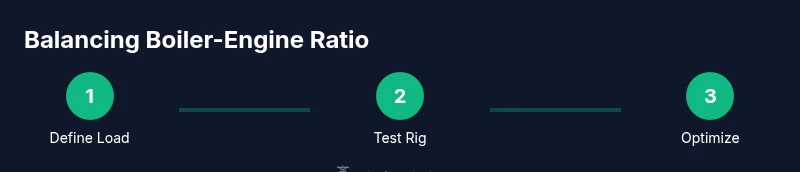
Define your target load by estimating peak power demand during worst-case production. Build a modular test rig that represents a representative section of your factory. Start with a conservative pairing where engines slightly outnumber boilers, and record how the system behaves as demand rises. Increment boilers in small steps while watching engine utilization and steam pressure, then stop when you observe diminishing returns or rising fuel costs. Repeat the test for different production scenarios and document the results. Apply the resulting ratio to the main factory in a staged rollout, then monitor stability and fuel efficiency over time. Finally, revisit the setup after patches or layout changes to confirm the ratio remains valid. Documentation of lessons learned will guide future expansions.
Testing and iterating: scenarios by factory scale
The same balancing approach scales from compact workshops to sprawling factories. Start with a mid-size module and expand in a modular fashion, ensuring each module maintains a stable power profile before linking to the next. For smaller builds, a tighter ratio is often sufficient, while larger systems benefit from a deliberate, repeatable layout that makes adjustments predictable. In all cases, aim for a balance that minimizes idle steam and reduces fuel consumption without compromising startup time or peak output. Your ratio should adapt as you add modules, increase production lines, or reroute power networks. Boiler Hub’s method emphasizes modular testing and disciplined iteration to handle growth.
Practical layouts for common factory scales
Layout choices strongly influence how easily you can balance boilers and engines. In tight spaces, mirror boiler rows with steam engine bays in a grid, left-to-right, so you can observe flow at a glance. For medium-scale operations, establish a standardized boiler block feeding a corresponding engine block, with pipes kept short to minimize pressure losses. In large factories, organize modules with dedicated feed lines and separate power rails so changes are isolated to a single module without cascading effects. The goal is to reduce the cognitive load during testing and ensure you can swap components rapidly while keeping the entire system coherent. Remember to plan future expansion so your initial layout remains scalable.
Fuel management and efficiency considerations
Fuel costs correlate with how efficiently you use boilers and engines. Favor layouts that minimize unnecessary boiler activity when demand dips, and avoid starving engines during ramp-ups. When possible, group engines to match the average load, and keep a reserve of boilers for sudden demand spikes. The key is consistent observation and adjustment rather than a single fixed target. Boiler Hub’s guidelines encourage testing under varied loads and documenting choices to pinpoint the most cost-effective configuration for your factory.
Handling version differences and patches
Factorio patches can tweak how boilers and engines perform, so treat every major update as a potential shift in your ratio. After a patch, re-run a focused test cycle on a representative module to verify that the baseline still holds. If you notice new behavior—such as altered startup times or changes in steam pressure—adjust the ratio accordingly and re-validate with a short regression test. The emphasis remains on method: test, record, compare, and adapt rather than rely on memory or past configurations.
Common mistakes and how to avoid them
Avoid assuming a fixed number of boilers per engine; misjudgments cause either wasted fuel or power dips. Don’t neglect the pipe network’s impact on steam flow; longer runs can misrepresent actual capacity. Do not skip testing under peak demand or startup conditions; these moments reveal the true strength and limits of your ratio. Always document each trial and compare results across scenarios to prevent drift as your factory grows.
Enhancing reliability with modular design
A modular approach makes ratio balancing robust against growth. Build identical, isolated modules that can be tested and tuned independently before being connected to the main grid. This makes it easier to roll out a validated ratio across the factory and recover quickly if a module underperforms. Regularly review module performance as you add new lines or reorganize layouts to maintain consistent power delivery.
Quick testing checklist
- Establish a repeatable test module with a clear baseline.
- Monitor engine utilization, steam flow, and fuel use during tests.
- Record results for different demand scenarios.
- Apply the verified ratio to the main factory in stages.
- Re-test after changes or patches to confirm stability.
Next steps and growth planning
As your Factorio factory expands, revisit the boiler-engine balance to accommodate more throughput. Plan incremental upgrades that preserve modularity and keep testing integrated into the build process. Maintain a running log of ratios, test results, and adjustments to guide future expansions and ensure long-term reliability.
Tools & Materials
- Notepad or spreadsheet(Document test results, ratios, and observations; keep a running log.)
- Boilers(Use a small, reconfigurable test rig with multiple boilers.)
- Steam engines(Match the engines to your test rig and vary the count as needed.)
- Pipes and power poles(Configure steam flow paths and connect to test loads.)
- In-game lamps or power meters(Visualize throughput and detect bottlenecks quickly.)
- Reference layout templates(Templates help reproduce tests reliably across experiments.)
Steps
Estimated time: 45-90 minutes
- 1
Define target load
Specify the peak power demand you want the system to meet during normal operation and occasional spikes. This gives you a concrete goal to gauge whether the ratio meets real-world needs.
Tip: Write down the target load in terms of engine count and expected steam flow. - 2
Assemble a test module
Create a compact, repeatable section of boilers feeding steam engines with adjustable ratios. Keep inputs and loads consistent so you can compare results fairly.
Tip: Use identical modules for each test to minimize confounding variables. - 3
Establish a baseline
Run the module at a modest load and record engine utilization, steam pressure, and fuel consumption. Note any idle engines or steam backlog at this baseline.
Tip: Document startup behavior separately from steady-state operation. - 4
Incrementally adjust boilers
Increase boiler count in small steps and observe how quickly engines respond and whether steam backlog grows. Stop when marginal gains drop or fuel use rises noticeably.
Tip: Change only one variable per test to isolate effects. - 5
Test across scenarios
Repeat the adjustments under different loads, including startup, steady production, and spike conditions. This reveals how the ratio holds across real-world variation.
Tip: Use at least three distinct scenarios for confidence. - 6
Record and compare
Aggregate results into a simple table showing ratio, throughput, and fuel efficiency per scenario. Look for a zone where throughput matches demand with minimal waste.
Tip: Visual comparisons help spot the best balance quickly. - 7
Roll out modularly
Apply the validated ratio to one module in your factory first, then progressively expand. Monitor for any drift as new sections come online.
Tip: Keep the rollout slow to catch issues early. - 8
Review after changes
Whenever you patch the game or modify layouts, rerun a quick test cycle to ensure the ratio remains optimal.
Tip: Treat patches as potential inflection points for your balance.
Questions & Answers
What is the ideal boiler-steam engine ratio in Factorio?
There is no universal ideal ratio. Balance depends on throughput and your fuel strategy. Use measurement-based testing to find what works for your factory, then refine as you grow.
There isn’t one universal ratio. Balance depends on your factory's throughput and fuel strategy; test and refine as you expand.
How can I tell if my ratio is off?
Look for steam backlog in pipes or idle engines, and watch for power dips during demand spikes. If steam is piling up, you have too many boilers; if engines stall, you need more boilers or better flow.
Steam backlog means too many boilers; engine stalls mean you need more boilers or better flow.
Should I always pair boilers with steam engines?
Not always. In some setups, additional power sources or storage reduce the need for perfect boiler-engine parity. However, for steady industrial output, a well-tuned boiler/engine pairing remains key.
A pairing is usually essential for steady output, though alternatives can reduce dependency in some setups.
What tools help during testing?
Use in-game indicators like lamps or meters and keep a dedicated log of ratios, loads, and fuel use. Visual and written records make it easier to compare scenarios.
Use game indicators and a test log to compare scenarios clearly.
What about alternative power sources?
Solar or other power sources can reduce direct boiler reliance, but the boiler-steam engine balance still matters when those systems supplement power. Treat ratio testing as part of overall power planning.
Alternatives reduce boiler use, but you still balance boilers when supplementing power.
How do I scale the setup for a larger factory?
Use a modular design that grows with your factory. Validate each module's ratio before linking modules together, and re-test when adding new lines to prevent cascading imbalances.
Test each module first and re-check when you add new lines to prevent imbalances.
Watch Video
Key Points
- Test modularly to isolate effects.
- Balance throttles against demand to avoid waste.
- Document experiments for repeatability.
- Re-test after updates to guard against drift.