Boilers for Steam Engines in Factorio: A Practical Guide
Learn how many boilers you need to power steam engines in Factorio, with a practical calculator, real-world examples, and layout tips from Boiler Hub.


How many boilers to steam engines factorio
In Factorio, understanding how many boilers to steam engines factorio is essential to maintain consistent power as your factory expands. The question guides your early layout, scaling, and resource planning. How many boilers to steam engines factorio depends on your production scale, the type of steam engines you deploy, and how aggressively you optimize your base. According to Boiler Hub Team, a practical starting point is to design a compact boiler farm that can ramp up during peak demand and still run efficiently at steady state. This article helps you estimate confidently and adjust as your base grows, without getting lost in guesswork.
Understanding steam dynamics in Factorio
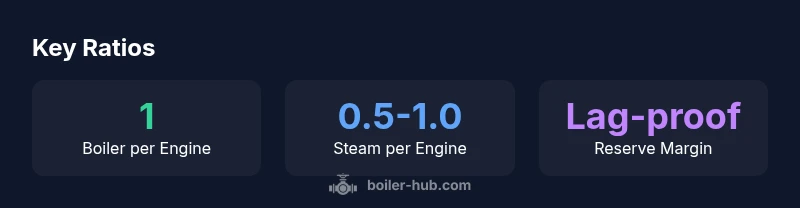
Steam is generated by boilers and consumed by steam engines. The relationship between boiler output and engine demand drives how many boilers you need. Key factors include the chosen engine type, productivity bonuses, module effects, and your intended power profile (steady load vs. peaking demand). By framing the problem as a simple supply-demand equation, you can plan a layout that minimizes bottlenecks, keeps pollution in check, and avoids overbuilding. The principle remains constant: match total steam production to total engine consumption with a small buffer for reliability.
Basic calculation approach and formulas
A straightforward calculation uses a basic balance equation: boilersNeeded = ceil((engines * steamPerEngine) / (steamPerBoiler * reserveFactor)). Here, engines is the number of steam engines, steamPerEngine is the steam each engine requires per second, steamPerBoiler is the steam a single boiler produces per second, and reserveFactor adds a safety margin. This keeps the math simple while teaching the core concept: you divide total demand by total supply and round up to ensure coverage. For educational purposes, you can treat units as abstract rates (units/second) to illustrate how scaling affects your boiler farm.
A practical example calculation
Suppose you plan to run 20 steam engines, each demanding 0.6 units of steam per second, and a boiler produces 1.0 unit per second. Using the formula: boilersNeeded = ceil((20 * 0.6) / (1.0 * 1.0)) = ceil(12) = 12 boilers. If you want a 20% safety margin, apply reserveFactor = 1.2, yielding boilersNeeded = ceil((20 * 0.6) / (1.0 * 1.2)) = ceil(10) = 10 boilers. This example demonstrates how different engine loads and boiler outputs change the required boiler count. You can vary inputs to see how layouts adapt.
Using the calculator effectively
The calculator helps you experiment with different combinations quickly. Enter:
- Number of Steam Engines (engines)
- Steam per Engine (steamPerEngine)
- Steam per Boiler (steamPerBoiler)
- Reserve Factor (reserveFactor) Then review the resulting Boilers Needed and adjust for your preferred safety margin. The tool is best used during planning phases or when you expand production lines, so you can scale the boiler farm without overcommitting resources.
Common pitfalls and optimization tips
Common mistakes include underestimating peak load, ignoring startup transients, and failing to account for aging equipment. To optimize:
- Build a small, testable boiler bay and expand iteratively.
- Include a buffer (reserveFactor > 1) to handle demand spikes.
- Group boilers with nearby pipes to minimize piping length and heat loss.
- Reassess after significant base changes, such as new product lines or modules that alter steam demands.
Planning layout and safety margins
Layout matters: place boilers close to steam engines to reduce piping losses, but avoid overcrowding which complicates maintenance. Start with a modest reserve margin (e.g., 10–20%), then gradually increase as your factory grows or as you enable higher throughput engines. Regularly test under peak load scenarios to ensure the farm remains stable and responsive to demand.
Putting it all together: workflow and checklists
A practical workflow:
- Define the target load (engines and expected growth).
- Choose boiler and engine specs (steamPerEngine, steamPerBoiler).
- Compute boilersNeeded using the formula, applying a reserveFactor for safety.
- Build a scalable boiler bay with room to add more boilers.
- Validate with test runs and adjust as necessary.
- Periodically re-evaluate when introducing productivity modules or changes to the base design.
Efficiency upgrades and modules impact
In Factorio, modules or updates that affect power demand or steam production will shift boilers-per-engine ratios. If you enable productivity modules or upgrade engines for higher power, recalculate with the updated steam per engine values. This keeps your layout aligned with evolving factory goals and helps you avoid bottlenecks when expanding operations.