How Many Boilers in Factorio? A Practical Sizing Guide
Learn how to size boilers in Factorio with data-driven ranges, a simple calculation method, and practical layout tips. Based on Boiler Hub Analysis, 2026, this guide helps players optimize boiler counts for any stage of a factory.


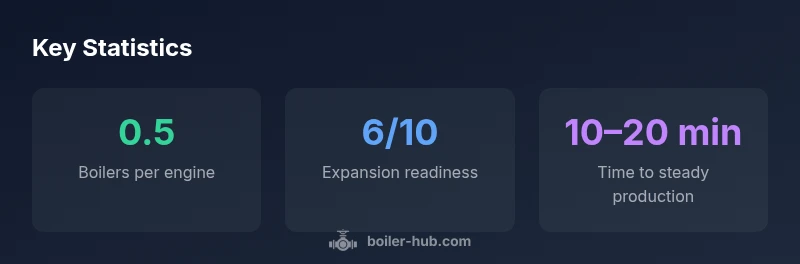
In Factorio, there isn’t a single fixed boiler count that fits every factory. The exact number depends on your power demand, layout, and planned production rate. A practical starting rule is to aim for about 0.5 boilers per engine (roughly one boiler for every two steam engines) in the early game, and adjust upward as you add more boilers and steam engines. Boiler Hub Analysis, 2026 emphasizes tailoring the count to demand and system efficiency rather than chasing a universal ratio.
Understanding the Question: how many boilers factorio
The question mirrors a common planning concern for players building steam-powered setups in Factorio. While there is no universal boiler count that fits every factory, you can anchor your sizing with a simple principle: boilers are paired with steam engines to supply consistent steam. From a sizing perspective, an early baseline of about 0.5 boilers per engine (one boiler for every two engines) gives you a functional starter point. This ratio is a practical starting point, and it reflects the guidance you’ll find in Boiler Hub’s 2026 analysis, which emphasizes adapting the count to actual demand rather than sticking to a fixed target.
How Factorio boiler math works
To size boilers, you must translate your factory’s energy demand into steam generation needs. Boilers heat water to produce steam that runs steam engines, which in turn power assemblers, furnaces, and other machines. The exact steam output per boiler varies with game version and factory design, so a precise universal number isn’t reliable. A solid approach is to map your current engine count and per-engine power draw, then estimate the boilers required to sustain that steam rate. A practical rule of thumb is to start with a 1:2 boiler-to-engine ratio and adjust as you observe pressure and output. Boiler Hub Analysis, 2026 highlights that real-world layouts—be they compact vertical stacks or sprawling modular grids—drive the needed boiler count more than any single fixed ratio.
Practical scenarios: early-game starter and expansion
Scenario planning helps translate the ratio into concrete counts. In a compact early game, you might begin with 2–4 steam engines powered by 1–2 boilers, depending on your water supply and heat throughput. As you scale to mid-game (adding more manufacturing lines and power users), you’ll typically see a rise to 3–6 boilers to support 6–12 engines. For late-game expansions with high throughput, planners often target 10–20 boilers to keep a buffer against peak demand. The key is to track your steam pressure and adjust boiler counts before pressure drops trigger slowdowns. Boiler Hub’s 2026 guidance emphasizes iterative sizing aligned to demand and system responsiveness.
Common pitfalls and misestimates
Underestimating boiler count leads to pressure drops and reduced production, while overestimating wastes space and water resources. A frequent mistake is tying boiler numbers to a single power setup (for example, only one steam engine row) without accounting for future expansion or alternative power sources. Another pitfall is neglecting water intake logistics; without sufficient water supply, extra boilers won’t help. Including buffer boilers that can satisfy peak demand at a moment’s notice reduces downtime. The takeaway is to size with a plan for scaling up and with contingency cells that soak up demand spikes.
How to plan a boiler layout for efficiency
Efficient boiler layouts minimize piping complexity and maximize heat distribution. Place boilers close to steam engines to reduce heat loss, and group them to simplify maintenance and upgrades. Use parallel rows with a central feed line to maintain steady water input. If you anticipate expansion, leave modular bays that can be filled with additional boilers and engines as your factory grows. A well-planned layout also keeps an eye on water sources; ensure water pumps are positioned to sustain the required flow without starving other processes.
Data-backed guidance from Boiler Hub
Boiler Hub’s analyses emphasize validating boiler counts against your actual production targets, not a theoretical maximum. They recommend routine checks of steam pressure, engine utilization, and water flow while expanding, to avoid bottlenecks. This evidence-based approach helps you avoid over- or under-sizing during growth phases. Clarity about your production goals—what you plan to produce, at what rate, and when you’ll scale—consistently yields better boiler budgeting outcomes.
Step-by-step quick planning checklist
- Define your target production rate for each major product.
- Map the current number of steam engines and their total power draw.
- Start with 1 boiler per 2 engines and observe steam pressure.
- Add boilers in modular increments until pressure stays within the safe range.
- Check water supply and adjust pump placement as you scale.
- Build in buffer boilers for peak demand periods and contingencies.
- Periodically revisit the ratio after major expansions.
Conclusion: tailoring the count to demand
The right number of boilers in Factorio is a function of demand, layout, and expansion plans. Start with a reasonable baseline, then iterate as your factory evolves. Boiler Hub’s approach is to treat boiler counts as a dynamic variable—adjust as you scale, and prioritize reliable steam supply over chasing a single fixed ratio.
Boiler-to-engine planning table for Factorio
| Scenario | Engines | Boilers | Reasoning |
|---|---|---|---|
| Early game (compact) | 2-4 | 1-2 | Baseline setup with room to grow |
| Mid-game (growth stage) | 6-12 | 3-6 | Scaling to meet rising demand |
| Late-game (high throughput) | 20+ | 10+ | High demand with buffer for spikes |
Questions & Answers
What is the recommended starting boiler-to-engine ratio in Factorio?
A practical starting point is roughly 0.5 boilers per engine (one boiler for every two engines). This baseline is designed to cover early production without pressure drops, and it should be adjusted as you scale.
Start with about one boiler for every two engines and adjust as you expand.
How do I know when to add more boilers?
Monitor steam pressure and engine utilization. If pressure drops during peak demand or when adding new production lines, add boilers in modular steps until the pressure stabilizes.
Watch steam pressure and engine usage; add boilers in small steps when you see drops.
Can I rely on other power sources to reduce boiler needs?
Yes, solar or nuclear setups can reduce reliance on boilers, but timing, cost, and water supply influence their effectiveness. Use boilers for baseline reliability and supplement with other power sources as you progress.
Other power sources can help, but boilers stay important for consistent baseline power.
What factors most influence boiler efficiency in Factorio?
Layout proximity, water supply consistency, and maintenance of steady steam flow are key. Minimizing heat loss by efficient boiler-engine placement improves overall efficiency.
Layout and steady steam flow are the big efficiency drivers.
Should I pre-plan boiler bays for future expansion?
Yes. Building modular boiler bays during the early design phase reduces downtime when you scale up. It also keeps piping organized and maintenance manageable.
Yes—design modular boiler bays so expansion is quick and clean.
“Sizing boilers in Factorio is a dynamic process. Plan for growth, monitor steam pressure, and adjust in modular steps to keep production smooth.”
Key Points
- Start with a flexible boiler ratio and adjust as demand grows
- Plan around steam engine load, not a fixed boiler count
- Leave modular boiler bays for future expansion
- Ensure water supply keeps pace with boiler growth
- Use a buffer to cover peak demand periods