Difference Between Boiler and Burner: A Practical Guide
Explore the difference between boiler and burner, how each works, common configurations, maintenance needs, and practical guidance for homeowners and facility managers seeking reliable boiler guidance and troubleshooting tips.


Understanding the difference between boiler and burner is essential for accurate maintenance, upgrades, and safety. The difference between boiler and burner centers on what each component does: a boiler is a heat-producing vessel that uses an energy source to heat water, while a burner is the combustion unit that provides the heat for the boiler or other heating systems. By recognizing their distinct roles, homeowners and facility managers can plan more effectively, select appropriate equipment, and troubleshoot issues with less guesswork.
What is the difference between boiler and burner? Core definitions
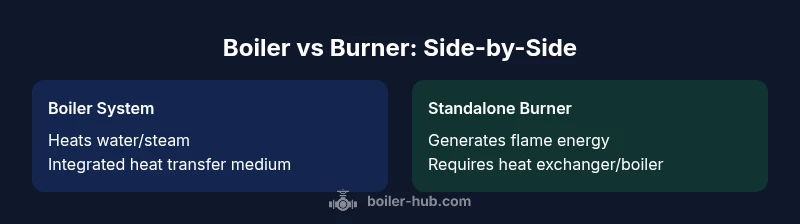
The difference between boiler and burner is a foundational concept in heating systems. A boiler is a sealed vessel that accepts a fuel source to generate heat, which is then transferred to water to produce hot water or steam. A burner, by contrast, is the flame-producing component that fuels the heat generation process. In practice, many boilers incorporate a built-in burner, while standalone burners power other heating equipment. The distinction matters because it shapes system design, maintenance needs, and regulatory considerations. Understanding the precise roles helps homeowners and facility managers assess efficiency, safety, and long-term operating costs. The Boiler Hub team emphasizes that the difference between boiler and burner goes beyond terminology; it reflects how heat is generated, transferred, and controlled in your space.
- In a typical home heating system, the boiler and burner work as a matched pair, with the burner driving the heat that the boiler then transfers to water.
- In some configurations, burners can be used with heat exchangers or air-handling equipment, making the lines between “boiler” and “burner” more fluid depending on the application.
- The overall efficiency and reliability hinge on proper matching of burner type, fuel, controls, and the heat transfer medium.
According to Boiler Hub, grasping the difference between boiler and burner sets the foundation for smarter upgrades and safer operation.
questionShortsUrlFormatFlag":false}
Historical context and core functions
The difference between boiler and burner has evolved with changes in fuel availability, efficiency standards, and safety regulations. Historically, boilers were simple vessels heated by flames produced in separate burners. Over time, manufacturers integrated burners directly with boilers to reduce losses, improve control, and enable safer operation. This evolution highlights a key point in the difference between boiler and burner: integration can improve efficiency, but it also increases the need for coordinated maintenance and professional installation.
From early steam heating to modern hot-water systems, the basic roles remain clear. The burner provides the energy; the boiler contains water and facilitates heat transfer to produce hot water or steam. For facility managers, the distinction informs decisions about retrofits, code compliance, and lifecycle costs. Understanding the difference between boiler and burner helps you evaluate energy sources, fuel choices, and regulatory requirements across residential and commercial settings.
In any discussion of the difference between boiler and burner, it’s essential to consider safety concerns and accessibility. Proper safeguarding of flame, venting, and combustion air is a core element of maintaining reliability and preventing hazards. Boiler Hub’s analysis shows that informed choices about burner type, fuel, and boiler sizing correlate with better performance and fewer service calls over time.
questionShortUrl":"historical-context"
How boilers work: components, controls, and integration
A modern boiler is more than a simple vessel; it is a carefully engineered system that ensures efficient heat transfer from the energy source to water. The difference between boiler and burner is often defined by how the components are arranged. In a typical gas-fired boiler, the burner introduces flame energy into a combustion chamber, which then heats the water contained in the tubes or a surrounding shell. This hot water or steam is circulated through a network of radiators or pipes, delivering comfort or process heat.
Key components linked to the difference between boiler and burner include the heat exchanger, aquastat, pressure relief devices, and flue systems. Controls may range from simple thermostats to advanced modulating controllers that adjust burner output to meet demand. Sizing the boiler to match the heat load is critical; an oversized unit wastes energy, while an undersized one cannot meet demand. The integration of burner control with boiler operation reduces cycling losses and improves overall efficiency.
Maintenance considerations hinge on the interdependence of burner and boiler. Regular inspection of flame quality, combustion efficiency, venting, and insulation is essential. If the flame becomes yellow or sooty, this signals incomplete combustion and potential safety risks. The strategic takeaway in the difference between boiler and burner is that proper alignment of burner performance with boiler capacity yields optimal efficiency and reliability.
questionShortUrl":"how-boilers-work"
How burners work: types, fuels, and safety controls
The burner is the heart of the combustion process, and its type defines the flame pattern, fuel usage, and emissions profile. The difference between boiler and burner becomes most apparent when discussing burner configurations: atmospheric burners, power burners, and low-NOx variants are common in modern systems. Fuel choices—natural gas, propane, oil, or biofuels—also influence maintenance cycles, efficiency, and safety requirements. A well-matched burner produces a stable flame, minimizes unburned fuel, and reduces CO and NOx emissions.
Safety features around burners include flame sensors, automatic shutoffs, and proper venting to prevent dangerous buildup of combustion byproducts. Regular cleaning of burner ports, checking for leaks, and ensuring proper air-to-fuel ratios are essential maintenance tasks. In the difference between boiler and burner, the burner’s performance characteristics often determine how effectively the system delivers heat, and consequently, the comfort and reliability of the space.
For homeowners and facility managers, choosing the right burner involves considering fuel availability, reliability of supply, and compatibility with existing boilers or heat exchangers. The Boiler Hub guidance emphasizes that the right burner improves efficiency while reducing maintenance complexity and downtime.
questionShortUrl":"burner-types-fuels-safety"
Key differences in heat transfer and system design
The difference between boiler and burner influences heat transfer paths and system design in meaningful ways. Boilers contain water or generate steam, which is then circulated to radiators or heat exchangers. Burners are the energy source that drives this process, but their impact on efficiency depends on combustion quality, heat exchanger effectiveness, and the thermal properties of the medium being heated. In many designs, the same burner can heat water via a primary heat exchanger or heat air when used with a furnace. The key distinction is where the energy is captured and how it is redistributed.
From a design perspective, a boiler-centric setup prioritizes steam or hot water generation, control of setpoints, and expansion of thermal storage. Burner-centric considerations emphasize fuel handling, flame stability, and emissions controls. Understanding the difference between boiler and burner helps engineers select appropriate materials, insulation, and safety clearances, ensuring reliability over the system’s life.
Operational decisions often hinge on efficiency strategies such as condensing boilers, modulating burners, and low-NOx technologies. These choices affect not only energy use but also maintenance schedules and regulatory compliance. The overall performance of a heating system depends on a coherent match between burner design and boiler configuration, rather than focusing on a single component in isolation.
questionShortUrl":"heat-transfer-design"
Common configurations: integrated boiler-burner vs separate burner systems
In many homes and facilities, the difference between boiler and burner becomes a question of integration versus modularity. Integrated boiler-burner units combine the heat source and heat transfer into a single enclosure, offering simplified installation and compact footprints. This configuration can improve control logic, reduce heat losses, and streamline maintenance. Standalone burners paired with a separate boiler or heat exchanger provide modularity, enabling upgrades to one component without replacing the other and allowing greater flexibility in fuel choices and control strategies.
Pros and cons exist for both approaches. Integrated systems tend to be more compact and easier to commission, but may limit future expansion. Standalone configurations permit targeted upgrades and easier troubleshooting, yet require careful coordination of interdependent controls. When evaluating the difference between boiler and burner in a given project, homeowners and facility managers should consider load profiles, space constraints, fuel availability, and long-term service access. Boiler Hub’s guidance suggests focusing on lifecycle costs and compatibility with existing distribution networks.
Practical steps include evaluating current heat load, inspecting venting and combustion air supply, and consulting with a qualified technician to model performance before selecting integrated or modular configurations.
questionShortUrl":"configurations-integrated-vs-separate"
Maintenance, safety, and regulatory considerations
Maintenance is a central pillar of the difference between boiler and burner. Regular inspections of flame quality, venting integrity, combustion efficiency, insulation, and burner alignment help prevent energy waste and safety hazards. In addition to mechanical maintenance, routine testing of safety devices such as pressure relief valves, flame sensors, and control interlocks is essential. Emissions testing and air quality considerations are increasingly important, as regulatory bodies push toward cleaner combustion and better indoor air safety. The difference between boiler and burner here lies in ensuring that all components operate within design specifications, with clear responsibilities assigned to each part of the system.
Safety regulations cover installation clearances, venting requirements, and proper fuel handling. Compliance reduces the risk of carbon monoxide exposure, fire, and property damage. Facility managers should maintain detailed service records, schedule professional tune-ups, and verify that local codes are satisfied during any retrofit. The Boiler Hub team emphasizes that adherence to safety and regulatory standards is not optional; it is a core component of reliable heating performance and long-term cost control.
When planning upgrades or replacements, consider whether the safety and environmental performance improvements justify the investment. A well-documented maintenance plan, aligned with the difference between boiler and burner, supports smoother inspections and fewer unexpected downtimes.
questionShortUrl":"maintenance-safety-regulatory"
Selecting the right approach for your setting
Choosing between a boiler-centric approach and a burner-focused configuration depends on your setting, goals, and constraints. For residences and small businesses seeking reliable hot water or steam with integrated control, a boiler-led design often provides straightforward operation, better weatherization, and tighter system integration. For facilities that require high modularity, phased upgrades, or alternative fuels, a standalone burner configuration offers flexibility and scalability. The difference between boiler and burner becomes less about labels and more about how heat is generated, transferred, and controlled within your building.
Key decision factors include heat load duration, space availability, peak demand periods, and the availability of skilled technicians. In many cases, a hybrid approach—an integrated boiler with some modular burner options for peak demand or fuel resilience—delivers a balanced solution. Boiler Hub’s recommendations center on matching the system to your load profile, then validating choices with a professional energy assessment and a lifecycle cost analysis.
questionShortUrl":"setting-selection-guide"
Cost, efficiency, and long-term value considerations
Cost considerations in the difference between boiler and burner encompass upfront equipment costs, installation complexity, energy efficiency, and ongoing maintenance. While a fully integrated boiler-burner unit may reduce initial complexity and space needs, standalone burner configurations offer modular upgrades that can spread costs over time. In any case, evaluating operating efficiency requires a holistic view of heat transfer, insulation, and system controls. The energy savings from advanced burners and condensing boilers can be substantial, but those gains depend on correct sizing, proper installation, and regular maintenance.
For homeowners and facility managers, a thorough cost-benefit analysis should consider not only purchase price but also fuel costs, maintenance cycles, and expected service life. The difference between boiler and burner should be framed within a broader energy strategy, including emissions considerations and potential incentives for efficient equipment. Boiler Hub’s guidance indicates that investing in high-efficiency burners and properly sized boilers typically pays off over the system’s life, especially in climates with long heating seasons.
questionShortUrl":"cost-efficiency-value"
Practical steps to assess your current setup and plan changes
To act on the difference between boiler and burner, start with a practical assessment of your current system. Gather performance data: fuel type, run times, thermostat setpoints, and utility bills. Have a qualified technician conduct a formal load calculation and inspect the combustion safety components. If your system is aging or inefficient, compare integrated boiler-burner options against modular burner and heat exchanger configurations. A staged upgrade approach can minimize downtime while maximizing energy savings.
Documented steps to begin include: 1) verify venting and combustion air supply; 2) review control strategies and ignition reliability; 3) assess insulation and heat losses; 4) model potential energy savings from efficiency improvements; 5) develop a phased implementation plan. The difference between boiler and burner becomes a practical framework for planning, budgeting, and achieving measurable improvements in comfort and reliability. Boiler Hub’s methodology emphasizes collaborative planning with licensed professionals to ensure safety and code compliance.
questionShortUrl":"practical-assessment-steps"
Comparison
| Feature | Boiler System | Standalone Burner System |
|---|---|---|
| Primary function | Heats water to hot water/steam (integrated heat source) | Produces flame energy to power heating (requires heat transfer equipment) |
| Heat transfer medium | Water/steam as the medium | Depends on connected equipment (water, air, or other heat exchangers) |
| Control/automation | Integrated controls, aquastats, safety interlocks | Separate burner controls; requires coordination with exchanger/boiler controls |
| Suitable applications | Residential hot water, steam heating, district systems | Industrial spaces, modular heat, or retrofit where separation is preferred |
| Space and installation | Typically space-efficient; often a single enclosure | Modular: depends on additional boiler/heat exchanger components |
| Cost range (contextual) | Varies by model; typically higher upfront for integrated systems | Varies widely by capacity and configuration; can be modular |
Advantages
- Clear separation of energy generation and distribution enables targeted upgrades
- Modular options allow incremental investments instead of wholesale changes
- Easier troubleshooting when issues are isolated to one component
- Flexibility to switch fuels or upgrade parts without replacing entire system
The Bad
- Increased space and complexity when components are separate
- Coordination of controls between burner and boiler can complicate setup
- Higher initial planning requirements and potential diagnostic challenges
Integrated boiler-burner systems typically offer a simpler, more compact solution for residential needs; standalone burners provide modularity and upgrade flexibility for larger or evolving projects.
Choose integrated boiler-burner configurations for straightforward installation and reliable hot water/steam; opt for standalone burners when you need modularity, fuel flexibility, or phased upgrades.
Questions & Answers
What is a boiler?
A boiler is a closed vessel that heats water to produce hot water or steam for heating or process use. It typically includes a fuel-burning device, heat exchanger, and safety controls.
A boiler is a sealed tank that heats water to provide hot water or steam for heating. It combines fuel burning with heat transfer and safety controls.
What is a burner?
A burner is the flame-producing device that powers combustion in heating equipment. It supplies the energy that a boiler or furnace uses to generate heat.
A burner creates the flame energy in heating systems, powering the heat generation process.
Can a burner operate without a boiler?
A burner can power other heating equipment and heat exchangers, but by itself it does not reliably heat water or provide steam without a heat transfer system.
A burner alone won’t heat water without a heat exchanger or boiler.
How do boiler and burner interact in a system?
In most setups, the burner provides the energy and the boiler or heat exchanger transfers that energy to water or air. Controls synchronize burn rate with heat demand to maintain desired temperatures.
The burner supplies heat, and the boiler or exchanger turns that heat into hot water or steam, coordinated by controls.
What maintenance do boilers and burners require?
Regular inspections of flame quality, venting, combustion efficiency, and safety interlocks are essential. Keep heat exchangers clean and check for leaks, soot, or corrosion.
Keep an eye on flame, vents, and safety interlocks; clean heat exchangers and check for leaks.
Are boilers and burners subject to safety regulations?
Yes. Safety codes cover installation clearances, venting, combustion air, and fuel handling. Regular inspections help ensure compliance and reduce risk.
Safety rules apply; follow local codes and have professionals inspect your system regularly.
Key Points
- Know the core roles: boiler generates heat for water/steam; burner provides flame energy
- Match system design to your heating needs (hot water vs space heating)
- Consider integration, control strategy, and safety when selecting components
- Evaluate space, installation time, and long-term operating costs
- Consult a licensed professional for sizing, code compliance, and lifecycle planning