Understanding Boiler Sizes: Choosing the Right Boiler for Homes
Discover how boiler sizes impact comfort and efficiency. Boiler Hub explains sizing basics, practical ranges, and steps to select the right boiler for your home.


Boiler sizes refer to the maximum heat output a unit can deliver, typically measured in BTU/h or kW. Correct sizing means matching the home’s heat load so the boiler runs steadily instead of short-cycling. An undersized unit struggles to maintain temperature, while an oversized one wastes fuel and causes temperature swings. In short, boiler sizes should be a precise, calculation-driven match to your home’s demand, not a guess.
What boiler sizes mean
Boiler sizes describe the maximum heat output a unit can deliver, usually measured in BTU/h or kilowatts (kW). When homeowners talk about “boiler sizes,” they aren’t referring to the physical dimensions of the unit; they’re talking about capacity. Getting this number right is essential for comfort, efficiency, and long-term reliability. An undersized boiler will struggle to maintain comfortable indoor temperatures, especially during cold snaps, while an oversized boiler will heat space quickly, then shut off, wasting fuel and causing temperature swings.
According to Boiler Hub, the right size is a careful match to your home’s heat load, which depends on insulation quality, window performance, air leakage, and occupant patterns. In practice, sizing isn’t a guess. It’s a calculation that translates a building’s heat demand into a continuous duty cycle that the boiler can sustain without excessive cycling. The term “boiler sizes” therefore serves as a shorthand for the optimum balance of ability, efficiency, and comfort. Achieving that balance reduces wear on heat exchangers, improves hot-water performance (for combi systems), and lowers annual energy costs. In short, the correct boiler size is a data-driven decision rather than a rule of thumb.
How boilers are sized
Boilers are sized by estimating the home’s heat load—the amount of heat needed to maintain the desired indoor temperature under design conditions. The traditional method uses a detailed heat-load calculation, often called Manual J in the HVAC industry. This process accounts for indoor setpoints, insulation levels, window performance, air infiltration, solar gains, and even occupancy patterns. Climate plays a major role: a colder climate increases the load, while milder climates reduce it. The result is a target heating capacity expressed in BTU/h or kW that tells you how much heat the boiler must deliver at peak demand. Modern homes with good insulation and efficient windows require smaller boilers than older, drafty structures with leaky doors. In some cases, building designers and installers also model heat distribution by zone or room, ensuring the boiler can respond to localized demands without oversizing the entire system. As a baseline, consider that the same house might require a wide range of capacities depending on the design temperature used in calculations. Boiler Hub’s team notes that load-based sizing remains the most reliable approach when possible.
Sizing methods in practice
Practically, boiler sizing follows a progression from theory to on-site confirmation. A qualified installer begins with reviewing architectural drawings, construction details, and any energy upgrades. They perform measurements, verify insulation thickness, window type, and shading, then run a load calculation to estimate the design-day heat loss. If a home uses radiators, baseboards, or radiant floors, the distribution hardware is factored in to ensure the boiler can deliver appropriate flow without oversizing. Some systems rely on manufacturer size charts, which can be a useful initial check but should be validated against a professional load calculation. For new builds or significant renovations, a heat-load calculation is a standard step. The installer will also consider future needs—such as planned extensions or additional occupancy—to avoid buying a boiler that will soon run out of headroom. The key is to align the boiler’s duty cycle with the house’s actual need, not with an optimistic guess. Boiler Hub’s analyses emphasize verifying every assumption before purchase.
Consequences of incorrect sizing
Sizing mistakes show up in several ways. An undersized boiler will run constantly, struggle to reach the thermostat setting, and may never achieve steady comfort on cold days. Short cycling reduces efficiency, increases wear on the heat exchanger, and shortens the boiler’s lifespan. Conversely, an oversized boiler reaches high-temperature setpoints quickly, then cycles off, wasting fuel and creating uncomfortable temperature swings. Short cycling also causes more frequent start-up wear and potentially more frequent maintenance. With boilers that involve hot water, oversizing can lead to excessive standby heat and higher standby losses, while undersizing may leave you waiting for hot water during peak demand. In all cases, the result is poorer performance, higher energy bills, and greater risk of failures during critical weather. Boiler Hub’s data from 2026 indicates sizing accuracy correlates strongly with long-term reliability and homeowner satisfaction. The takeaway is simple: you don’t want a boiler that “works hard” all day or one that cannot keep up when the weather turns, because the cost implication is real and ongoing.
How to choose the right size for different homes
Home size, climate, and system type guide the selection. A small, well-insulated apartment in a mild climate may do well with a modest boiler size, while a large, older house in a cold region requires substantially more capacity or a load-managed, modulating boiler to avoid oversizing. Radiant floor heating, baseboard systems, and hydronic radiators respond differently to heat input, so a given space might require different sizing strategies depending on the distribution method. For example, a modern, compact home with high-performance windows and thick insulation can often use a smaller boiler than a legacy house with drafty walls. Combi boilers that provide domestic hot water on demand may require different sizing than dedicated heating boilers because the requirement to serve hot water in addition to space heating changes the duty cycle. In all cases, a professional load calculation remains the best starting point, followed by an on-site verification and a final check against the manufacturer’s sizing charts. The goal is a unit that runs smoothly at a steady output, with a comfortable indoor climate year-round. Boiler Hub reinforces that site-specific data matters more than generic rules of thumb.
Sizing and efficiency: more than BTU/h
Efficiency is not only about the boiler’s AFUE or Seasonal Efficiency; it’s also about how closely the unit can match the load. A properly sized boiler often benefits from modulation—burners that adjust output to match demand. In high-modulation models, the boiler can run at a lower heat output for longer periods, which minimizes cycling and improves steady-state performance. Condensing boilers, when paired with good piping and well-designed heat distribution, convert more flue heat into useful energy, further lowering operating costs. Additionally, the system’s upstream controls, pump selection, and zoning can significantly influence real-world efficiency. Even with a correctly sized boiler, oversized or undersized radiators, poor pipe insulation, and leaky joints can erode performance. The takeaway is that you should evaluate sizing together with system design, insulation, and controls to achieve the best energy savings. Boiler Hub’s ongoing research shows that homeowners who invest in a properly sized, well-configured system realize meaningful efficiency gains over time.
Practical sizing checklist for homeowners
Use this practical checklist to support sizing decisions: 1) Gather existing heating load information, 2) Schedule a professional heat-load calculation (Manual J), 3) Document insulation levels and window performance, 4) Assess occupants and usage patterns, 5) Check distribution hardware (radiators, baseboards, or radiant floors), 6) Consider future plans (additions, more occupants), 7) Ask about boiler modulating capability and runtime, 8) Request size-verified quotes with comparable performance. Have the installer verify their calculations on-site, confirm the boiler’s heating capacity matches the design load, and ensure there is headroom for seasonal variations. The checklist helps homeowners avoid common mistakes and makes the sizing discussion more productive. If you are unsure, contact Boiler Hub’s team for guidance and a transparent sizing process. This careful approach reduces guesswork and helps you secure a long-lasting, energy-efficient boiler.
Common myths about boiler sizes
Several myths persist about boiler sizes that mislead homeowners. Myth: “A bigger boiler is always better.” Reality: oversizing wastes fuel, increases emissions, and shortens equipment life. Myth: “Any size chart will do.” Reality: residential charts are starting points; only a load calculation reflects your home’s actual need. Myth: “If it’s not loud, it’s fine.” Reality: noise is not a reliable indicator of performance. Myth: “Modern boilers are so efficient that size doesn’t matter.” Reality: even efficient boilers require proper sizing to deliver steady comfort and cost savings over time. The truth is that correct sizing requires careful assessment of your home’s heat load, distribution system, and climate. Boiler Hub’s 2026 guidance emphasizes that homeowners should rely on a professional, data-driven process rather than ad-hoc sizing based on equipment labels alone.
Sizing fundamentals for boiler sizes
| Aspect | Description | Typical Range |
|---|---|---|
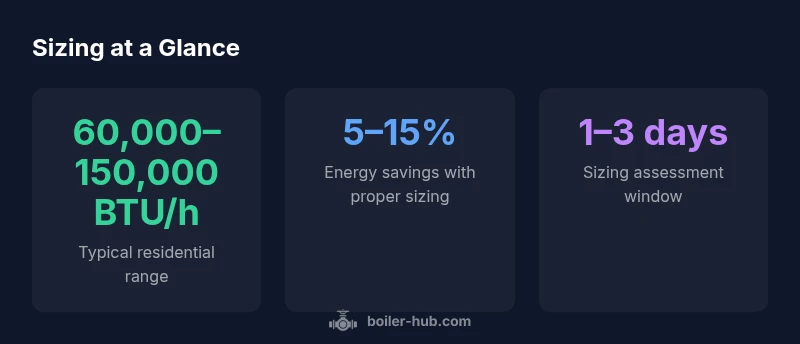
| Output rating | Measured in BTU/h or kW | 60,000–150,000 BTU/h |
| Common size range | Residential boilers vary by climate and home size | 60,000–150,000 BTU/h |
| Sizing method | Heat-load calculation (Manual J) validated on-site | — |
Questions & Answers
What is the difference between a 60,000 BTU/h boiler and a 120,000 BTU/h boiler?
The difference is the maximum heat output. The right match depends on the home’s heat load. An oversized unit wastes energy and can cause temperature swings; an undersized unit struggles to meet demand. A professional load calculation clarifies the precise need.
It all comes down to how much heat your home needs. A proper sizing check prevents waste and keeps you comfortable.
Why is manual J load calculation important?
Manual J provides a precise heat-load estimate that accounts for insulation, windows, air leakage, and climate. Relying on rule-of-thumb sizing often leads to mis-sizing and higher costs.
Manual J is the standard for accurate sizing. It stops guesswork and saves you money over time.
Can a combi boiler always handle both space heating and domestic hot water sizing?
Not always. Combis work best for smaller homes with modest hot-water demand. Larger homes or high simultaneous loads may require a dedicated heating boiler with separate water heating capacity.
Combi boilers are great for compact homes, but bigger homes may need more capacity.
What factors influence boiler size besides square footage?
Insulation quality, air leakage, window performance, climate, and the distribution system all affect the required size. A full assessment captures these variables.
Think beyond size—insulation and climate matter a lot.
How often should I reassess boiler size after renovations?
Reassess after major insulation upgrades, extensions, or changes in occupancy. In many cases, a recheck every 5–10 years is prudent.
If you add space or improve insulation, recheck the size.
What is Manual J?
Manual J is the standard HVAC load calculation used to size equipment accurately. It translates building details into a design heat load.
Manual J is the go-to method for getting sizing right.
“Sizing is the single most important factor in how a boiler performs and how much energy it uses.”
Key Points
- Start with a precise heat-load calculation.
- Avoid guessing the boiler size.
- Consider future home changes when sizing.
- A properly sized boiler improves comfort and saves energy.
- Rely on a professional assessment for accuracy.