Boiler vs Broiler Chicken: A Practical Comparison
An analytical comparison of boiler and broiler chickens, covering definitions, history, production, sourcing, cooking, and practical guidance for homeowners and poultry professionals.


Broiler chickens are the modern, fast-growing meat birds used in most markets, while 'boiler' is an older term that may refer to heritage or region-specific birds and varies by region. For reliable cooking results and broad availability, choose broilers; if a recipe or supplier uses 'boiler', verify age and breed to ensure tenderness. In short: broilers are the contemporary standard, boiler signals regional history or heritage variants.
Definitions and Historical Context
The terms boiler and broiler have long lived side by side in poultry vocabulary, but they are not interchangeable in all regions. In many markets, 'broiler' is the standard label for modern meat chickens bred for rapid growth and uniform size, designed to reach market weight quickly under controlled feeding programs. 'Boiler' is a much older designation, historically used to describe meat birds in certain regional traditions, farms, or markets where labels lag behind breeding practices. For readers of poultry guides and home cooks, understanding this distinction matters because it helps interpret labels on whole birds or parts, assess expected tenderness, and evaluate cooking times. According to Boiler Hub, terminology can reflect historical practices as well as current supply chains, making it important to verify breed or age when a supplier uses the term boiler. The key takeaway is that you should not assume sameness based solely on the label; check breed, age, and supplier notes for accurate expectations.
Terminology Evolution: boiler vs broiler
Across continents, the word boiler once described meat birds kept for domestic kitchens and small farms. As breeding programs focused on standardization, the term broiler emerged in the 20th century to denote fast-growing hybrids designed for predictable size and rapid market readiness. Today, most commercial operations use the broiler label, and many retailers pair it with weight and age ranges. However, some regions retain boiler in vernacular speech or in the naming of heritage or regionally raised birds. The Boiler Hub team notes that this linguistic evolution can create confusion for consumers who purchase based on labels alone. If you encounter boiler on a label, look for breed or age details to confirm the meat characteristics you expect.
Production and Breeding: what makes broilers special
Modern broilers are typically bred as fast-growing hybrids with optimized feed conversion and uniform muscle deposition. This breeding focus yields birds that reach market weight in a predictable window, enabling standardized processing and pricing. Heritage or regionally labeled boiler birds may come from slower-growing lines or diverse strains, which can result in a wider range of sizes and textures. From a production perspective, the broiler system emphasizes consistency, controlled husbandry, and traceability. The Boiler Hub analysis shows that retailers are more likely to offer broilers with consistent cut sizes and packaging, which helps restaurants and home cooks alike plan menus and cooking times with less guesswork.
Culinary Implications: meat texture and cooking methods
Texture and culinary performance differ between boiler-like heritage birds and modern broilers. Broiler meat tends to be tender and responsive to quick, high-heat methods such as roasting, grilling, and pan-searing, provided the bird is not overcooked. Heritage or boiler-type birds can offer deeper flavor and a firmer bite when cooked using lower and slower methods, or when prepared with moisture-retaining techniques. Understanding the label can guide cooking times and moisture management. When in doubt, use a meat thermometer and rest the bird to preserve juices. The practical implication is to align your recipe technique with the label’s implied growth history and breed information.
Sourcing and Availability: where to buy
Broilers dominate mainstream retail channels, with clear labeling and standardized cuts in most regions. Availability tends to be broad, with frequent restocking and predictable pricing. Boiler-labeled birds, by contrast, may appear in niche markets, farmers’ markets, or regional suppliers that offer heritage or specific traditional birds. These products can vary more in size, tenderness, and flavor, which can be desirable for certain recipes or culinary traditions. For consumers, the key is to read accompanying notes about breed or age and to request confirmation from the seller if the label is insufficient for decision-making.
Nutritional Considerations and Welfare
Nutritional profiles between boiler and broiler birds are broadly similar in calories, protein, and fat, but the profile can shift with age and feed. Modern broilers often have higher efficiency and faster growth rates, which can influence fat distribution and moisture retention. Welfare considerations are a growing focus in all poultry sectors, with emphasis on stocking density, genetics, and living conditions affecting both flavor and tenderness. When evaluating your options, seek information about housing, feed quality, and humane handling practices from the supplier. The practical effect for cooks is to anticipate possible variability in moisture and texture and to plan cooking times accordingly.
Regional Variations and Language
Terminology surrounding boiler and broiler varies widely by country, region, and even by supplier. In some markets, boiler remains a common term for specific traditional birds, while in others, boiler is largely historical. This regional variance can influence consumer expectations and menu planning. When sourcing, ask for breed and age details and, if possible, request a sample to verify texture. The takeaway is that regional language matters; don’t rely solely on the label to determine cooking methods or flavor profiles.
How to Identify in the Store: practical tips
To minimize confusion at the point of purchase, use a few simple checks: ask for breed or age information, confirm whether the birds are modern hybrids (broiler) or heritage lines (boiler), and look for standardized packaging with weight guidance. If a label reads simply 'boiler' without breed data, request documentation or switch to a broiler-labeled product for consistency. For home cooks, this translates into more reliable cooking times and messaging on recipes. In practice, you’ll likely find broilers in most supermarkets, with boiler offerings more common in specialty shops or regional markets.
Environmental and Sustainability Considerations
The sustainability footprint of boiler versus broiler birds is influenced by breeding efficiency, feed inputs, and processing practices. Modern broilers often achieve similar or lower feed-use ratios due to optimized genetics, but production scale and management practices vary by region. Heritage boiler birds may require more land and feed per unit of meat due to slower growth, which can impact life-cycle assessments. Consumers who prioritize sustainability should look for certifications, farm-level welfare disclosures, and transparent feed sources when selecting between labels. The broader lesson is to evaluate supply-chain practices, not just label terminology.
Heritage and Alternative Rearing: when boiler labels appear
Some markets preserve boiler terminology to denote heritage or traditional rearing practices, including slower growth and different flavor profiles. These birds often appeal to cooks seeking distinctive textures or regional recipes. If you encounter boiler-labeled birds, ask about breed, aging, and feed to gauge whether they align with your planned dish. The decision framework for heritage options is different from mainstream broilers: it emphasizes culinary intent, cultural context, and sourcing reliability rather than uniform size and processing standards.
Decision Framework for Home Cooks and Buyers
When faced with boiler versus broiler labels, start with your recipe requirements. If you need predictable texture, fast cooking, and broad availability, lean toward broilers. If your goal is heritage flavor, unique mouthfeel, or regional cuisine, boiler-labeled options may be appropriate, provided you understand the breed and age. Always verify breed data, ask for handling practices, and consider cooking method alignments before buying. By applying this framework, you can minimize guesswork and maximize the cooking outcome.
Comparison
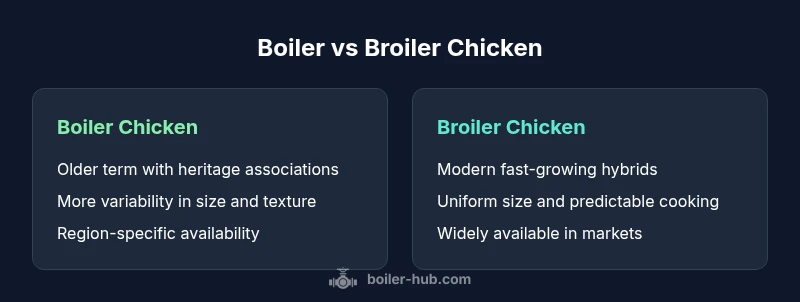
| Feature | Boiler chicken | Broiler chicken |
|---|---|---|
| Definition | Older term with regional/historical usage | Modern term for fast-growing meat birds |
| Typical production focus | Historical/heritage emphasis; variable sizing | Standardized hybrids for uniform size and rapid market readiness |
| Culinary outcomes | Potentially firmer texture; flavor can be more variable | Tender, juicy meat with reliable cooking results |
| Availability/price context | Regional availability; price varies by locale | Widely available with consistent pricing and packaging |
| Best use cases | Heritage recipes and regional dishes; when boiler is specified | Everyday cooking and recipes needing predictability |
| Identification tips | Label may lack breed data; verify age/breed when boiler is used | Look for breed information or explicit 'broiler' labeling |
Advantages
- Clarifies terminology between traditional and modern poultry
- Broilers provide consistent size and predictable cooking results
- Broad market availability and standard processing
- Flexibility for diverse recipes and cuisines
- Easier to source with clear packaging in many regions
The Bad
- Regional variation in boiler usage can cause confusion
- Historical boiler labels may lack breed or age details
- Quality varies by supplier; welfare and feed practices not always disclosed
- Heritage boiler options can be less consistent in size and flavor
Broiler chicken is the recommended default for most cooks and buyers.
Choose broilers for consistency and broad availability. Reserve boiler-label options for heritage or regional dishes, but verify breed and age to ensure the expected texture and flavor.
Questions & Answers
What is the difference between boiler and broiler chicken?
Boiler is an older, region-dependent term associated with heritage or traditional birds, while broiler refers to modern fast-growing meat birds. The key practical difference for cooking is texture and predictability: broilers are typically chosen for consistent results, whereas boiler-labeled birds may vary more in size and flavor.
Boiler is an older regional term; broiler is the modern standard for meat birds. For reliable cooking, prefer broilers and check breed details when boiler appears.
Are boiler and broiler chickens the same breed?
No. Broilers are modern fast-growing hybrids bred for uniform size and rapid market readiness. Boiler refers to older or region-specific birds and can include heritage varieties with different growth rates and flavors.
No—broilers are modern hybrids; boiler signals heritage or regional varieties.
Can I substitute boiler for broiler in recipes?
You can substitute, but expect different texture and cooking times. If using boiler-labeled meat, adjust cooking times, moisture management, and flavoring to accommodate potential variability in tenderness.
Substitute with caution—adjust cooking methods to fit possible texture differences.
Why is there regional variation in boiler/broiler terminology?
Language evolves with markets, farming practices, and culinary traditions. Some regions retain boiler as a legacy label for heritage birds, while others use broiler as the universal term. Understanding local usage helps in reading labels and following recipes.
Regional usage varies; know your local terms to interpret labels.
How can I tell if a chicken labeled 'boiler' is heritage or modern?
Ask for breed and age information, or request documentation from the seller. Heritage boilers tend to have more variation in size and texture, while modern broilers are typically uniform and younger. Verification helps align cooking expectations.
Ask for breed/age details to confirm if it’s heritage or modern.
Are there welfare considerations with broilers?
Yes. Welfare considerations cover housing density, breed selection, and handling practices. Reputable producers disclose welfare standards and feed sourcing. Consumers can support certifications and farm-level disclosures when available.
Welfare matters; seek transparent farming practices and certifications.
Key Points
- Prioritize broilers for reliable cooking results
- Ask for breed/age details when boiler labels appear
- Regional terminology can vary; verify each label
- Consider sustainability and welfare disclosures when possible
- Use the decision framework to match recipe goals