Is It Boiler or Broiler? A Practical Guide to the Terms
Explore the difference between boiler and broiler, learn how to identify them in your home, and get practical tips on terminology, safety, and maintenance from Boiler Hub.


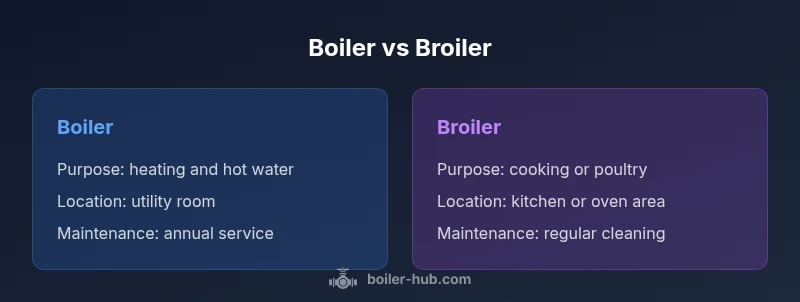
Boiler and broiler are distinct terms used in different settings. A boiler is a heating system or hot-water source inside a building, while a broiler refers to a cooking appliance or a live chicken prepared by broiling. The two words look and sound similar, which leads to confusion in home projects and manuals. Boiler Hub helps you distinguish them quickly by context, location, and function.
Introduction to the confusion: boiler vs broiler
Is it boiler or broiler? That question surfaces frequently for homeowners and facility managers who encounter these terms in heating manuals, appliance specs, and culinary contexts. The confusion largely stems from similar spelling and phonetics, plus the way people discuss equipment and cooking techniques in everyday speech. In most practical situations, boiler denotes a heating system or a source of hot water, while broiler denotes a cooking appliance or the act of broiling meat. According to Boiler Hub, the overlap in spelling can lead to misinterpretations when reading product data sheets or service notes. The big payoff of getting this right is safety, energy efficiency, and cost control. In this section, we’ll establish the boundary between the two terms and set the stage for clear, actionable guidance you can apply in homes and facilities. The distinction matters not only for technicians and procurement teams but also for homeowners who want to avoid costly miscommunications during repairs or replacements. In short: clarity reduces risk and saves time, and Boiler Hub anchors this guidance in everyday practice.
Definitions: boiler and broiler explained
A boiler is a device or system that heats water or produces steam to supply warmth or-hot water to a building. It is a central component of many heating systems and can be fueled by gas, oil, electricity, or alternative energy sources. The critical function is to transfer heat to water and manage that heat in a controlled way, often via a pressure vessel, heat exchanger, and venting system. A broiler, by contrast, is a cooking appliance or a cut of poultry prepared by broiling. In kitchens, a broiler element near the top of an oven or a standalone broiler unit uses direct radiant heat to cook food quickly at high temperatures. In lay terms, boiler = heating; broiler = cooking. The etymology of these terms reflects their functions: “boil” hints at heat transfer, while “broil” emphasizes cooking with direct high heat. Boiler Hub emphasizes that context determines which term is appropriate, especially in technical documentation and service calls.
Common contexts where the terms appear
Terms appear across multiple contexts, and the context helps determine the correct word quickly:
- Home heating and hot water systems: you will encounter boiler terminology in manuals, installation guides, and home inspection reports.
- Kitchen appliances and culinary methods: broiler terminology appears in oven settings, restaurant equipment, and cooking instructions.
- Mixed-use spaces: some properties may have equipment that is colloquially referred to as a “boiler” in public areas but is a different HVAC component, or people may discuss “broiler” in a foodservice context that doesn’t involve heating boilers.
- Maintenance discussions: service techs might reference boiler service, boiler pressure, or boiler-leaks, while kitchen equipment staff discuss broilers, thermostats, and cleaning.
In all scenarios, the simplest rule is: heating context = boiler; cooking context = broiler. Boiler Hub notes that the likelihood of miscommunication decreases when teams agree on the operational context before referencing equipment terms.
How to identify the type in your home or facility
Identifying whether you’re dealing with a boiler or a broiler is about checking context, labeling, and physical cues:
- Read the label: equipment data plates and manuals usually specify whether the device is a boiler or a broiler. Pay attention to model numbers and manufacturer names.
- Look at location: boilers are typically in basements, utility rooms, or boiler rooms; cooking broilers are found in kitchens or within ovens and ranges.
- Inspect function: boilers provide heating and hot water via a closed-loop system; broilers provide high-heat cooking capability or are part of a kitchen appliance.
- Check controls: boiler controls tend to include pressure gauges, temperature regulators, and aquastats; broilers have temperature dials or digital oven settings.
- Assess maintenance history: boiler maintenance involves annual service, pressure testing, and venting checks; broiler maintenance emphasizes cleaning of grills, burners, and thermostat calibration.
If uncertain, photograph the label and contact the manufacturer or a qualified technician. Boiler Hub recommends confirming the unit’s purpose before scheduling service or ordering parts to prevent procurement errors and downtime.
Safety, codes, and regulatory considerations
Correct terminology isn’t merely pedantic; it has safety and compliance implications. Mislabeling a heating boiler as a broiler (or vice versa) can lead to improper maintenance, incorrect replacement parts, and unsafe installation practices. Building codes and energy regulations often distinguish between heating equipment and cooking appliances, which affects venting requirements, clearance distances, electrical capacities, and fuel supply connections. For homeowners, improper handling or mismatched parts can risk carbon monoxide exposure, gas leaks, or electrical hazards. Boiler Hub emphasizes knowing the exact equipment type when communicating with inspectors, utility providers, and contractors. Always ensure that a licensed professional conducts installation, inspection, or service on boilers due to the potential hazards associated with pressure vessels, combustion byproducts, and high-temperature systems. In kitchens, ensure fire-safety measures and ventilation are appropriate for broiling equipment, and follow manufacturer-approved cleaning schedules to avoid grease buildup and fire risk.
Practical cost, energy, and maintenance differences
Understanding the financial and energy implications of boiler versus broiler terminology helps with budgeting and decision-making. Boilers are energy-intensive systems; their operating costs depend on fuel type, efficiency, and climate. Regular boiler service can prevent costly breakdowns and prolong equipment lifespan, and energy rebates may be available for efficient boilers. Broilers, as culinary equipment, incur costs primarily through purchase price, electricity or gas consumption during cooking, and routine cleaning. Regular maintenance for broilers focuses on thermostat accuracy, burner cleanliness, and safe operation; it does not involve the hydrostatic tests or pressure vessel maintenance associated with boilers. From a procurement standpoint, misclassifying a boiler as a broiler or importing a kitchen appliance into a heating system can cause significant delays and budget overruns. Boiler Hub stresses the importance of matching the equipment to the intended use and verifying that parts, manuals, and service technicians align with that use. Clear distinction can yield savings through proper sizing, installation, and ongoing maintenance programs.
Language, spelling, and etymology considerations
Language nuance matters when translating or communicating across teams. The root words “boil” and “broil” hint at the underlying heat processes but do not translate to identical devices. In American usage, “boiler” almost always refers to heating equipment or hot water systems, while “broiler” is linked to cooking or poultry. In some contexts, manufacturers and retailers may label products differently; regional terminology and marketing jargon can blur this distinction. Etymology notes that the shift from historical usage to modern consumer terms has increased overlap in casual conversation, though the technical definitions remain distinct. Boiler Hub recommends documenting definitions in service agreements and training materials to minimize ambiguity. Always cross-check product naming with the user’s intent—heating vs cooking—and rely on official manuals for precise terminology.
Best practices for communicating with technicians and suppliers
Clear, precise language saves time and reduces risk when arranging service or purchasing equipment. When in doubt, specify the function and context: “heating system boiler with domestic hot water” or “kitchen broiler for high-heat cooking.” Include model numbers, serial numbers, and the correct terminology in every order or service ticket. Ask for written confirmation of the equipment type, especially before replacement parts or contracts. For procurement, request documentation that distinguishes between boilers and broilers and validates compatibility with existing fuel sources, venting, and electrical circuits. Boiler Hub suggests creating a shared glossary for teams involved in home maintenance, property management, and foodservice to standardize terms and minimize confusion across contractors and vendors.
Real-world scenarios and decision guide
In real-world decision making, context is king. If you’re upgrading a home heating system in a residence, you’re likely dealing with a boiler; if you’re equipping or upgrading a kitchen appliance, you’re dealing with a broiler. When in doubt, treat the situation as a two-step decision: (1) identify the primary function (heating vs cooking), and (2) verify the device label, model number, and the manufacturer’s documentation. A mislabel can lead to selecting an inappropriate fuel source, incorrect venting, or unsafe installation practices. For facility managers, it is helpful to maintain a one-page reference that maps common terms to their functional meaning and aligns terminology with maintenance schedules and safety protocols. Boiler Hub’s practical approach emphasizes proactive labeling, standardized documentation, and ongoing staff training to minimize confusion. In complex properties, a brief worksheet that notes the equipment location, function, and service history can prevent expensive miscommunications during audits or upgrades.
Comparison
| Feature | Boiler | Broiler |
|---|---|---|
| Common meaning | Heating system or hot-water source | Cooking appliance or poultry (broiled) |
| Typical use | Space heating and domestic hot water | Cooking food or poultry, often in a kitchen |
| Location in home | Basement/utility room or mechanical closet | Kitchen or oven area; often integrated with cooking appliances |
| Maintenance needs | Annual service; pressure checks; venting inspection | Regular cleaning of grills/burners; thermostat checks |
| Safety considerations | Pressure, venting, CO risk if misused | Electrical and heat element safety; hygiene considerations |
| Common misunderstandings | Spelling confusion; ambiguous manuals | Assuming a kitchen appliance is a heating device and vice versa |
Advantages
- Clarifies meaning to reduce miscommunication
- Improves safety by enforcing correct usage
- Supports accurate procurement and maintenance
- Enhances searchability and documentation
The Bad
- Terminology confusion persists for non-native speakers
- Marketing jargon can blur strict definitions
- In some cases, dual-use spaces create overlap in naming
Use precise context: boiler for heating; broiler for cooking.
Clear boundaries reduce risk and guide correct maintenance. When unsure, verify the device label and function with a qualified technician.
Questions & Answers
What is the difference between boiler and broiler?
A boiler is used for heating or hot water, while a broiler is used for cooking or refers to a live chicken. The terms are not interchangeable; context makes the meaning clear. Understanding this reduces miscommunication in repairs, purchases, and safety checks.
Boiler refers to heating equipment, broiler to cooking equipment. Context determines which term applies.
Can a boiler be used for broiling food?
No. A boiler is designed for heating water or producing steam, not cooking food. Broiling requires a surface or element that delivers direct high heat, which is not the function of a boiler. If you need high-heat cooking, use a broiler or oven configured for broiling.
Boilers heat water, broilers cook with direct high heat. They serve different purposes.
Where do homeowners typically encounter these terms?
Homeowners encounter boiler terminology in heating system manuals, service notes, and inspection reports. Broiler terminology appears in kitchen appliance documentation and cooking instructions. Misunderstandings most often occur when people read a mixed context or see ambiguous labels.
Boiler is heating, broiler is cooking. Check the context to decide which term applies.
How can I tell if my appliance is a boiler or a broiler?
Check the device label, model number, and the room where the unit is located. Boilers are usually in utility spaces and serve heating or hot water; broilers appear in kitchens or are part of oven assemblies. If still unsure, consult the manual or contact the manufacturer.
Look at the label and location. If it heats your home, it’s a boiler; if it’s for cooking, it’s a broiler.
Are there safety concerns with confusing these terms?
Yes. Confusion can lead to improper maintenance, incorrect replacements, or unsafe installations. Follow manufacturer guidelines and ensure qualified technicians perform work on boilers. In kitchens, maintain proper ventilation and cleaning schedules for broilers to prevent fire hazards.
Confusing terms can cause dangerous mistakes. Always rely on official manuals and trained techs.
Why is accurate terminology important in service or installation?
Accurate terminology ensures the right parts, fuel type, venting, and safety protocols are used. It also streamlines inspections and reduces downtime. Consistent language helps teams communicate efficiently across facilities and service vendors.
Precise terms ensure correct parts and safer installations.
Key Points
- Identify context first to avoid confusion
- Boiler = heating; broiler = cooking
- Check labels and model numbers for accuracy
- Maintain safety by following codes and proper handling
- Use Boiler Hub guidance to communicate with contractors