Is it ok to put a boiler in the loft? A homeowner's guide
Explore safety, regulations, and practical options for loft boiler placement. Learn when loft installation is viable, how to plan with a qualified engineer, and alternatives to protect your home’s heating system.


This guide explains whether a boiler can be placed in a loft by weighing space, ventilation, access, and regulatory requirements. You’ll learn risks, professional pathways, and practical alternatives. By following the steps, you’ll know when loft installation is viable and how to proceed safely with a Gas Safe professional.
Is it ok to put a boiler in the loft?
The question is not one-size-fits-all. A boiler in the loft can be viable in some homes, but it hinges on space, ventilation, access, and regulatory compliance. According to Boiler Hub, loft locations demand careful planning to minimize frost damage, condensation, and CO risks, and to preserve serviceability. If your loft lacks headroom, has poor ventilation, or your insurer requires explicit compliance, loft mounting may not be advisable. A professional assessment is essential before any decision. Understanding local codes, service access, and routine maintenance will help you determine if a loft installation is a practical option for your home. The Boiler Hub team has found that when these factors align, loft installations can work, but only under strict-safe conditions and with proper commissioning.
Loft installation safety fundamentals
Loft boiler installations demand solid safety foundations. Key factors include maintaining required clearance around the boiler and flue, ensuring unobstructed access for servicing, and providing adequate ventilation to prevent over-pressurization, backdrafts, and condensation issues. Installations should include reliable CO detectors and a functioning smoke alarm system in or near the boiler area. Adequate ladder access and secure means of reaching the loft hatch are essential for safe maintenance. Regularly inspecting insulation around pipes and the condensate discharge path helps prevent frozen condensate in winter and potential water damage. Always involve a qualified professional to verify that all clearances, venting, and electrical connections meet current safety standards. According to Boiler Hub, adherence to these fundamentals reduces risk and improves reliability.
Regulatory considerations and insurance implications
Regulatory requirements for loft boilers vary by region, and many jurisdictions require a Gas Safe engineer for installation or relocation. Building regulations often govern flue routing, ventilation, and access to the unit, while warranties may hinge on meeting these standards. Insurance policies may demand documentation of compliance and a recognized professional installation to maintain coverage. Because requirements differ widely, obtain written guidance from your local authority and your insurer before proceeding. Boiler Hub analysis shows that navigating regulations early can prevent costly rework and coverage gaps later, saving time and stress for homeowners and facility managers alike.
Choosing the right boiler type for a loft
Not every boiler type is suited to a loft location. Compact combi boilers can fit in tight spaces, but they demand robust ventilation and reliable mains water pressure. System boilers and heat-only configurations offer advantages in lofts with large unheated spaces or limited feed-and-expansion options. In all cases, the chosen boiler must be compatible with the existing piping layout, have a suitable condensate disposal path, and allow safe service access. When evaluating options, factor in future maintenance, potential for condensate freezing, and the height/angle requirements for servicing. A loft-appropriate boiler should also be supplied with a properly rated flue kit and weatherproofing to prevent cold drafts from impacting performance.
Flue routing and frost risk in lofts
Flue design is a critical loft consideration. Vertical or inclined flue routes must be installed to minimize backdraft risks and ensure safe biomass exhaust dispersal. Lofts often experience lower ambient temperatures, increasing the risk of condensate freezing or condensation buildup that can corrode components. Frost exposure can also affect thermostat readings and burner performance. Any loft installation should include frost protection strategies and a clear plan for flue maintenance access. Engage a Gas Safe engineer to evaluate the feasibility of routing the flue through the loft and, if required, design a compliant termination point that complies with local regulations.
Loft insulation, ventilation, and air supply
Loft environments can be drafty and poorly insulated, which affects boiler efficiency and safety. Adequate ventilation is essential to prevent buildup of potentially dangerous gases. Simultaneously, insulation around hot water pipes and the boiler can reduce heat loss and improve energy efficiency. A properly sealed loft with controlled ventilation—and an air supply that meets regulatory standards—helps maintain stable operating temperatures and prevents moisture-related issues. When planning, ensure there is an accessible duct or vent path to avoid restricting airflow to the boiler and its combustion chamber.
Maintenance, servicing, and safety checks
Ongoing maintenance is non-negotiable for loft boilers. Schedule annual service with a Gas Safe engineer, inspect flue integrity, check condensate drainage, and verify CO detectors are functioning. Keep the loft clear of storage to allow easy access and prevent debris from entering the boiler area. Emergency shut-off routes should remain unobstructed. Maintain up-to-date records of servicing and compliance certificates to support warranty protection and insurance coverage. Regular checks reduce the risk of sudden failures and keep the system running efficiently.
Alternatives to loft installation
If loft installation proves impractical, consider relocating the boiler to a heated, accessible space such as a utility room or kitchen cushioning the space with vibration-damping mats and proper mounting. External boiler enclosures or compact wall-mounted cabinets can provide protection while preserving service access. In some homes, upgrading to a more efficient boiler located in a dedicated boiler room or upgrading insulation in the loft to protect piping may offer better long-term value. Always weigh safety, cost, and future maintenance when evaluating alternatives.
Quick-start loft readiness checklist
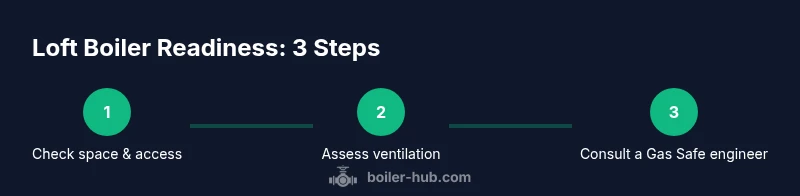
Use this practical starter checklist before committing to a loft installation: confirm headroom and clearance for the boiler and flue; verify loft hatch accessibility for maintenance; ensure adequate ventilation paths; plan condensate disposal routing; obtain formal quotes from Gas Safe engineers; check insurance requirements; ensure alarms are properly positioned; confirm warranty terms; schedule a professional site survey; document compliance steps for records.
Tools & Materials
- Gas Safe registered engineer(Only a qualified professional should install or relocate a boiler.)
- Measuring tape(Verify clearances around the boiler and flue.)
- Ladder or loft access equipment(Safe access to the loft hatch is essential.)
- PPE (gloves, eye protection, hard hat)(Protect yourself during inspection and planning.)
- CO detectors and smoke alarms(Place near the boiler area and ensure battery backup.)
- Floor protection and drop sheets(Protect loft surfaces during work and transport.)
- Condensate trap and drainage path(Ensure safe disposal of condensate and prevent freezing.)
- Basic hand tools (screwdrivers, spanners, pliers)(For basic adjustments during the planning stage.)
- Crane or suction equipment (if needed for heavy components)(Optional for heavy components in tight loft spaces.)
Steps
Estimated time: 2-6 weeks
- 1
Assess loft viability
Evaluate headroom, access, insulation, and proximity to living spaces. Identify potential frost exposure and condensation risks that could affect boiler performance. This initial assessment helps decide whether loft installation is feasible with professional adjustments.
Tip: Document dimensions and photo the loft hatch area for reference in quotes. - 2
Engage a Gas Safe engineer for a site survey
Arrange an on-site assessment to determine suitable boiler type, flue routing options, and required ventilation. The engineer will check current piping, gas supply, and electrical compatibility to avoid costly rework.
Tip: Ask for a written plan detailing flue termination, ventilation, and service access. - 3
Evaluate space, ventilation, and condensate routing
Map out a safe footprint for the boiler, flue, and condensate pipe. Ensure the loft has a clear condensate path to a drain and that venting will not compromise living areas below.
Tip: Include a dedicated route plan for condensate drain and boiler wiring. - 4
Confirm regulatory and insurance implications
Get written confirmation of applicable regulations and any insurance considerations. Clarify warranty requirements with the boiler manufacturer and insurer before purchase.
Tip: Request copies of the relevant building codes and warranty terms. - 5
Select a loft-friendly boiler and flue kit
Choose a boiler model with a compact footprint and a compatible loft flue option. Ensure the kit includes appropriate weatherproofing and a condensation disposal solution for loft conditions.
Tip: Confirm that the flue kit is rated for your chosen boiler and loft installation scenario. - 6
Prepare the loft for installation
Clear storage, protect surfaces, and ensure a clean, dry workspace. Verify safe access lanes for technicians and confirm the ladder is stable.
Tip: Leave space around the hatch for the technician to maneuver safely. - 7
Install and commission by a qualified professional
The engineer will install, connect services, test, and commission the system. Expect a certification indicating compliance with safety and regulatory standards.
Tip: Do not attempt to connect gas, electrical, or ventilation components yourself. - 8
Perform post-install safety checks and document
Verify alarms are functioning, inspect for leaks, and confirm adequate ventilation. Save all certificates and maintenance records for warranty and insurance.
Tip: Keep the documentation in a central place for future reference.
Questions & Answers
Is it legal to install a boiler in the loft?
Legality depends on local regulations and the boiler’s installation requirements. In many areas, a Gas Safe professional must perform the installation and obtain necessary permits. Always verify with your local authority and ensure compliance to protect safety and warranties.
In many places, loft boiler installation requires a Gas Safe pro and proper permits. Check local rules to stay compliant and maintain warranty coverage.
What are the main risks of loft boiler installation?
Key risks include frost damage, condensation buildup, restricted servicing access, and potential carbon monoxide exposure if the system is not vented correctly. Proper sizing, ventilation, and professional commissioning mitigate these risks.
Main risks involve frost and condensation plus CO concerns. A professional setup reduces these risks significantly.
Can I relocate my boiler to a loft if the loft is small?
A small loft can be workable with a compact boiler and optimized flue routing, but it often increases risk of servicing difficulty and frost exposure. A professional assessment will confirm feasibility.
A small loft may be possible, but it requires a professional assessment to verify feasibility and safety.
Do insurance policies cover loft boiler installations?
Insurance coverage varies by policy. Most insurers require compliance with regulations and installation by a qualified professional. Check your policy details and keep documentation.
Coverage depends on your policy; most require a licensed install and proof of compliance.
What alternatives exist if loft installation isn’t feasible?
Consider relocating the boiler to a heated space like a utility room, using a compact wall-mounted boiler with proper ventilation, or exploring enhanced loft insulation to protect piping. Each option has different cost and maintenance implications.
If lofting isn’t feasible, move the boiler or upgrade insulation; a pro can guide the best option.
How much does loft boiler installation typically involve?
Costs vary based on scope, boiler type, flue routing, and access. Obtain multiple quotes from Gas Safe engineers and compare regulatory requirements before committing.
Expect variation by project scope; get quotes and verify regulatory needs with a pro.
Watch Video
Key Points
- Assess viability before any purchase or removal decisions.
- Engage a Gas Safe engineer for surveys, installation, and commissioning.
- Ensure ventilation, space, and condensate drainage meet regulations.
- Consider alternatives if loft conditions are not suitable.
- Keep thorough maintenance records for safety and warranty.