Can Boilers Go in a Cupboard? Safe Placement Guide
Can a boiler safely sit in a cupboard? This guide explains ventilation, clearance, and safer alternatives. Learn how to evaluate cupboard placement with step-by-step checks and expert tips from Boiler Hub.


Can boilers go in a cupboard? The short answer is: only if the cupboard is designed for boiler clearance, ventilation, and service access, and if local codes and the manufacturer’s installation manual permit it. In most homes, cupboard installations require dedicated make-up air, exterior ventilation, and easy service access. Always consult a qualified gas safe engineer before moving a boiler into a cabinet. Boiler Hub emphasizes safety through proper ventilation and access.
Can a boiler go in a cupboard? A practical question for many homes. The correct answer hinges on three essentials: ventilation, clearance, and service access. The keyword can boilers go in a cupboard appears here to set expectations for readers seeking guidance on safe placement. According to Boiler Hub, cupboards can be considered in certain scenarios, but only when the design explicitly accommodates combustion air supply, heat dissipation, and unobstructed maintenance access. If any of these elements are missing, placing a boiler in a cupboard becomes unsafe and could violate local regulations. This section will lay out the core principles, explain why cabinets pose unique risks, and help you decide when to pursue alternatives rather than forcing a cupboard installation.]]
Ventilation and clearance: Why cupboard placement matters. Boilers require a steady supply of combustion air and a clear path for heat to escape during operation. In a cupboard, airflow can be restricted by doors, shelves, and clutter, reducing efficiency and increasing the risk of dangerous buildup. A tightly sealed cabinet can also trap moisture and promote corrosion on boiler components. The boiler’s manufacturer specifies minimum clearances around the unit for safe operation, service access, and heat dissipation; cupboards that fail to meet these clearances void warranties and may contravene building codes. Practical checks include confirming a non-obstructed space around intakes and exhausts, ensuring there is a dedicated vent or make-up air path, and verifying that any door or drawer does not impede airflow. Boiler Hub notes that ventilation should mimic a small utility room rather than a tightly closed cabinet, and that any cupboard must be designed to accommodate routine servicing. In short, ventilation is non-negotiable.
Key takeaways: ensure air supply, avoid blocked vents, and maintain easy access for engineered maintenance.
Cupboard configurations and risk profiles. Cabinets come in many shapes—from wall-mounted niches to tall pantry-style enclosures. The riskiest configurations are those with limited air exchange, sealed doors, and no bypass for fresh air. If the cabinet is near a cooking area or close to other heat-generating devices, heat buildup becomes more pronounced. A cupboard with perforated back panels, passive vents, or integrated ducting can reduce risk, but only if the builder and boiler manufacturer approve such arrangements. Case-by-case assessment is essential; do not assume a cupboard is safe simply because it looks spacious. It’s better to implement a purpose-built enclosure with compliant ventilation than retrofit a generic cabinet.
Readers should note that in many regions, codes require outdoor or dedicated utility-room installations for boilers. The takeaway is simple: cabinets can work only when they meet ventilation and service access standards, and only under professional guidance. The reader should plan for a space that behaves like a small utility room rather than a decorative cabinet.
Regulations, codes, and best practices. Local regulations vary, but most authorities require a minimum clearance around the boiler, explicit combustion air supply, and unobstructed service access. Manufacturers provide installation manuals detailing venting, make-up air, and service clearances; deviations can void warranties and compromise safety. A prudent approach is to consult a licensed engineer who can interpret local rules and confirm whether a cupboard installation is permissible. Boiler Hub emphasizes aligning installation with both code requirements and the boiler’s technical specifications to avoid safety risks such as gas leaks, carbon monoxide buildup, or improper venting.
In practice, many households opt for a dedicated boiler cupboard that is purpose-built with ventilation grills, external ducting, and easy access. When evaluating regulatory compliance, homeowners should request a formal assessment from a pro and reference the boiler’s installation manual. If a cupboard cannot satisfy these requirements, explore safer alternatives.
Practical evaluation checklist: can the cupboard work? Use this practical approach to assess viability. Start with physical space: measure the cabinet dimensions and compare them to the boiler’s minimum clearance and venting requirements in the manual. Check for a dedicated air inlet, an exhaust path, and a way to provide make-up air from the outside or a separate room. Ensure service access is clear from all sides and that a qualified technician can reach the controls, filters, and connections without moving other equipment. Confirm that the cupboard is dry, away from water sources, and that shelves won’t block access or trap heat. Create a plan for cable runs, gas supply (if applicable), and electrical connections, with strain relief and adequate protection. Finally, obtain written approval from a gas-safe engineer, and document the agreed-upon ventilation and clearance strategy to maintain safety and compliance.
Tip: Do not proceed if you cannot guarantee unobstructed service access or adequate ventilation. Rushing this step can lead to dangerous outcomes.
Alternatives to cupboard mounting. If the checklist flags concerns, consider alternatives such as a dedicated boiler closet designed with ventilation grills and exterior venting, a utility room with the boiler mounted on a non-combustible base, or an outdoor boiler housing where permitted. In some homes, upgrading to a compact or higher-efficiency model that requires smaller clearances and better venting can also open up safer installation options. The goal is to balance convenience with safety and regulatory compliance. Consider professional space planning that prioritizes clean air supply, easy maintenance, and a safe escape path for exhaust gases.
Planning a cupboard project: steps to take. Begin with a feasibility study that includes the boiler’s spec sheet and your cupboard’s dimensions. Engage a licensed engineer to review ventilation options—such as perforated panels, dedicated intake ducts, or a dedicated external vent—and to evaluate whether the cabinet’s construction supports the installation. Obtain written permission from the warranty holder and your local building authority if required. Prepare a detailed plan with make-up air routes, vent placement, and service access diagrams before any modification. Finally, implement the plan with a certified installer, and schedule post-installation safety checks to confirm air quality, exhaust integrity, and proper operation. Time spent on planning can prevent costly retrofits later.
Maintenance and future-proofing the cupboard setup. Once installed, maintain clear access to the boiler and venting paths, inspect for signs of corrosion or moisture, and test carbon monoxide detectors regularly. Keep all documentation from the installer accessible for warranty purposes and regulatory audits. Periodic professional inspections help identify wear, loose connections, or changes in airflow that could impact safety. If you plan renovations, consult the same engineer to reassess clearances and venting. These proactive steps maximize safety, efficiency, and long-term reliability of the cupboard installation. Boiler Hub notes that ongoing attention to airflow and access is essential for any cupboard-based boiler arrangement.
Tools & Materials
- Measuring tape(At least 2 meters; used to verify clearances around the boiler and cabinet openings.)
- Pen and notepad(Document measurements and decisions for future reference.)
- Level(Ensure the cabinet base and boiler are level for proper operation.)
- Flashlight(Inspect tight spaces behind shelves and vent paths.)
- Carbon monoxide detector(Place outside the cupboard and in adjacent living spaces as a safety baseline.)
- Smoke detector(Ensure working detectors in nearby living areas.)
- Vent grills or ducting (if modifications are planned)(Used to improve make-up air and exhaust venting if allowed by manufacturer.)
- Non-combustible mounting base or slab(If required by the installation manual for in-cupboard mounting.)
- Gas engineer contact card(Only licensed professionals should handle gas connections.)
- Electrical tester or multimeter(Used to verify power supply for the boiler area when planned modifications occur.)
Steps
Estimated time: 60-120 minutes
- 1
Identify boiler type and installation manual
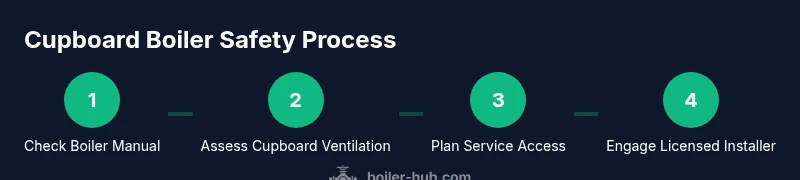
Locate the boiler model and review the manual for required clearances, ventilation needs, and service access. Confirm whether cupboard mounting is permitted by the manufacturer. This step is critical because manufacturers often specify non-restrictive ventilation and dedicated air supply for safe operation.
Tip: If you can’t find the manual, contact the manufacturer or your installer before proceeding. - 2
Assess cupboard ventilation and air supply
Check whether the cupboard has any ventilation, grills, or existing ductwork. Evaluate whether you can provide make-up air from outside or from a ventilated room. Inadequate ventilation is a leading risk factor for poor combustion and CO buildup.
Tip: Avoid blocking any vents with storage or shelving. - 3
Check access and service clearance
Measure the space around the boiler to ensure maintenance access, panel removal, and safe disconnection if needed. The servicing area should not be obstructed by doors, hinges, or brackets.
Tip: Plan at least 1-2 feet of free space around all sides. - 4
Consult a licensed gas engineer
Have a qualified professional review your cupboard idea, airflow plan, and electrical/gas connections. A pro can validate the plan, perform pressure/vent checks, and confirm compliance with local codes.
Tip: Do not proceed without professional sign-off. - 5
Implement ventilation and safety upgrades
Install approved ventilation strategies (permitted by the boiler’s manual) such as grills, external vents, or a dedicated air intake. Ensure detectors stay functional and accessible.
Tip: Document the changes for future servicing and audits. - 6
Obtain formal approval and schedule installation
Secure written authorization from the boiler manufacturer and local authority if required. Schedule installation with a licensed installer and plan a post-install safety check.
Tip: Keep all certifications and manuals in a central location.
Questions & Answers
Can a boiler be installed in any cupboard, and what factors determine safety?
A cupboard installation is only safe when it provides adequate ventilation, clearances, and service access per the boiler’s manual and local codes. Without these, a cupboard is unsafe and may breach warranties and regulations.
Cupboard installations need proper ventilation and access; otherwise, they’re not safe and may violate regulations.
What are the main risks of placing a boiler in a cupboard?
Key risks include carbon monoxide buildup, poor combustion due to inadequate air supply, overheating, and inaccessible servicing. These hazards make cupboard mounting inappropriate unless all requirements are met.
Carbon monoxide and overheating are the main dangers if a cupboard installation isn’t properly ventilated.
Are there safer alternatives to cupboard placement?
Yes. Consider a dedicated boiler room, utility room, or a purpose-built enclosure with ventilation and make-up air. Exterior venting or relocation to a compliant area often provides safer operation.
A dedicated space with ventilation is usually the safest option.
Will cupboard placement affect boiler performance or warranty?
Improper cupboard installation can impact performance and void manufacturer warranties. Always follow the installation manual and obtain professional approval.
Warranties and performance can be affected if you don’t follow the manual and codes.
Who should assess cupboard viability for a boiler?
A licensed gas engineer or boiler installer should assess viability, perform vent checks, and confirm compliance with local regulations.
A licensed professional should assess viability and safety.
What maintenance is needed after cupboard installation?
Regular safety checks, test CO detectors, and schedule annual service. Keep documentation of all changes and maintain clear access for servicing.
Regular checks keep the system safe and efficient.
Watch Video
Key Points
- Evaluate clearance and ventilation before cupboard placement
- Use licensed professionals for any gas connections
- Maintain easy service access and proper air intake
- Install dedicated ventilation rather than improvising with shelves
- Document all approvals and safety checks for warranty and codes