How Big Should a Boiler Cupboard Be?
Learn how to size a boiler cupboard for safe access, ventilation, and maintenance. This guide covers measurements, layout options, and compliance to help homeowners plan a compliant, efficient boiler space.


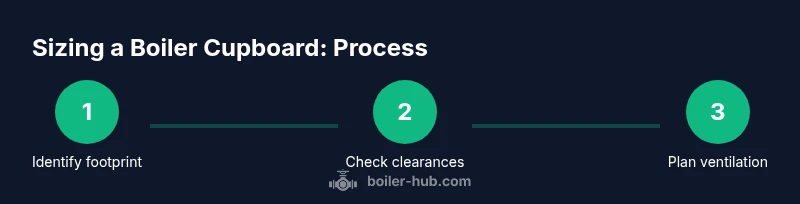
To size a boiler cupboard, ensure space for the boiler itself, proper service clearances, and adequate ventilation. Start with the boiler’s footprint, then follow the manufacturer’s clearance guidance and local safety rules to determine overall dimensions. The Boiler Hub approach emphasizes safe access, unobstructed maintenance, and compliant air supply for reliable operation.
How big does a boiler cupboard need to be?
The size of a boiler cupboard directly affects safety, maintenance, and efficiency. For homeowners asking how big a boiler cupboard needs to be, the short answer is: it must fit the boiler footprint with enough clearance for service, repairs, and ventilation. Start with the boiler model you plan to install, then add space for access doors, flue connections, and ventilation grilles. Local regulations and the manufacturer's manual should guide the final dimensions. This approach helps reduce service delays and ensures reliable operation. The Boiler Hub team emphasizes safe access and compliant air supply as foundational to any sizing plan.
Sizing rules of thumb: clearance, ventilation, and access
Beyond the footprint, you need to think about three pillars: service clearance, ventilation, and access. Service clearance means there must be room to reach controls, remove panels, and disconnect utilities during maintenance. Ventilation matters because boilers require a supply of fresh air; restricting air can cause efficiency losses or unsafe conditions. Access involves path to the cupboard and room for removing the boiler if a replacement is needed. The exact clearances vary by model, but the principle remains: give the installer space to work and the boiler room to breathe. If your space is marginal, planning with a professional will help you choose a cupboard size that accommodates future upgrades. The Boiler Hub guidance also highlights cross-ventilation considerations and the importance of not obstructing flues or air intakes.
Measuring your space: a practical approach
Begin by identifying the boiler footprint: measure width, height, and depth of the unit as installed or as per the manufacturer specifications. Add generous service clearances around the sides, top, and front so technicians can reach controls and replace components without removing the unit. Consider door swing paths and any fixed plumbing or electrical runs that could limit placement. Use masking tape to mark the intended outline on the wall or floor, then walk through the area to confirm there is unobstructed access for maintenance. Capture photos for reference and keep a simple measurement log.
Ventilation considerations and air supply
A boiler cupboard must have adequate ventilation to supply combustion air and dispersal for heat. Natural ventilation relies on intentional gaps or vents; mechanical ventilation may be required in tightly sealed homes. Ensure that any air inlets remain unobstructed and that the cupboard does not trap heat, which could affect efficiency or safety. The space should permit periodic air changes without drafts near the boiler. If unsure, consult a professional to assess whether the current layout meets both the boiler’s needs and local building codes.
Layout options and door considerations
Cupboard layouts vary from standalone closets to integration within a utility room. Key considerations include access to service panels, clearance for the flue, and space for piping or condensate lines. A common pitfall is placing a cupboard where doors or drawers block access to the boiler controls or vent grilles. When possible, design with removable panels for easy service. If the cupboard shares space with laundry or storage, ensure vibration isolation and noise dampening so normal use does not affect boiler performance.
Safety, compliance, and professional input
Local codes and safety guidelines govern cupboard sizing, ventilation, and installation methods. Always verify requirements with your local authority or a licensed professional. Boiler Hub’s guidance emphasizes that sizing decisions should prioritize safe access, proper air supply, and compliance with manufacturer instructions. Before proceeding with a build or cabinet modification, obtain a professional opinion to avoid late-stage rework and potential safety issues.
Planning for future changes: upgrades and expansions
If you anticipate upgrading to a larger boiler, more efficient model, or additional equipment (like an expansion tank or intermediate heat exchanger), size the cupboard with extra margin. Planning for future changes reduces the need for costly reconfigurations later. Document dimensions and clearances, and keep a digital copy of the boiler manual for reference during future replacements. A well-sized cupboard can also improve energy efficiency by ensuring consistent ventilation and access for routine servicing.
Tools & Materials
- Tape measure (at least 3 meters)(To capture width, height, and depth accurately)
- Pencil and notebook(Record measurements and layout notes)
- Masking tape(Mark layout on floor/wall temporarily)
- Level(Check that base and mounting surfaces are even)
- Stud finder(Locate framing or hidden services if needed)
- Flashlight(Inspect dark corners, vents, and flue areas)
- Safety gloves and goggles(Protect during measurements and handling)
- Boiler manual (digital copy)(Clarifies clearance and ventilation requirements)
- Camera or smartphone(Capture key views for reference)
Steps
Estimated time: 2-4 hours
- 1
Record boiler footprint
Identify the exact model you will install and measure width, height, and depth. Note any protrusions like burners, gas fittings, or thermostat enclosures that may affect space. This establishes the minimum footprint the cupboard must accommodate.
Tip: Have a helper hold the tape measure to ensure accurate diections and avoid gaps. - 2
Check manufacturer clearance
Consult the boiler manual for required service clearances around all sides, the top, and the front. If the manual specifies margins, use them as your baseline for outer cupboard dimensions.
Tip: Take a photo of the clearance table for quick reference during install. - 3
Assess ventilation needs
Determine whether natural ventilation suffices or if a mechanical solution is needed. Ensure intake and exhaust paths are clear and that the cupboard does not trap heat around the boiler.
Tip: If in doubt, get a professional assessment to avoid combustion air issues. - 4
Plan outer dimensions
Add the footprint plus the recommended clearances to arrive at the cupboard’s outer width, depth, and height. Consider door swing, adjustable shelves, and any fixed piping.
Tip: Design with a little extra space to accommodate future replacements. - 5
Ensure service access
Map out a clear path to service panels, flue connections, and condensate lines. Include removable panels if permanent access is constrained by cabinetry.
Tip: Label components so future technicians can locate them quickly. - 6
Consult a professional
Have a licensed technician review your measurements and layout. This step validates safety and compliance before you cut or modify space.
Tip: A professional review can prevent costly rework and ensure code adherence.
Questions & Answers
What is the minimum space around a boiler in a cupboard?
Minimum space depends on the boiler model and the manufacturer’s clearance guidelines. Always follow the manual and local codes to ensure safe service access and ventilation.
The required space varies by model; check the manual for minimum clearance and be sure to leave room for service access and ventilation.
Do all boilers require a dedicated cupboard?
Not always. Some boilers fit in closets or utility rooms, but every installation should provide adequate clearance and ventilation per code and manufacturer instructions.
Boilers don’t always need a separate cupboard, but you must meet clearance and ventilation requirements wherever they are installed.
How do I measure for ventilation in a boiler cupboard?
Assess whether natural ventilation provides sufficient air for combustion and safe heat dissipation. If the space is tight, you may need vents or mechanical ventilation following local codes.
Check if natural air supply works; if not, plan for vents or a mechanical system according to code.
Can I install a boiler cupboard in an existing kitchen cabinet?
Installing in a kitchen cabinet is possible with proper clearance, ventilation, and service access. Verify that the setup meets manufacturer and safety requirements.
Yes, but you must ensure clearance and ventilation meet the boiler’s specs and code rules.
Who should size or install a boiler cupboard?
A licensed boiler technician or a qualified professional should size and install the cupboard to ensure safety and compliance.
Hire a licensed technician to size and install the cupboard for safety and code compliance.
What safety codes apply to boiler cupboard sizes?
Safety codes vary by location and boiler type. Check local building codes, gas safety requirements, and the boiler manufacturer’s instructions.
Local building and gas safety codes apply; follow the boiler maker’s instructions and get professional input.
Watch Video
Key Points
- Measure the boiler footprint, then add manufacturer clearances.
- Prioritize safe access and proper ventilation in all layouts.
- Plan for future upgrades to avoid rework.
- Consult a professional for code compliance and safety.
- Document everything for maintenance and replacements.