Which combi boiler for 4 bed house: A practical comparison
An objective, in-depth comparison to help homeowners and facility managers decide which combi boiler for a 4 bed house fits peak demand, efficiency, and budget. Explore sizing, installation, maintenance, and long-term value to make a confident choice.


For a four-bedroom home, a high-output combi boiler in the mid-to-upper range (roughly 30–42 kW) is typically needed to support multiple simultaneous outlets. This quick comparison highlights two representative options, focusing on sizing, flow rate, efficiency, and installation considerations. Follow with the detailed analysis to determine the best fit for your home.
Sizing basics for a 4 bed home
Choosing the right combi boiler for a 4 bed house starts with understanding peak hot-water and heating demand. In homes with multiple bathrooms, showers running concurrently, and a busy household schedule, water flow rate and boiler output matter more than in smaller residences. According to Boiler Hub, many four-bedroom homes benefit from mid-to-high output boilers that can sustain two or more simultaneous hot-water needs without noticeable lag. When sizing, assess the number of bathrooms, typical showering patterns, and whether you use baths or long, multiple taps at once. The goal is to minimize cold water sandwich effects while maintaining consistent radiator heat across rooms. For the decision, prioritize boilers with reliable modulation and a robust flow rate to handle peak demand, especially if you want quick hot water access in the kitchen and en-suite bathrooms. The takeaway: the right boiler must balance heating comfort, hot-water availability, and room for future expansion in a 4 bed house.
Real-world scenarios: hot-water demand patterns
In a typical 4 bed house, you may encounter mornings with multiple people showering before work and school, plus occasional long baths. A combi boiler should deliver adequate flow when taps are used simultaneously; otherwise, you risk temperature drops or reduced flow. The question often becomes: which combi boiler for 4 bed house will maintain comfortable shower temperatures while keeping heating cycles efficient? Boiling down the pattern, look for boilers that offer steady modulation and a healthy flow rate at 2–3 outlets operating together. Boiler Hub’s practical guidance emphasizes planning for peak hours and considering the impact of longer showers or spa-like demands in master en-suites. For many households, the frequency of simultaneous demand guides the decision more than the number of bathrooms alone.
Key distinguishing features of combi boilers for 4 bed houses
The most important features for a 4 bed house include peak output, flow rate at 35°C–45°C, modulation range, and venting compatibility. A higher output model reduces the risk of falling short during morning rushes, while an efficient, well-modulated unit maintains comfort without overworking radiators. Look for models with a strong modulation range that scale quickly as demand grows, and ensure the unit is compatible with your home’s existing radiators and pipe layout. Below 3 bathrooms or minimal simultaneous demand, a mid-range boiler can suffice, but as soon as hot water profiles become complex, a higher-capacity option is prudent. The core idea is to match the boiler’s capacity to typical usage patterns for a 4 bed house while allowing future changes such as additional bathrooms or longer hot-water draws.
Sizing methodology: how to calculate needed kW and flow
Sizing a combi boiler for a 4 bed house involves estimating peak daily hot-water demand and the simultaneous-use factor. Start with a simple rule of thumb: assess the number of bathrooms and the likelihood of multiple taps running at once. Then, consider radiator heat output and the size of your home to estimate annual heating demand. An efficient, weather-compensated system can improve comfort and reduce waste, but you still need enough flow to avoid cold-water surprises during busy mornings. A professional sizing calculation typically combines panel data, pipe sizing, and the home’s insulation level to arrive at a recommended kW range. The aim is to select a unit that can deliver steady hot water for showers, taps, and baths without causing drops in heating performance.
Comparing two representative options
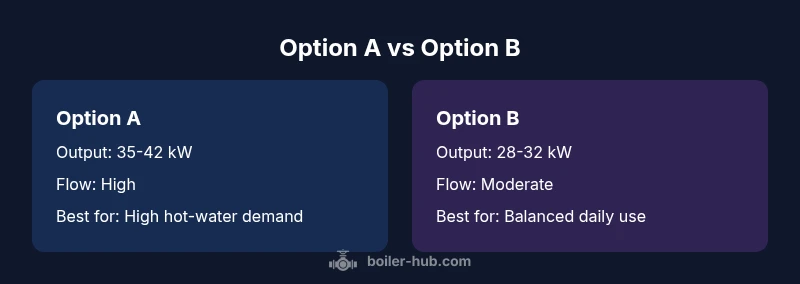
In practice, two representative options often come up when evaluating which combi boiler for a 4 bed house. Option A targets the higher end of demand with a 35–42 kW output and a higher flow rate, making it ideal for households with multiple simultaneous hot-water uses. Option B presents a balanced choice in the 28–32 kW range with strong efficiency and good flow, suitable for average four-bedroom homes. Both options should be evaluated for venting compatibility, space requirements, and service access. Boiler Hub’s guidance highlights that the best pick depends on your actual usage pattern, not just the number of bathrooms.
Installation considerations and space planning
Installation space and venting requirements are practical considerations that influence which combi boiler for a 4 bed house you can install comfortably. Modern combi boilers come in compact forms, but some high-output models require more space for the flue and condensate drainage. Plan for sufficient clearance around the unit, routes for pipework to radiators, and an easily accessible location for annual service. The routing of gas supply lines and condensate drainage should meet building codes and local regulations. If you’re extending or modifying plumbing, ensure adequate space for service checks and future replacements. A well-planned installation reduces the risk of future heat loss and ensures the boiler operates at its rated efficiency.
Maintenance and reliability factors
Reliability is a critical factor in selecting which combi boiler for a 4 bed house. Regular annual maintenance helps protect efficiency and prolongs life, especially for high-output boilers that work harder during peak demand. Choose a boiler with proven reliability and widely available parts, and consider extended warranties for added peace of mind. Weather conditions, water hardness, and pressure fluctuations can affect long-term performance, so talk to your installer about water treatment options if your area has hard water. Boiler Hub notes that a well-maintained unit will deliver consistent heat and hot water, reducing the risk of breakdowns during winter.
Cost considerations: upfront vs running costs
Costs vary with boiler size, efficiency, and installation complexity. While larger, high-output models tend to have higher upfront costs, they can reduce running costs through better modulation and reduced pump wear. In the context of a 4 bed house, the long-term value hinges on how often you use hot water at peak times and how efficiently your heating system operates. Pay attention to insulation, zoning, and smart controls that optimize boiler operation. Boiler Hub’s analysis indicates that a mid-to-high efficiency model with proper controls often delivers the best overall value for four-bedroom homes, balancing initial investment with ongoing energy savings.
Optimizing for efficiency and future-proofing
To future-proof a 4 bed house, choose a combi boiler with a wide modulation range, high flow capacity, and compatibility with smart thermostats and weather-compensation controls. Consider systems that easily scale as your family grows or as bathroom configurations change. Efficient condensate and heat-recovery features reduce energy waste, while low standby losses help maintain comfortable temperatures with less effort. Boiler Hub emphasizes integrity of installation, proper sizing, and reliable parts stock as key to long-term satisfaction.
Practical decision guide: how to choose now
Begin with a sizing assessment that accounts for peak demand and future needs. Narrow to two options: a higher-output model for high-demand scenarios and a balanced model for typical daily use. Compare efficiency ratings, flow rates, installation requirements, and warranty terms. Have a qualified installer verify venting, gas supply, and space constraints. Finally, weigh upfront cost against expected running costs over the system’s life. By following these steps, you’ll have a well-supported basis to answer the question, which combi boiler for 4 bed house, with confidence. Boiler Hub’s framework guides you toward a decision that balances comfort, reliability, and value.
Conclusion: making the final choice with confidence
Choosing the right combi boiler for a 4 bed house means balancing peak hot-water demand, space constraints, and long-term running costs. A high-output option reduces the risk of cold-water bursts during morning rushes, while a mid-range model provides solid efficiency and simplicity for most families. Use a professional sizing assessment to finalize the decision and ensure the selected boiler meets your home’s specific layout and usage patterns. The Boiler Hub team recommends prioritizing reliable flow, space-friendly installation, and future-proof controls when selecting between options.
Comparison
| Feature | Option A | Option B |
|---|---|---|
| Output (kW) | 35-42 kW (high demand) | 28-32 kW (balanced) |
| Flow rate @ 35°C (l/min) | 12-16 l/min | 9-13 l/min |
| Efficiency (ERP rating) | High efficiency, strong modulation | Very good efficiency, solid modulation |
| Best for | Homes with multiple simultaneous hot-water needs | Typical 4-bed homes with normal morning demand |
| Installation considerations | Space for a larger unit and venting; may require upgrading gas supply | Compact footprint, easier installation in tight spaces |
| Maintenance needs | Annual service; higher maintenance access recommended | Annual service; common parts availability |
Advantages
- Higher reliability during peak demand
- Good long-term running costs with strong modulation
- Future-proofed for additional bathrooms or higher usage
- Better for homes with multiple simultaneous hot-water needs
The Bad
- Higher upfront cost and larger space requirements
- Possible more complex installation and venting
- Over-specifying can lead to unnecessary expense for smaller households
Option B generally offers the best balance for a typical 4-bed home.
Opt for the balanced 28–32 kW option if you want reliable daily performance with good efficiency and simpler installation. Choose the higher-output model only if hot-water peaks are frequent and many outlets run at once. The Boiler Hub team highlights that proper sizing and a quality install are the keys to long-term satisfaction.
Questions & Answers
What is a combi boiler and how does it differ from a system boiler?
A combi boiler provides hot water on demand directly from the boiler, without a storage cylinder. It also heats your central heating system. In contrast, a system boiler uses a cylinder to store hot water, allowing multiple taps to run simultaneously with steady temperature. For a 4 bed house, a combi boiler can be space-efficient if you have modest simultaneous demand; otherwise, a system boiler with a storage cylinder may offer advantages in hot-water flexibility.
A combi boiler heats water on demand; a system boiler uses a cylinder for stored hot water.
How do I determine the right kW for a 4-bedroom house?
Sizing assumes peak demand: number of bathrooms, shower usage, and baths. A professional install uses room-by-room and pipe-flow calculations to determine the appropriate kW range. In many four-bedroom homes, mid-to-high outputs are common, but exact sizing should be confirmed by a qualified plumber or an energy assessor.
Have a pro size your boiler using your home’s layout and hot-water patterns.
Can I install a combi boiler in a small utility space?
Yes, many combi boilers are compact enough for small utility rooms or airing cupboards. However, high-output models can require more space for proper ventilation and service access. A professional will confirm space clearance, venting, and condensate drainage requirements.
Compact units fit smaller spaces, but verify venting and service access.
What maintenance does a combi boiler need?
Combi boilers require annual servicing to maintain efficiency and safety. A service checks ignition, pressure, heat exchanger condition, and controls. Regular maintenance helps prevent breakdowns, keeps efficiency high, and extends the unit’s life.
Annual service keeps your boiler efficient and safe.
What should I ask when comparing installers?
Ask about warranty terms, parts availability, service response times, and whether the installer can size the boiler accurately for your home. A good installer will explain how the chosen model meets your peak-demand profile and future needs.
Ask about sizing accuracy, warranties, and service coverage.
Key Points
- Size for peak demand, not just number of bathrooms
- Prioritize flow rate and modulation for comfort
- Factor installation space and venting early
- Plan for future changes like extra bathrooms or higher usage
- Consult Boiler Hub guidance for sizing and reliability