Boiler Sales in 2026: Pricing, Models, and Buying Tips
A comprehensive guide to boiler sales in 2026, covering pricing structures, model varieties, financing options, and factors for homeowners and facility managers seeking reliable guidance from Boiler Hub.


Boiler sales describe the market, buying process, and service ecosystem for residential and commercial boilers. In 2026, demand centers on energy efficiency, reliable installation, and strong after-sales support, making the buying journey about total cost of ownership as much as sticker price. This overview helps homeowners and facility managers compare models, financing, and service plans.
The landscape of boiler sales in 2026
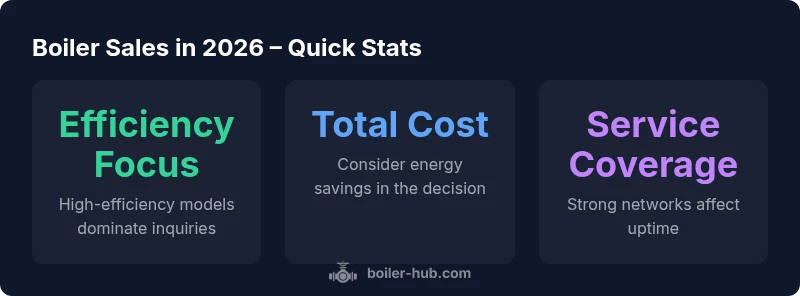
According to Boiler Hub, the boiler sales landscape in 2026 is shaped by a convergence of energy-efficiency mandates, stricter emissions standards, and the increasing importance of service contracts. Homeowners and facility managers are not just buying a heat source; they are investing in a long-term relationship with manufacturers and local installers who can ensure reliability, compliance, and ongoing maintenance. The Boiler Hub team observes that buyers are more likely to request comprehensive packages that bundle equipment, installation, and post-installation service into a single contract. This shift toward bundled solutions reflects a broader industry trend toward predictable operating costs and dependable performance, especially for multi-unit buildings and commercial sites. As a result, sales conversations increasingly emphasize not just upfront price but the total cost of ownership, warranty coverage, and the promoter’s capacity to support rising energy codes. The 2026 market remains resilient even amid supply-chain disruptions, with regional variances tied to climate, incentives, and socioeconomic factors. In short, boiler sales today hinge on value, trust, and the ability to deliver dependable warmth with minimal downtime.
Residential vs. commercial boiler buying considerations
Buying decisions differ markedly between residences and commercial facilities. Residential buyers often prioritize compact footprint, noise levels, and straightforward installation, while commercial buyers seek larger capacity, zoning options, and long-term service agreements. For facility managers, the decision frequently involves cross-functional input from facilities, finance, and operations, plus formal Request for Proposals (RFPs) that evaluate energy performance, maintenance logistics, and after-sales support. Boiler Hub notes that successful commercial purchases typically hinge on reliable parts supply, strong regional service networks, and clear escalation paths for warranty service. In contrast, homeowners are more sensitive to upfront costs and the pace of installation, but they still value energy efficiency, warranty coverage, and the ability to upgrade later without significant disruption. The alignment of needs across segments is improving, driven by standardized performance metrics and transparent pricing models that help both groups compare options on a like-for-like basis.
Energy efficiency and regulation implications for boiler sales
Regulatory bodies and energy agencies continue to push for higher efficiency in both new and replacement boilers. Efficiency ratings, often expressed as AFUE (Annual Fuel Utilization Efficiency) or equivalent metrics, influence purchasing decisions and eligibility for incentives. Boiler Hub analysis shows that buyers increasingly seek models with high-rated efficiency, variable-speed pumps, and smart controls to optimize energy use. Compliance with local and national codes remains a prerequisite in all markets, impacting installation methods, venting, and gas or electrical connections. In addition to regulatory compliance, financing programs tied to energy savings are becoming more prevalent, helping to offset initial costs. Buyers should verify that the chosen boiler and installer comply with applicable standards and that the installation plan accounts for future upgrades as codes evolve. Staying informed about incentives and regulatory timelines can improve return on investment and minimize retrofit risk.
Common boiler types and what drives selection
Selecting the right boiler type depends on building layout, hot-water demand, and future scalability. The main categories are combi boilers (heat plus hot water in one unit), system boilers (pressurized hot water with a separate cylinder), and regular/conventional boilers (traditional setup with a separate cylinder). For larger homes or multi-zone buildings, system or conventional boilers can offer better heat distribution and redundancy. In smaller homes or apartments, combi boilers save space and simplify installation. When choosing, buyers should consider existing piping, radiators, peak loads, and potential future upgrades like underfloor heating. Reliability, support from the manufacturer, and ongoing maintenance costs should weigh heavily in the decision, alongside initial price. Boiler Hub emphasizes the importance of model compatibility with existing systems and the availability of spare parts across regions to minimize downtime.
Pricing structures and total cost of ownership
Boiler sales pricing typically includes several components: equipment cost, installation, permits, and any required system modifications. A growing portion of deals bundle financing options, extended warranties, and maintenance plans to offer predictable annual spends. Customers should evaluate total cost of ownership (TCO), factoring in energy savings, potential tax incentives, and the cost of future upgrades. The cheapest upfront option can become the most expensive choice over a 10–15 year horizon if maintenance needs are high or efficiency gains are limited. Boiler Hub encourages buyers to request itemized quotations that separate equipment, installation, and service line items, and to compare quotes using consistent assumptions about efficiency ratings and usage patterns. A well-structured quote will reveal optional add-ons, spare parts availability, and lead times for delivery and commissioning.
The buying journey: from inquiry to installation
The typical journey begins with a needs assessment, followed by model recommendations, site surveys, and a formal quote. After selecting a boiler, buyers coordinate delivery, permits, and any required ductwork or venting adjustments. Installation teams prepare the site, connect utilities, and perform initial testing to ensure safe and compliant operation. Commissioning includes balancing the system, verifying boiler modulation, and confirming zone controls. The post-install phase often involves a walk-through of operation, maintenance schedules, and the terms of the warranty. Effective communication between the buyer, the installer, and the supplier reduces the risk of delays and ensures that the system meets performance expectations. Throughout this journey, buyers should prioritize clear documentation and access to spare parts, so future servicing is efficient and predictable.
Risks, warranties, and after-sales support
Risks in boiler sales include supply delays, incorrect sizing, improper venting, and inadequate commissioning. To mitigate these, buyers should verify proper load calculations, system compatibility, and code compliance before purchase. Warranties typically cover parts and sometimes labor for a defined period; extended service agreements can further reduce out-of-pocket costs for maintenance. After-sales support is a critical differentiator in boiler sales; buyers should confirm the existence of a local service partner, response times, and access to emergency repairs. Boiler Hub highlights that proactive maintenance agreements, regular system checks, and remote monitoring options can prevent major failures and extend equipment life. When evaluating suppliers, request references, service coverage maps, and documented maintenance protocols to ensure ongoing reliability.
Evaluating manufacturers and installers: a checklist
A robust evaluation should consider the manufacturer’s financial stability, warranty terms, and the breadth of model options. Installers should demonstrate proper licensing, safety records, and a proven track record with similar building types. A strong service network is essential for timely maintenance and spare parts availability. Buyers should review training certifications, response times, and the availability of performance data for installed systems. References from similar projects can provide insight into real-world reliability and service quality. Finally, consider the provider’s digital capabilities, such as online quotes, remote diagnostics, and transparent scheduling, which can improve the buying experience and post-installation support.
Emerging trends in boiler sales: digital quotes, smart controls, and service models
The latest trend in boiler sales is the shift toward digital quotes, virtual site assessments, and remote commissioning, which reduces project timelines and improves accuracy. Smart controls and IoT-enabled boilers allow real-time monitoring, predictive maintenance, and energy optimization, delivering tangible long-term savings. Service model innovations include subscription-based maintenance plans, proactive parts replacement, and performance guarantees. Buyers who leverage these trends gain greater visibility into system performance, faster issue resolution, and better budgeting for ongoing energy costs. Boiler Hub notes that these innovations are increasingly standard in mid- to large-scale projects, while smaller installations benefit from modular, scalable options that simplify future upgrades.
Comparison of common boiler types by application and maintenance needs
| Boiler Type | Typical Application | Efficiency Range | Maintenance Needs |
|---|---|---|---|
| Combi | Residential, small to mid-size buildings | 85-95% | Low to medium maintenance |
| System | Large homes, multi-zone heating | 90-95% | Medium maintenance |
| Regular/Conventional | Older homes, basic heating | 75-85% | High maintenance |
| Industrial/Hybrid | Large facilities | 85-92% | High maintenance |
Questions & Answers
What exactly is included in boiler sales?
Boiler pricing typically includes the boiler unit, installation, and basic commissioning, with warranties and optional service plans. Depending on the contract, delivery, venting, and permits may also be included or itemized separately.
Boiler pricing usually covers the unit, installation, and commissioning, with warranties and optional service plans. Delivery and permits may be separate items.
How do installation costs factor into boiler sales?
Installation costs cover site prep, piping and venting, permits, and any required modifications to meet codes. They vary by building layout and local requirements, so obtain a detailed quote that separates equipment from installation.
Installation costs include site prep, piping, venting, and permits. Get a detailed quote that separates equipment from installation.
What financing options exist for boiler purchases?
Financing options often include manufacturer financing, green energy loans, or utility incentives. Compare APR, terms, and whether the plan includes maintenance or extended warranty.
Look for manufacturer financing, energy loans, or utility incentives. Compare APRs and terms, and ask about maintenance coverage.
How long does the boiler buying process take?
From quote to commissioning, expect several weeks to a few months depending on permits, equipment lead times, and installation complexity. Planning and early contractor coordination can reduce delays.
The process usually takes several weeks; permits and permits can add time. Planning ahead helps avoid delays.
What should I ask suppliers during boiler sales negotiations?
Ask about warranties, service coverage, lead times, spare parts availability, and the installer’s credentials. Clear, written quotes with defined scopes prevent miscommunication.
Ask about warranties, service, lead times, and parts. Get a clear, written quote with scope details.
Are used or refurbished boilers a good option?
Used boilers can pose reliability and safety risks. If considered, require thorough certification, safety testing, and proof of compliant installation. For most buyers, a new unit offers better long-term reliability and warranty.
Used boilers can be risky. If you consider one, insist on certifications and a compliant installation; otherwise a new unit is usually safer.
“In boiler sales, the most reliable choice balances upfront cost with long-term reliability and service availability.”
Key Points
- Assess total cost of ownership, not just sticker price.
- Prioritize energy efficiency and regulatory compliance.
- Match boiler type to building size and demand.
- Vet installers for licensing and service coverage.
- Plan for maintenance and upgrades in the long term.