Choosing the Right Boiler for In-Floor Heating
Learn how to select and install a boiler for in-floor heating with radiant floors. This practical guide covers sizing, efficiency, controls, and essential installation steps for safe, reliable warmth.


To power an in-floor radiant system, choose a low-temperature boiler sized for radiant heating and compatible with a mixing valve. You’ll prioritize high efficiency, reliable outdoor reset or smart controls, and a buffer tank to stabilize temperature. According to Boiler Hub, ensure proper piping, pump sizes, and boiler clearance for safe, efficient installation.
What is in-floor heating and why a boiler matters
In-floor heating, often called radiant floor heating, uses warm water circulated through tubing embedded in the floor to provide comfortable, even heat. A boiler is the heat source that heats water to the programmed supply temperature. For in-floor heat, you typically want a boiler that runs at low temperatures to maximize efficiency and comfort. This is because radiant floors respond slowly to temperature changes, so stable, low water temperatures reduce overshoot and give more consistent warmth. When selecting a boiler for in-floor heat, you should consider fuel type, efficiency, and the ability to operate with a mixing valve to keep floor temperatures safe and comfortable. Modern high-efficiency boilers, especially condensing models, can achieve substantial energy savings when paired with radiant heating.
Key design considerations for boiler for in-floor heat
Important design decisions include selecting a boiler that can supply the water temperatures required by radiant floor loops (often 85-130°F / 29-54°C depending on slab and insulation). A primary/secondary piping arrangement reduces thermal shocks and ensures balanced flow. The mixing valve or an outdoor reset control helps maintain desired floor temperatures while protecting pipes and people from scalding. If you have an older home, you might need a buffer tank to smooth boiler cycling and accommodate variable heat loads. Consider whether the system will be heat source only or part of a heat pump or solar hybrid, which can further boost efficiency. Ensure the boiler complies with local codes and is sized to meet peak winter loads.
Sizing, efficiency, and controls
In-floor heating requires careful boiler sizing. Oversized boilers frequently short-cycle and waste fuel; undersized units fail to maintain warm floors. Use heat-loss calculations for the living area and consider the radiant floor's thermal mass. Efficiency matters: a condensing boiler with low return water temperature minimizes exhaust losses. Controls: setpoint controls, outdoor reset, and high-quality mixing valves improve comfort and energy use. An efficient setup often includes a buffer tank and a variable-speed circulator to modulate flow with demand. In addition, ensure the system is sealed and insulated to minimize heat loss in the trenches or attic spaces.
System components and compatibility
Beyond the boiler, radiant floor systems require piping (PEX or copper), a circulation pump, a manifold, a tempering valve, and an expansion tank. Check compatibility: some boilers are better paired with a specific type of mixing valve or with a buffer tank. Use compatible pumps and ensure correct delta-T (difference between supply and return temperatures) to protect floors. Some boilers include built-in controls, but most benefit from an external control system, such as a smart thermostat or zone controls to prioritize comfort in living spaces.
Installation overview and common pitfalls
Installing a boiler for in-floor heat is a multi-component project that benefits from careful planning. Common pitfalls include oversizing, improper delta-T, and bypassing the mixing valve. Always verify floor loops are leak-free before pressurizing, and ensure the slab or radiant mat is properly insulated. Use correct piping materials and tighten connections to avoid leaks. Follow local codes on venting, combustion air, and electrical connections. When in doubt, consult a licensed HVAC contractor and reference the latest Boiler Hub guidelines for radiant floor installations.
Maintenance tips for long-term reliability
A reliable boiler for in-floor heat requires regular maintenance. Schedule annual service to check combustion settings, thermostat wiring, and pump operation. Inspect expansion tank pressure and purge air from the system to prevent air locking. Monitor floor temperature and energy usage to detect anomalies early. Keep an updated parts list and a service log; this simplifies troubleshooting and ensures safe operation over many winters.
Tools & Materials
- Low-temperature boiler compatible with radiant floor heating(Rated for supply temps ~85-130°F; consider outdoor reset compatibility)
- Mixing valve (tempering valve)(Maintains safe floor temperatures and protects flooring materials)
- Circulation pump(Proper flow rate for radiant loops; check curve against floor area)
- Expansion tank(Correct capacity to absorb pressure swings)
- Piping: PEX or copper(Connects boiler to manifold and floor loops)
- Manifold and zone valves(Helpful for zoned control or future expansion)
- Thermostats/controls(Smart thermostats or zoning panels for comfort and efficiency)
- Leak detector and pressure gauge(Essential for safety and early leak detection)
Steps
Estimated time: 3-8 hours
- 1
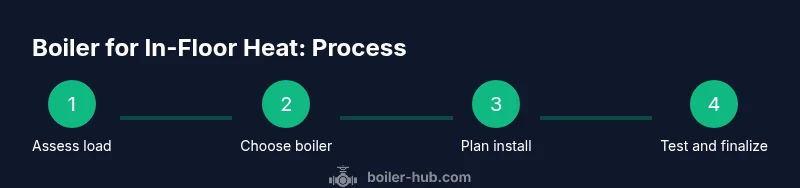
Assess heat load and floor system
Calculate the building’s heat loss and review floor construction, insulation, and slab type to determine required water temperatures and boiler size for in-floor heat.
Tip: Use a certified heat-loss calculation and verify floor slab insulation; this protects against under- or over-sizing. - 2
Select boiler type and size
Choose a boiler that delivers the target low water temperatures and fits your fuel type, space constraints, and future expansion. Size the boiler for peak loads and include margin for cold snaps.
Tip: Prefer condensing, high-efficiency models if your fuel supports it; check boiler curves with radiant floor loads. - 3
Plan piping layout and mixing strategy
Decide on a primary/secondary loop, a mixing valve, and temperature control strategy to maintain floor temperatures around the setpoint with room for zoned control.
Tip: Install a tempering valve and verify delta-T between supply and return is appropriate for your floor system. - 4
Install boiler, pump, and safety devices
Mount the boiler in a ventilated area, connect the circulation pump, expansion tank, and safety valves. Verify venting and combustion air per code.
Tip: Use isolation valves for future service and leave room for future expansion or replacement. - 5
Set up controls and zone strategy
Install thermostats or a smart zoning system, outdoor reset, and the mixing valve control to maintain comfort. Test each zone and verify response times.
Tip: Program outdoor reset to minimize energy use while avoiding cold rooms. - 6
Test, commission, and document
Pressure test the system, check for leaks, and ensure all controls respond as commanded. Document settings, and retain service records for future reference.
Tip: Perform a leak test and purge air before closing up walls or floors.
Questions & Answers
Can I reuse an existing boiler for in-floor heating?
You can reuse an existing boiler if it can deliver the required low water temperatures and meet the peak load for radiant floor heating. Many older boilers aren’t efficient at low-temperature operation, which can lead to comfort issues or higher fuel use. If in doubt, have a professional assess compatibility and efficiency.
You can reuse an existing boiler if it can meet the low-temperature flow needs; otherwise, consider replacement for efficiency and reliability.
What temperature should the boiler supply water for radiant floors?
Typically 85-130°F (29-54°C), depending on floor construction, insulation, and floor covering. Higher temperatures are usually unnecessary and can shorten system life, while too-low temps may fail to heat effectively.
Most radiant floors work best around 85 to 130 degrees Fahrenheit depending on setup.
Do I need a buffer tank with radiant floor heating?
A buffer tank helps smooth boiler cycling and stabilize temperatures during fluctuating loads. It’s not always required, but it improves efficiency and comfort in many homes, especially when outdoor reset or zoning is used.
A buffer tank can help your boiler run more smoothly and save energy, especially with varying loads.
Is an electric boiler suitable for in-floor heating?
Electric boilers can power small radiant floor projects, but may be costly to run long-term compared with gas/oil condensing boilers or heat pumps. They’re best for limited spaces or where gas/oil isn’t available.
Electric boilers work for small setups, but consider long-term costs and energy efficiency.
How should I maintain a boiler for in-floor heat?
Schedule annual service to check combustion, clean the heat exchanger, replace worn components, purge air, and verify expansion tank pressure. Keep a service log and inspect floor temperature settings to prevent damage to flooring.
Annual service, purge air, and monitor floor temps to keep your system reliable.
What safety concerns exist with radiant floor heating?
Gas-fired boilers require proper venting and gas-safety measures; always install CO detectors and ensure adequate combustion air. Electrical components must be installed per code to avoid shock or fire hazards.
Ensure proper venting and CO detectors, and follow electrical and gas safety rules.
Key Points
- Size boiler for load, not room size
- Use low water temperatures for radiant floors
- Pair with mixing valve and buffer tank
- Ensure correct delta-T and controls