How to Size a Boiler for Radiant Floor Heat: A Step-by-Step Guide
Learn how to size a boiler for radiant floor heating with a step-by-step process, considering insulation, flooring, and climate to ensure comfort and efficiency.


By the end, you’ll size a boiler for radiant floor heat using a heat-load calculation, floor type, insulation, and climate. You’ll gather room-by-room data, pick an appropriate boiler output, and verify compatibility with your radiant loop. This quick guide gives you a practical sizing plan to avoid under- or over-heating.
Understanding radiant-floor heating and boiler sizing
Radiant floor heating delivers warmth from the floor surface at relatively low water temperatures, which changes how you size the boiler. According to Boiler Hub, proper sizing starts with a formal heat-load calculation rather than guesswork. A radiant system typically requires less peak boiler output than a traditional radiator setup, but it must be well matched to floor construction, insulation, and climate. Because of this, the boiler needs enough output to maintain the target floor temperature without cycling excessively. In this block, we’ll outline the key ideas and set up the framework for accurate sizing: define the design heat load in BTU/h (or kW), translate it into a boiler output range, and plan for a practical safety margin. Boiler Hub Analysis, 2026 notes that many homes are mis-sized due to relying on rough estimates, which leads to comfort issues and wasted energy. The goal is to choose a boiler that can modulate across the expected load while maintaining floor temperatures in the comfort zone.
How radiant-floor heat loads differ from space heating
Radiant floors spread heat through the floor slab or finish, producing a steady, comfortable warmth with less temperature swing. Unlike hot-water radiators or forced-air systems, radiant loops operate at lower water temperatures, which affects the required boiler size. Because the surface area delivers heat more uniformly, the design heat load is driven by floor assembly, insulation, and room usage rather than single-point heat sources. This means a correctly sized radiant system can often meet comfort targets with a smaller boiler than a comparable space-heating system, provided the envelope is well sealed and the floor temperature targets are respected. In practice you’ll combine a building heat-loss calculation with specifics of your radiant loop to determine the design load and the modulating range the boiler must cover.
Estimating the design heat load: methods and data you need
Estimating the design heat load begins with a formal method like Manual J (or an equivalent, widely accepted approach) and climate data for your location. Gather envelope performance data (R- and U-values for walls, attic, floors, and windows), floor construction details (subfloor type, insulation thickness, and finish), and the expected indoor temperature setpoint. You’ll also need data about the radiant loop: tubing spacing, anticipated floor temperature targets, and intended flow rate. All of this translates into a design heat load in BTU/h or kW. The climate zone and occupancy patterns matter; a well-documented load drives accurate boiler sizing and helps prevent cycling or undersupply. Boiler Hub Analysis, 2026 reinforces that precise load data reduces oversizing and improves system efficiency over the life of the installation.
Flooring, insulation, and temperature targets: how they impact boiler size
Flooring materials and insulation dominate how much heat must be delivered. A well-insulated floor with low thermal resistance reduces the load, while a poorly insulated slab or unfinished subfloor increases it. Temperature targets for radiant floors typically sit lower than traditional systems, which means the water can run cooler and the boiler can operate more efficiently. However, very high finish temperatures or insufficient insulation can negate these advantages. Consider the finish layer (tile, wood, carpet), the depth of insulation, and whether radiant mats or tubing run in a slab or over joists. Matching the design load to realistic water-temperature targets helps you choose a boiler that can modulate effectively and avoid unnecessary on/off cycling.
Boiler output, efficiency, and modulating boilers
Modern radiant-floor designs favor modulating, condensing boilers because they respond to load changes at low water temperatures. A correctly sized modulating boiler maintains comfortable floor temperatures with minimal energy waste. Efficiency gains come from maintaining return-water temperatures low enough to trigger condensing and from robust controls that match outdoor and indoor conditions. If a fixed-output boiler is chosen, you’ll rely more on zone controls and tempering strategies to avoid overheating or cold zones. In all cases, confirm that the boiler’s modulation range aligns with the expected low-temperature operation of radiant floors and that the equipment can maintain the target floor temperature across the design conditions.
Sizing workflow: data collection, calculations, and verification
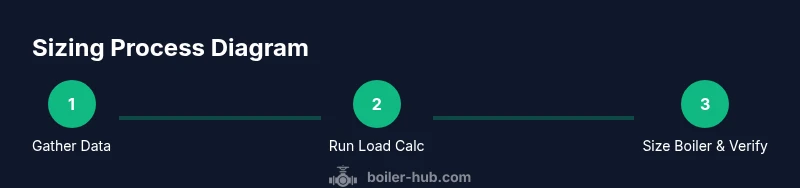
A disciplined sizing workflow keeps errors to a minimum. Start with data collection (house plans, insulation specs, climate data, and floor details). Next, run the design heat-load calculation, then select a boiler with a modulation range that comfortably covers the load, including a safety margin. Finally, verify the results with a basic system balance: check loop flow, pump curves, and expected return temperatures to ensure the boiler can run efficiently at the calculated setpoints. This workflow reduces the risk of oversized boilers that cycle too frequently or undersized units that struggle to meet comfort targets.
Step-by-step calculation example (conceptual)
In this conceptual example, you’ll follow the same steps as a full calculation but without fixed numbers. Start by listing heated zones and their floor types, estimate heat losses per zone, and compute a total design load. Then determine the target floor temperature and estimate the required water temperature to achieve that heat transfer. Select a boiler with a modulation range that spans the resulting load and ensures you can stay within the efficient sub-130°F return temperatures for many radiant floors. The key is to document all assumptions and verify that the chosen boiler can handle variations in weather and occupancy.
Verification, commissioning, and long-term considerations
After installation, commissioning confirms that calculated estimates translate into real-world comfort. Verify setpoints with live measurements, install proper sensors near representative zones, and test under loading conditions (cool mornings, warm afternoons). Track energy use and comfort reports for the first season to confirm the design load held and that you did not overshoot. Plan for maintenance and possible future expansion: additional zones, changes to insulation, or a higher-performance floor finishing can alter the load, so keep the sizing data current and aligned with actual performance.
Common pitfalls and quick-checks
Pitfalls to avoid include relying on one-room heuristics, ignoring envelope performance, and selecting a boiler outside the modulation range needed for radiant floors. Quick-checks: confirm floor temperature targets, verify that insulation is continuous, ensure adequate flow and low returning water temperature, and validate that the boiler’s control system can respond to outdoor-temperature changes. Remember that a well-sized system improves comfort and reduces energy use over the long term.
Tools & Materials
- Room-by-room area data sheet(List heated zones with square footage or square meters for accurate zone-based calculations)
- Floor construction details(Subfloor type, insulation thickness, floor finish, and presence of radiant mats or tubing)
- Envelope performance data(R-values and U-values for walls, ceilings, and windows; include door and window types)
- Climate/Outdoor design temperature data(Use local climate data or ASHRAE climate data for the design day)
- Tubing layout plan or manifold map(Document tubing spacing (inches/cm) and loop lengths per zone)
- Calculation tool or spreadsheet(Software or a well-structured spreadsheet for Manual J-equivalent calculations)
- Measuring tools(Tape measure, laser measure for room dimensions; helps with data accuracy)
Steps
Estimated time: 2-3 hours
- 1
Gather building and system data
Collect plans, room dimensions, insulation specs, window types, and the radiant loop layout. This creates the foundation for an accurate load calculation and avoids assumptions that could skew results.
Tip: Have plans and insulation specs on hand; confirm any recent renovations that changed envelope performance. - 2
Define design indoor temperature targets
Set consistent comfort temperatures for living spaces and consider seasonal extremes. Record any occupancy or usage patterns that affect heat loss.
Tip: Document your target indoor temp and the time of day you expect peak loads to occur. - 3
Calculate the design heat load
Use a formal method (Manual J or equivalent) to compute total building heat loss and allocate loads by zone according to floor type and usage.
Tip: Cross-check results with envelope data and floor construction to catch over- or underestimations. - 4
Estimate floor-loop parameters
Determine tubing spacing, loop lengths, and target floor temperatures that will achieve the comfort setpoints without overheating.
Tip: Choose a conservative floor temperature target to avoid oversizing the boiler. - 5
Select boiler type and size range
Choose a modulating, condensing boiler if possible; ensure its modulation covers the planned load with a margin.
Tip: Verify that the boiler can operate efficiently at low return temperatures typical of radiant floors. - 6
Verify return-temperature and balance
Check that the system’s design ensures sufficient heat transfer without excessive return temperatures that reduce efficiency.
Tip: Incorporate a mixing valve or smart controls if needed to maintain optimal return temps. - 7
Document assumptions and produce sizing report
Record all data, calculations, and chosen equipment. Produce a sizing report for project records and future reference.
Tip: Include a safety margin and note any areas where future expansion might occur. - 8
Commission and test
Install sensors and test under load; compare actual floor temperatures to targets and adjust as needed.
Tip: Keep a log of temperatures and energy use during the initial operation period.
Questions & Answers
What is the first step to size a boiler for radiant floor heat?
Begin with a formal heat-load calculation using a recognized method and gather floor and envelope data to establish accurate design requirements.
Start with a formal heat-load calculation and collect floor and envelope data.
How does floor type affect boiler size?
Floor construction and insulation determine heat transfer; better insulation lowers the load, reducing boiler size needs and improving efficiency.
Floor type and insulation shape the boiler size needs.
Can I oversize or undersize a boiler for radiant floor heat?
Yes, both are problematic: oversizing wastes energy and causes cycling, while undersizing results in cold floors. Rely on load calculations and proper margins.
Oversizing wastes energy; undersizing leads to cold floors.
What about zoning and multiple zones?
Zoning lets each area run at the right load, preventing a single boiler from overworking parts of the house or leaving some rooms cold.
Zoning helps match heat to each area’s need.
Is a modulating boiler necessary?
A modulating boiler is typically best for radiant floors because it can adjust output as the load varies and maintain efficiency at low temperatures.
Yes, a modulating boiler is usually best for radiant floors.
Do I need to hire a pro for sizing?
A professional who can perform Manual J calculations and hydronic design reduces risk, ensures code compliance, and aligns with local standards.
A professional helps ensure accurate sizing and code compliance.
Watch Video
Key Points
- Start with a formal heat-load calculation.
- Floor type and insulation drive the required water temperature.
- Choose a modulating, condensing boiler for radiant floors.
- Verify calculations with commissioning tests and sensible margins.