Know If Your Boiler Is Gas or Electric: A Practical Guide
Learn how to determine whether your boiler uses gas or electricity, why fuel type matters for safety and efficiency, and practical steps to confirm the feed without risky guesswork.


This guide helps you determine whether your boiler is gas or electric. You’ll learn common visual cues, how to read the nameplate, and safe steps to confirm the fuel type without risking injury. By the end, you’ll know the fuel source, required safety precautions, and when to involve a professional.
Why knowing the fuel type matters
Knowing whether your boiler runs on gas or electricity matters for safety, maintenance, and efficiency. Fuel type determines replacement parts, venting needs, and service procedures. If you're wondering how to know if my boiler is gas or electric, begin with non-destructive checks you can perform safely. Correctly identifying fuel type helps you evaluate energy costs, schedule the right service, and avoid dangerous mistakes, such as attempting to disconnect gas lines or bypass controls. In many homes, the fuel type is fixed by installation, but mislabeling or aging equipment can blur the distinction. By understanding the basics described here, homeowners and facility managers can make informed decisions and coordinate with qualified technicians when needed. Boiler Hub’s guidance emphasizes safety, accuracy, and practical steps you can take today.
Throughout this article you’ll see references to common signs, official labeling, and simple checks you can perform without removing panels. Always prioritize safety and consult a licensed professional if you encounter gas lines, pressurized equipment, or uncertain labels. This guidance aligns with Boiler Hub Analysis, 2026, and is designed for homeowners and facility managers seeking reliable boiler guidance.
Visual cues and labeling you should look for
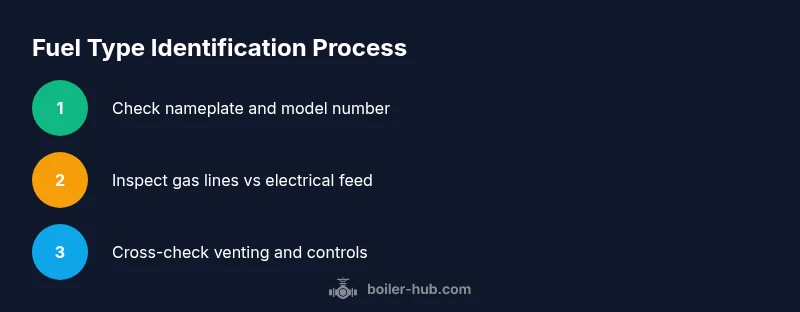
Visual cues are your first, low-risk clue about fuel type. Start by locating the unit’s nameplate or data sticker. Look for terms like “gas-fired,” “natural gas,” “propane,” or a gas utility valve symbol. Electric systems typically show electrical ratings (volts, amps) and components like a heating element or electric boiler controller. In some installations, the unit is labeled with a model number that you can cross-check with the manufacturer’s documentation. If you see a gas supply line entering the cabinet or a shutoff valve, that strongly suggests a gas boiler. If you only see electrical conduit, a heating element, or a transformer, it’s more likely electric. These visual cues are not foolproof, but they give you a solid starting point for the next steps.
Reading the nameplate and equipment markings
The nameplate is your most reliable quick reference. It lists the model number, serial number, and often the fuel type or compatible fuels. Some labels include a schematic showing a burner or heating element. If the label indicates gas, propane, or a gas supply connection, the boiler is gas-fired. If it shows volts, hertz, amperage, or a heating element symbol, the device is electric. Take a photo of the nameplate for future reference, then compare the model number to the manufacturer’s online documentation. When you can match the model to an official spec sheet, you’ll confirm the fuel type with confidence. In ambiguous cases, capture all photos and proceed to the next verification step.
Gas supply lines and shutoff valves
A gas boiler will typically have a gas shutoff valve and a gas supply line entering the unit. Look for a rigid or flexible pipe connected to the boiler with a shutoff valve nearby. The valve handle orientation (perpendicular to the pipe when off) is a common safety cue. If you encounter a gas line but see no valve or the pipe is sealed, treat this as a potential safety issue and do not attempt to operate the system. Never loosen joints or test gas lines by hand. If you smell gas or hear a hiss near the boiler, evacuate the area and contact your gas utility or emergency services. Electric boilers will not have gas lines or shutoff valves; instead, you’ll see electrical connections and possibly a transformer or control panel.
Electrical feed, controls, and power connections
Electric boilers rely on a dedicated electrical supply. Inspect the main power switch or disconnect near the boiler and look for labeling such as 120V/240V, amperage, or a circuit breaker. If you can access a dedicated electrical panel or a control board with settings for heating elements, that’s a strong indicator of an electric boiler. Do not attempt to disassemble electrical components unless you’re qualified. For a gas boiler, you should still be mindful of electrical controls (ignition systems, controls, and safety interlocks), but the primary fuel pathway will be gas. Always use a non-contact voltage tester to verify power status before touching any wiring. Understanding these electrical cues helps you answer the question about fuel type without guessing.
Burner types and venting differences
Gas boilers use a burner assembly and require venting (chimney or direct vent) to expel combustion byproducts. Look for exhaust venting that leads outside, often connected to a flue or pipe system. Electric boilers do not burn fuel and typically do not vent combustion products. They may have sealed enclosures for the heating element and insulation. If you can access the combustion area safely, you may observe a burner or heating coil; however, never perform intrusive inspections. Matching venting characteristics to the fuel type is a reliable differentiator, but venting configurations vary by model and installation. When unsure, rely on the nameplate and model documentation as your primary sources of truth.
How model numbers help confirm fuel type
Model numbers often encode fuel type through specific prefixes or suffixes in the manufacturer’s nomenclature. Cross-reference the model number with the official spec sheet or installation manual. If the document lists “gas-fired” or “electric” in the fuel section, you’ve confirmed the fuel type. If the model is older or undocumented, use the serial number to contact the manufacturer or a professional for confirmation. This step ensures you aren’t relying on color, size, or guesswork, which can be misleading in older installations or refurbished systems.
Safety reminders and best practices for misidentification
If you’re uncertain about the fuel type, do not operate knobs, disconnect switches, or gas lines. Misidentifying a boiler can lead to dangerous outcomes, including gas leaks or electric shock. Always stop work if you encounter unfamiliar components, and call a licensed technician to verify the fuel type and perform any needed services. Keeping a labeled, up-to-date manual and model number record helps reduce uncertainty during future maintenance.
When to call a professional and next steps
If inspection is inconclusive or you cannot safely verify fuel type, contact a licensed plumber or boiler technician. A pro can perform a non-destructive assessment, confirm fuel type, and complete any necessary service with proper permits. After confirmation, update your home records with the fuel type, service schedules, and emergency contacts. Regular professional checks are especially important in older homes where fuel sources may have changed over time.
Tools & Materials
- Flashlight(Shine into tight boiler cabinets and cabinet doors)
- Owner’s manual or model sticker(If missing, photograph the unit and any exposed labels)
- Non-contact voltage tester(Verify power status before touching wires)
- Screwdriver set(Dip into crevices if panels are secured with screws)
- Gas leak detector solution (soapy water) or approved detector(Use only if you are trained; do not attempt leaks yourself)
- Camera or smartphone(Document labels and model numbers for lookup)
- Work gloves and eye protection(Protect hands and eyes during inspection)
Steps
Estimated time: 30-60 minutes
- 1
Identify the boiler and locate the nameplate
Begin by locating the boiler unit and opening any access panels. Look for a nameplate or data sticker on the side, back, or inside the cabinet door. Record the model and serial numbers and take clear photos for later reference.
Tip: Having photos of every label helps you cross-check with online manuals without needing to return to the unit. - 2
Check for a visible gas line or shutoff valve
Examine the area around the boiler for a gas supply line and a shutoff valve. If a pipe enters with a valve that you can turn perpendicular to the pipe, that’s a strong sign of gas fuel. If you do not see a gas line, proceed with other checks.
Tip: Do not turn any valves or disconnect fittings unless you are trained and it’s safe to do so. - 3
Inspect electrical feed and controls
Look for electrical conduits, a control board, or a power switch/disconnect near the boiler. Electric boilers often present clear electrical ratings (voltage, amps) on a panel or label. Use a non-contact tester to ensure power is off before touching any wiring.
Tip: If you see a dedicated breaker or transformer, you’re likely dealing with an electric unit. - 4
Look for a burner or heating element
Gas boilers have a burner assembly and combustion chamber, while electric boilers contain heating elements or coils. Do not open the combustion chamber unless you’re trained; observe only what’s safely accessible.
Tip: Burner and vent configurations are strong differentiators but require caution; defer to professionals for any internal inspection. - 5
Cross-check model numbers with documentation
Use the model and serial numbers to locate the official spec sheet or installation manual online. Look for explicit fuel type references such as 'gas-fired' or 'electric.'
Tip: If the model is older, contact the manufacturer with the numbers for a definitive answer. - 6
Check venting and exhaust arrangements
Gas boilers vent exhaust gases outside via a flue or vent pipe. Electric boilers do not require combustion venting. Observe the vent path if accessible, but avoid disturbing any gas connections.
Tip: Venting arrangement can be model-specific; use fuel type as the primary guide when available. - 7
Document your findings
Compile notes on nameplate data, fuel cues, and any model lookups. Create a simple log that can be shared with future technicians.
Tip: A documented log saves time and reduces uncertainty during maintenance or replacement. - 8
If uncertain, call a professional
When fuel type remains unclear or you encounter gas lines, avoid any risky actions. A licensed technician can confirm the fuel type non-invasively and perform necessary work safely.
Tip: Professional confirmation prevents dangerous mistakes and ensures correct service.
Questions & Answers
What should I do first if I’m unsure whether my boiler is gas or electric?
Start with the nameplate and visible labels. Check for a gas line or electrical supply, then cross-check the model number with the manufacturer’s documentation. If uncertainty remains, stop and contact a licensed professional.
Begin with the nameplate, look for gas lines or electrical wiring, and verify the model with the manufacturer. If still unsure, call a licensed technician.
Can a boiler run on both gas and electricity?
Most boilers are designed for a single fuel type. Dual-fuel configurations exist in specialized setups, but they require specific components and commissioning. Always confirm the fuel type before attempting service or replacement.
Most boilers use one fuel type. Dual-fuel systems are rare and require professional verification.
Why is it important to identify the fuel type correctly?
Correctly identifying fuel type ensures proper maintenance, safe operation, and accurate energy-cost assessments. It also guides the installation of the right venting, controls, and safety measures.
Fuel type matters for safety, maintenance, and efficiency.
What if the nameplate is missing or unreadable?
If the nameplate is missing, use the model number and serial number to contact the manufacturer or a licensed technician for verification. Do not rely on appearance or guesswork.
No nameplate? Use the model numbers to contact the manufacturer or a professional.
Are there safety signs that indicate gas vs electric?
Gas systems will show gas piping, shutoff valves, and venting. Electric systems show electrical components and wiring. If you detect gas odor or hissing, evacuate and contact the utility.
Gas signs include piping and shutoffs; electric signs show wiring. If you smell gas, leave the area.
Watch Video
Key Points
- Identify fuel type from the nameplate first.
- Gas and electric boilers have distinct components and venting.
- Never bypass safety devices or fuel lines; call a professional if unsure.
- Document fuel type and model details for future maintenance.