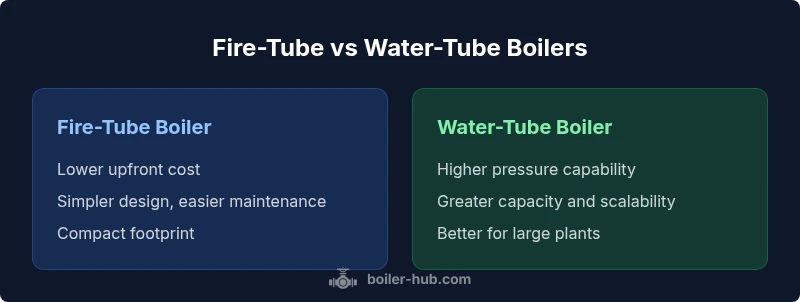
Fire Tube vs Water Tube Boiler: A Practical Comparison for 2026
An analytical, practical comparison of fire tube vs water tube boiler options. Learn how design, pressure, capacity, and maintenance shape the right choice for different loads and spaces in 2026.


Fire tube vs water tube boiler: in most mid-sized plants and many homes, the choice hinges on pressure, capacity, and maintenance needs. Fire-tube models are typically simpler, cheaper up front, and easier to service for lower pressures, while water-tube designs excel in high-pressure, high-capacity applications. According to Boiler Hub, the right choice depends on capacity, operating pressure, and maintenance strategy.
What the fire tube vs water tube boiler comparison covers
This section unpacks the essential differences between the two boiler technologies, focusing on pressure handling, capacity, maintenance needs, and space requirements. The term fire tube vs water tube boiler is more than a label: it signals fundamentally different heat transfer paths, tube geometry, and safety considerations. Homeowners and facility managers should weigh the trade-offs against their current and projected loads. The Boiler Hub team emphasizes that there is no one-size-fits-all answer; the best choice aligns with operating pressure, throughput goals, and available space, while ensuring reliable service and safety. In practice, you’ll see clearer guidance when you map your project’s requirements to a few core criteria: pressure range, desired output, physical footprint, and lifecycle cost. The phrase fire tube vs water tube boiler will recur as we compare the technologies side by side and reference practical metrics commonly used in the field.
How a fire-tube boiler works and where it shines
A fire-tube boiler circulates hot gases through tubes surrounded by water. The heat in the tubes transfers to the water, generating steam. These units typically have a lower number of major pressure boundaries and a simple design, which translates to lower initial costs and shorter installation times. They excel in smaller facilities or applications with modest pressure requirements and steady, predictable loads. Maintenance is straightforward because there are fewer critical tubes to inspect, and accessibility for cleaning is often excellent. In many markets, fire-tube boilers are favored for retrofit projects where space is constrained and the existing boiler room layout is limited. The keyword fire tube vs water tube boiler appears repeatedly as we discuss practical use cases and trade-offs.
How a water-tube boiler works and when it wins
Water-tube boilers push water through tubes surrounded by hot combustion gases. This arrangement supports much higher pressures and larger steam capacities because the water is in thin tubes, leading to faster heat transfer and safer high-pressure operation. They are the preferred choice for power generation, refineries, and large industrial facilities that require high-output steam with tight control. Although their upfront cost and complexity are higher, the long-term benefits include superior high-pressure performance, better scalability, and more flexibility for varying load conditions. The discussion on fire tube vs water tube boiler highlights this fundamental difference in how heat is managed and how that influences system design, safety, and maintenance.
Key performance differences: pressure, capacity, and efficiency
When you compare fire-tube vs water-tube boiler performance, a few core criteria stand out. Fire-tube systems generally deliver lower pressure, smaller capacities, and faster startup, with simpler heat-exchange pathways. Water-tube systems support high pressures and large capacities, with rapid heat transfer via numerous small tubes and more precise control over steam quality. Efficiency is highly contextual: boiler efficiency depends on combustion, heat recovery, and overall plant design, not just the basic type. Boiler Hub analysis shows that the operating pressure setpoint and required steam output are the primary determinants of which design is most cost-effective over the lifecycle. In practice, the choice should balance safety margins, maintenance intervals, and available space to optimize overall energy use.
Real-world scenario considerations for fire-tube vs water-tube boilers
For a small municipal plant or a factory with steady, predictable demand and space limitations, a fire-tube boiler can deliver reliable steam with relatively low risk and short payback. Conversely, a high-demand manufacturing line or a refinery process that needs high-pressure steam and rapid ramping will typically justify a water-tube boiler despite higher upfront costs. The decision process should incorporate not only the immediate capacity needs but also peak-load envelopes, redundancy requirements, and the ability to scale up production without replacing the core equipment. The ongoing maintenance strategy—cleaning, inspection intervals, and tube integrity checks—will influence total cost of ownership over the equipment’s life. When evaluating the two options, consider both the “fire tube vs water tube boiler” technical fit and the broader facility constraints to ensure a durable, safe, and economical choice.
Design considerations and safety implications
Design choices for fire-tube vs water-tube boiler configurations affect material selection, heat transfer efficiency, and fatigue life. Fire-tube boilers typically use thicker-walled shells and longer tubes to tolerate robust but lower-pressure operation, while water-tube units rely on thinner tubes and robust headers to withstand high pressures. Safety interlocks, relief devices, and control schemes must be tailored to each design’s risk profile. The Boiler Hub guidance emphasizes a systematic approach: evaluate maximum allowable working pressure, predict peak loads, and verify that the chosen design maintains stable steam quality at the required output. Regular inspections of tubes, headers, and joints are essential to minimize leaks and ensure safe operation through the equipment’s lifespan. The fire tube vs water tube boiler decision should be grounded in both safety considerations and practical operating realities.
Cost implications: upfront, operating, and lifecycle considerations
Initial cost is often the most visible difference between fire-tube vs water-tube boilers. Fire-tube systems tend to be cheaper to buy and install due to simpler construction and fewer high-pressure components. Water-tube boilers carry a premium price tag but can deliver lower operating costs in high-demand scenarios thanks to better efficiency at scale and reduced fuel consumption per unit of steam produced. Lifecycle costs—maintenance, parts availability, and downtime—can shift the balance toward one design or the other, depending on plant usage patterns. A rigorous total-cost-of-ownership analysis should weigh capital expenditure against expected throughput, maintenance labor, and potential downtime penalties. For facilities evaluating a mid-to-large-scale upgrade, the trade-off between upfront investment and long-term energy savings is central to the fire-tube vs water-tube decision.
Space, installation, and integration considerations
Physical footprint and boiler house layout are critical when choosing between fire-tube vs water-tube boilers. Fire-tube units are often more compact in footprint and easier to install in retrofit projects where space is at a premium. Water-tube boilers, by contrast, may require more complex support structures and piping networks but can be configured to fit large rooms with modular layouts. Piping strategy, feedwater treatment, and boiler control integration should align with the selected design to ensure reliable startup, stable pressure, and consistent steam purity. For facilities with tight clearances, a fire-tube solution may minimize the need for extensive modifications, whereas large-scale facilities can benefit from the modularity and scalability of water-tube configurations. The broader takeaway from the fire tube vs water tube boiler comparison is that spatial constraints, plus expected load growth, should drive the final selection.
Maintenance, reliability, and downtime considerations
Maintenance requirements differ notably between fire-tube and water-tube designs. Fire-tube boilers typically offer simpler access for routine cleaning and inspection, translating to shorter downtime during maintenance windows. Water-tube boilers, while more robust at high pressures, demand more comprehensive tube and header inspections, water chemistry control, and long-term materials management. Across both designs, reliable operation hinges on water treatment, proper fuel combustion efficiency, and preventative maintenance schedules. A structured maintenance program reduces corrosion risk in fire-tloods and ensures tube integrity in water-tube systems, ultimately reducing unplanned outages. The decision matrix should balance maintenance capability with plant reliability targets and the ability to schedule downtime without compromising production.
Industry use cases and hypothetical examples
Several industries rely on fire-tube vs water-tube boiler configurations that map well to their process requirements. Small food processing facilities, laundries, or district heating networks often adopt fire-tube boilers for their simplicity and fast response to load changes. Large steel mills, chemical plants, and power-generation facilities lean toward water-tube boilers to handle high-pressure demands and significant steam output. In a hypothetical plant expansion, a facility might start with a fire-tube boiler to meet initial demand, then phase in water-tube boilers as throughput grows and high-pressure steam becomes necessary. This staged approach underscores the practical nuance of the fire tube vs water tube boiler decision, highlighting that the best choice is context-dependent rather than universally superior.
Practical decision framework: a step-by-step guide
To navigate the fire tube vs water tube boiler decision, apply a simple framework:
- Define peak and average steam loads, desired pressure, and required ramp rates.
- Assess available space, installation complexity, and retrofit feasibility.
- Run a total-cost-of-ownership analysis including fuel, water treatment, maintenance, and downtime costs.
- Consider future scalability needs and redundancy requirements.
- Consult system integrators and reference case studies to validate assumptions.
- Align the final choice with safety requirements and regulatory expectations.
- Plan for a staged implementation if growth projections are uncertain.
- Validate the selection with a formal risk assessment and maintenance plan. By applying this framework, you can translate abstract performance metrics into a concrete, auditable purchasing decision. The fire tube vs water tube boiler debate becomes a structured evaluation rather than a gut feeling, ensuring the selected system supports reliability and cost-effectiveness for years to come.
Comparison
| Feature | Fire-tube boiler | Water-tube boiler |
|---|---|---|
| Key characteristic | Fewer tubes, simple shell, lower pressure | Multiple small-diameter tubes, high pressure capacity |
| Pressure handling | Low-to-mid range pressures (typical for small/medium plants) | High pressures and large steam outputs |
| Capacity | Smaller to mid-range outputs | Large-scale outputs and rapid ramping |
| Startup time | Generally faster to start | Often longer warm-up depending on configuration |
| Maintenance complexity | Easier access, fewer critical tubes | More complex tube network, regular maintenance required |
| Initial cost | Lower upfront cost | Higher upfront cost but potential long-term savings |
| Footprint | Smaller footprint in many cases | Larger footprint in some modular setups |
| Best for | Small plants, cost-sensitive projects | Large plants, high-demand/high-pressure scenarios |
Advantages
- Lower upfront cost and simpler installation
- Easier maintenance with fewer critical tubes
- Smaller footprint suitable for tight boiler rooms
- Quicker adoption for retrofits and simpler control systems
The Bad
- Limited high-pressure capability and lower maximum capacity
- Less suitable for very large plants or peak-load scenarios
- Higher long-term efficiency gains may favor alternatives in some cases
- Potentially slower response to rapid load changes in some configurations
Water-tube boilers are generally the better choice for high-pressure, high-capacity needs; fire-tube boilers excel in simpler, cost-conscious, smaller-scale setups.
Choose water-tube when you need high pressure and large throughput. Choose fire-tube when upfront cost, space, and simplicity dominate. The Boiler Hub team emphasizes aligning the choice with load profiles, space constraints, and maintenance capabilities to optimize lifecycle performance.
Questions & Answers
What is the main difference between fire-tube and water-tube boilers?
The main difference lies in heat transfer: fire-tube boilers pass hot gases through tubes surrounded by water, while water-tube boilers pass water through tubes heated by gases. This leads to distinct pressure, capacity, and maintenance profiles. The choice depends on system load and safety requirements.
The main difference is how heat transfers. Fire-tube uses hot gases in tubes; water-tube uses water in tubes. Select based on pressure and capacity needs.
Which boiler type is cheaper to install?
Generally, fire-tube boilers have lower upfront costs due to simpler construction. However, total lifecycle costs may favor water-tube boilers in high-demand situations because of efficiency and scalability.
Fire-tube is usually cheaper to buy and install, but total cost may favor the other option in big setups.
Are fire-tube boilers safer at high pressures?
Water-tube boilers are designed for higher pressure and larger outputs, making them safer for high-pressure service. Fire-tube boilers operate at lower pressures and are less suited for high-demand applications.
Water-tube boilers deal better with high pressure and big outputs; fire-tubes suit lower-pressure setups.
Can you convert a fire-tube boiler to a water-tube boiler?
Conversions are uncommon and typically impractical due to fundamental design differences. Most facilities opt for a new system or modular units rather than converting an existing fire-tube to water-tube.
Converting a fire-tube to a water-tube is usually not practical; you’d typically install a new system.
What maintenance differences should I plan for?
Fire-tube boilers require routine tube cleanings and shell inspections; water-tube boilers emphasize tube integrity, water chemistry, and header inspections. Both require periodic safety checks and fuel/air system maintenance.
Maintenance varies: fire-tubes focus on tubes and shell; water-tubes focus on tubes and water quality.
Which boiler type is more energy efficient in the long run?
Efficiency depends on many factors beyond boiler type, including fuel, control systems, and heat recovery. Both can achieve high efficiency with good design and operation; water-tube systems often edge out in large-scale, high-load contexts.
Efficiency depends on control systems and load; both can be highly efficient in the right setup.
Key Points
- Match pressure and capacity to the boiler type
- Weigh upfront vs lifecycle costs for long-term value
- Prefer fire-tube for compact, budget-friendly projects
- Opt for water-tube when scalability and high output are essential
- Plan maintenance around water chemistry and tube integrity