Most Efficient Boiler: Choosing, Installing, and Maintaining High-Efficiency Heating
Explore how condensing boilers, modular controls, and proper installation maximize efficiency. A data-driven guide for homeowners and facility managers seeking reliable boiler guidance in 2026.


The most efficient boilers today are condensing gas boilers with modulating burners, typically delivering 90-98% AFUE. These units recover latent heat from flue gases and adapt output to demand. For maximum efficiency, ensure proper sizing, professional installation, and regular maintenance. Weather-compensation controls and smart thermostats further boost performance. In some homes, floor and radiator design also affects overall efficiency.
What 'most efficient' means for boilers
In everyday terms, efficiency describes how effectively a boiler converts fuel into usable heat. For boilers, the standard metric is AFUE (annual fuel utilization efficiency). A higher AFUE means less wasted energy. In practical terms, the most efficient boilers today are condensing models with modulating burners that continuously adjust output to match the building load, minimizing fluctuations and heat loss. While older, non-condensing units might show AFUE in the 60-80% range, modern condensing systems routinely reach the mid-to-upper 90s in typical residential installations. The result is better comfort with lower energy bills, especially in cold climates where heating demand is persistent. Remember that real-world performance depends on proper sizing, ductwork/radiator design, thermostat placement, and how well the system is integrated with your home's controls. Boiler Hub analyses from 2026 show that the efficiency gains from upgrading to a condensing, modulating boiler can be substantial over a decade, particularly when paired with weather-responsive controls and regular maintenance.
Condensing technology: Why it's the baseline for efficiency
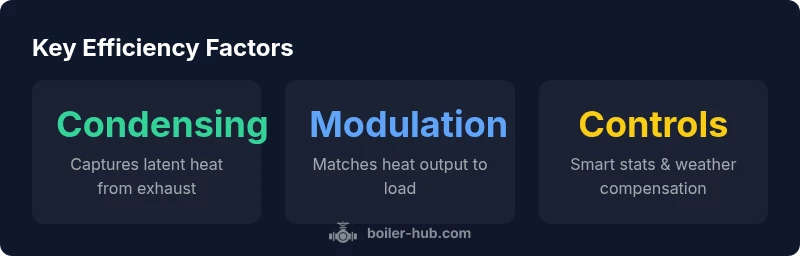
Condensing boilers recover additional heat by cooling exhaust flue gases to the point of condensation, capturing latent heat that would otherwise be vented. This architectural shift dramatically improves efficiency compared with non-condensing designs. In practical terms, a condensing boiler can achieve AFUE values well into the 90s, with some high-end models approaching 98% in ideal conditions. However, achieving that upper range requires proper installation, a compatible venting system, and working at appropriate return water temperatures. Condensing performance is also sensitive to climate and heating system design; older radiators, poor insulation, and undersized circulators can mask the potential gains. For facility managers, this means evaluating the whole system: boiler, piping, and building envelope. The Boiler Hub Team notes that the most meaningful improvements come from combining condensing technology with robust controls and well-sealed, well-insulated spaces.
Modulating burners and control strategies
Modulating burners continuously adjust flame size to meet the fluctuating heat load, rather than turning on a fixed-high output and then modulating down. This approach reduces cycling losses, minimizes temperature swings, and lowers fuel use over the course of a year. When combined with outdoor reset controls, indoor sensors, and smart thermostats, modulating boilers can deliver steadier comfort and higher average efficiency. The key is proper calibration: the boiler must be sized for the building's peak load, yet have the ability to operate at low-output ranges most of the time. Many boilers also support weather compensation, which tweaks the setpoint based on outdoor temperatures, further optimizing energy use. In practice, homeowners and facility managers should look for models with wide modulation ranges (e.g., 5:1 or greater) and compatible integration with control platforms.
Sizing, installation, and system integration
Efficiency is a system property, not just a boiler specification. An oversized boiler will short-cycle, wasting fuel and increasing wear, while an undersized unit will run at full tilt to meet demand, also wasting energy. A professional heat-load calculation is essential, followed by selecting a boiler with an efficient modulation ratio and a compatible circulation pump, valves, and piping layout. System integration includes compatible storage, if used, and compatibility with existing buffers or mixing valves. For retrofits, it's important to assess the entire heating system: water temperature targets, radiator or underfloor heating design, and the potential need for a buffer tank. Boiler Hub's guidance emphasizes that even the most efficient boiler cannot perform at peak efficiency without a well-designed distribution system and properly sealed building envelope.
Thermostats, zoning and weather compensation
Smart thermostats and zoning can dramatically improve real-world efficiency by reducing heat delivery where it is unnecessary or temporarily unnecessary. Zoning allows different parts of a building to operate at different temperatures, while weather compensation adjusts boiler output based on outdoor conditions. Together, these controls enable the boiler to maintain comfortable indoor temperatures with minimal energy use. When shopping, look for compatibility with open protocols (like MQTT or standard APIs) to enable data-driven optimization. In addition, consider floor-slab heating compatibility, which often runs at lower water temperatures and can produce significant efficiency gains when paired with a high-efficiency boiler.
Maintenance practices to sustain high efficiency
Even the best boiler loses efficiency without regular maintenance. Schedule an annual professional service to inspect gas pressures, venting, heat exchangers, and burner settings. Clean or replace filters, verify insulation on piping, and check for leaks in the system or in the building envelope. Regularly bleeding radiators in hot-water systems and balancing the circulation can improve heat delivery and reduce energy waste. Maintenance also includes monitoring fuel bills and performance indicators; if efficiency declines, a service call should be scheduled to diagnose potential issues such as slugging, scale buildup, or corrosion in the heat exchanger.
Real-world ROI: ROI, case studies and budget considerations
In real homes and facilities, the ROI of upgrading to a most efficient boiler depends on climate, fuel prices, and usage patterns. In moderate to cold climates with high heating demand, the payback period for a condensing, modulating boiler can be several years, after which annual savings accrue. For facilities, the economics may include labor savings, longer equipment life, and reduced emergency repair costs. The total cost of ownership should include installation, controls, and building envelope improvements. Boiler Hub's analysis suggests that combining a high-efficiency boiler with weather-responsive controls, proper insulation, and a well-sealed building envelope yields the strongest ROI over a 10- to 15-year horizon. When evaluating options, demand professional guidance to ensure compatibility with existing systems and to avoid oversizing.
Policy, incentives and choosing the right installer
Many jurisdictions offer rebates or tax incentives for high-efficiency boilers or sustainable heating upgrades. Before purchasing, check utility programs, government grants, and local rebates, as these incentives can significantly reduce the upfront cost. Also, verify installer qualifications, manufacturer warranty terms, and post-installation service options. A professional, reputable installer will perform a detailed load assessment, ensure proper venting, and set up the right controls for your home or facility. The investment in a most efficient boiler is not just the device; it is a system upgrade that produces cumulative comfort and cost savings over time.
Efficiency by boiler type
| Boiler Type | Typical AFUE | Common Fuel | Notes |
|---|---|---|---|
| Condensing gas boiler | 90-98% AFUE | Gas | Captures latent heat from exhaust; most efficient option in homes with gas supply |
| Non-condensing gas boiler | 70-85% AFUE | Gas | Lower efficiency; may be restricted in new installs |
| Oil boiler (condensing) | 85-95% AFUE | Oil | Good where gas isn't available; higher fuel price varies by region |
| Electric boiler | 99%+ efficiency | Electric | Depends on electricity source; higher operating cost in many markets |
Questions & Answers
What defines the 'most efficient' boiler?
Efficiency is measured by AFUE for boilers; condensing boilers recover heat from exhaust, and high AFUE values indicate less energy wasted. Real-world performance also depends on installation quality and system matching.
Efficiency is the share of fuel energy turned into heat; condensing boilers recover latent heat. Look for high AFUE ratings and proper installation.
Is a condensing boiler worth the installation cost?
In most homes with reliable gas supply, the energy savings typically justify the higher upfront cost over the lifecycle of the boiler, especially in colder climates or high-use settings.
Yes—condensing boilers typically pay back over time with lower fuel bills when paired with good controls.
Do all homes qualify for the most efficient boiler?
Not every home; space for installation, venting constraints, and fuel availability influence which high-efficiency model is suitable.
Not every home can install a condensing boiler; availability of gas and space matters.
How can I improve boiler efficiency without replacing it?
Regular professional maintenance, weather-based controls, smart thermostats, and zone controls can raise efficiency of existing boilers.
Maintenance and good controls can boost efficiency without a full replacement.
What maintenance schedule is recommended for high-efficiency boilers?
Schedule an annual professional service; check ventilation, gas pressures, and insulation; keep heat exchangers clean.
Annual servicing helps keep the system efficient and safe.
Are there rebates for high-efficiency boilers?
Many regions offer incentives; check local utility programs and government grants for high-efficiency boiler installations.
Yes, there are often rebates or incentives available.
“High-efficiency boilers are not a single device but a system upgrade: condensing technology, smart controls, and precise installation work together to deliver real energy savings.”
Key Points
- Choose condensing boilers with modulating burners for best efficiency.
- Pair with smart controls and weather compensation to maximize savings.
- Accurate sizing and professional installation are essential.
- Regular maintenance sustains high efficiency and prevents heat loss.
- Check local rebates and regulations to maximize ROI.