Electric Boiler Cost: A Practical Guide for Homeowners and Managers
A practical guide to electric boiler cost, covering installation, running costs, and cost-saving strategies. Boiler Hub analyzes size, efficiency, and electricity rates to help homeowners estimate total bills and plan smarter.


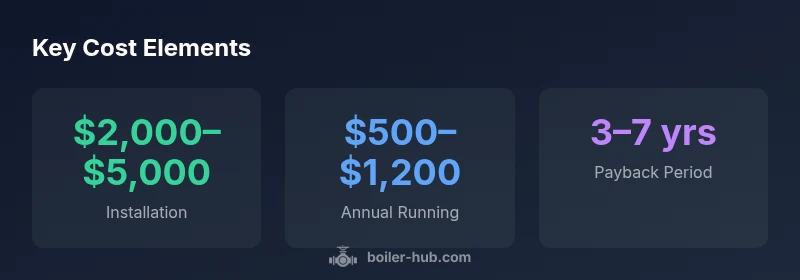
Electric boiler cost ranges widely, but a practical starting point is: installation typically $2,000–$5,000 and annual running costs around $500–$1,200, depending on usage and local electricity rates. This quick snapshot helps homeowners estimate total bills, and, as Boiler Hub notes, sizing and efficiency matter most for long-term costs.
Why electric boilers can be a cost-effective choice for certain properties
Electric boilers offer a compact, low-maintenance heating option that can reduce upfront complexity in homes without gas supply. In many climates, they pair well with well-insulated spaces and low water heating loads. The key cost takeaway is that while the upfront price can be higher than some gas options, long-term running costs depend on electricity prices, usage patterns, and your boiler’s efficiency. According to Boiler Hub, sizing and efficiency matter most for minimizing the total electric boiler cost over time.
- Pros: quick installation in some scenarios, modular sizing, fewer combustion risks.
- Cons: running costs can be higher if electricity prices rise or if the system is oversized.
Cost breakdown: upfront versus ongoing expenses
Understanding the cost split helps you plan cash flow. The main upfront expense is the boiler unit plus installation and any electrical upgrades to support the load. Ongoing costs include electricity consumption, potential maintenance, and occasional service checks. For many homes, the upfront price ranges from $2,000 to $5,000, while annual operating costs fall in the $500 to $1,200 band, heavily influenced by local electricity rates and how you use the system.
Tips to curb upfront costs: compare quotes, consider a basic model with future upgrade options, and ensure the electrical panel can handle the load.
Factors that drive total cost: size, efficiency, and electricity rates
The unit size (kW) determines both purchase price and heat output. A larger boiler can heat spaces faster but may waste energy if oversized for your home. Efficiency ratings (Seasonal Efficiency) influence running costs; higher efficiency reduces electricity use but may cost more upfront. Local electricity prices and your heating demand are critical: a cold climate with high rates will push running costs upward. Boiler Hub Analysis, 2026, emphasizes matching the boiler to your actual needs to minimize the electric boiler cost over its life.
Other considerations: locate the unit close to the heating distribution system to avoid long pipe runs and heat losses.
Sizing and efficiency: how to optimize your electricity bill
Accurate sizing is essential to avoid an under- or oversized system. A typical 2–3 bedroom home or small apartment often uses a 6–12 kW electric boiler, but this varies with insulation, floor area, and heat load. Invest in good insulation, weather stripping, and a smart thermostat to reduce peak demand. High-efficiency models reduce running costs, but the incremental gains taper off if you still have large heat losses elsewhere in the home.
Practical step: obtain a heat-loss calculation from a qualified installer to determine the right size and efficiency class for your property.
Practical strategies to reduce electric boiler costs
- Improve insulation and air sealing to reduce heat loss.
- Install a programmable thermostat and zone controls to heat only where needed.
- Schedule regular maintenance to keep the system running at peak efficiency.
- Compare electricity tariffs or time-of-use plans to shift usage to off-peak periods.
- Consider hybrid approaches or alternative heat sources for peak demand days, if local options exist.
Boiler Hub recommends running a cost-benefit analysis for any upgrade, factoring in both upfront and ongoing costs.
How to estimate your total electric boiler cost: a simple calculation and example
Follow these steps to estimate total cost over the first five years:
- Determine installed price (unit + installation) within the $2,000–$5,000 range.
- Estimate annual running costs based on local kWh price and your expected heat load (use $0.12–$0.25 per kWh as a rough guide).
- Add maintenance allowances (e.g., $50–$150 per year).
- Multiply yearly running costs by five and add upfront costs to get a rough five-year total.
Example: If you install a mid-range 8 kW unit at $3,500 with $800/year running costs and $100/year maintenance, five-year total is about $7,000–$8,000, depending on electricity prices. Use a professional quote for precise figures.
Cost reference for electric boiler implementation
| Cost Component | Typical Range | Notes |
|---|---|---|
| Installation cost | $2,000–$5,000 | All-in price incl. basic electrical work |
| Annual running cost | $500–$1,200 | Depends on electricity price and usage |
| Payback period | 3–7 years | Based on typical heating load and rate changes |
Questions & Answers
Is an electric boiler cheaper to install than a gas boiler?
Electric boilers often have lower installation costs because they don't require venting or fuel lines, but running costs depend on electricity rates. A professional quote will reveal the exact difference for your home.
Electric boilers generally cost less to install than gas boilers, but long-term costs depend on local electricity prices.
What size electric boiler do I need for a small home?
Common ranges are 6–12 kW for typical small homes; a heat-load calculation is essential to avoid under- or oversizing and to minimize costs.
For a small home, a 6 to 12 kilowatt boiler is common; get a heat-load calculation.
Can I replace a gas boiler with an electric model?
Yes, but the electrical service capacity may need upgrades; plan for wiring, panel capacity, and space considerations with a qualified installer.
Yes, but you may need electrical upgrades and careful planning.
Do incentives or rebates apply to electric boilers?
Some regions offer energy efficiency incentives; check local programs and utility plans for potential rebates or credits.
There may be rebates depending on your location.
Are electric boilers suitable with radiators or underfloor heating?
Electric boilers can power radiators or underfloor heating, but flow temperatures and controls matter for efficiency and comfort.
They can work with radiators or underfloor heating if sized correctly.
“When sized correctly and paired with good insulation, electric boilers can be a cost-effective option, but total cost hinges on electricity prices and usage patterns.”
Key Points
- Expect upfront installation costs in the $2,000–$5,000 range.
- Plan for annual running costs of $500–$1,200, depending on rates.
- Size and efficiency drive long-term bills; don’t oversize.
- Improve insulation to lower total cost and energy use.
- Use smart controls to shift usage to off-peak periods.