Crown Boiler Prices: Costs, Quotes, and What Affects Them
Explore Crown boiler prices, what drives total costs, and how to compare quotes. Practical guidance on price factors, ownership costs, and saving tips for 2026 installations.


Crown boiler prices vary widely by model, installation, and region. According to Boiler Hub Analysis, 2026, most homeowners see quotes that depend on boiler size, efficiency rating, and labor needs. For a clear starting point, expect total installed costs to differ from simple unit prices, and always obtain multiple quotes to compare gear, labor, and permits.
Crown Boiler Prices: A Practical Overview
Crown boiler prices are not a single figure you can memorize. They depend on the model you choose, its efficiency, and how your home is wired, vented, and zoned. Historically, homeowners have faced a gap between the sticker price of a unit and the installed cost, once labor, venting, and permits are added. In 2026, the Boiler Hub Team notes that regional labor markets and permitting requirements further shape final quotes. For homeowners and facility managers, understanding the split between equipment cost and installation cost is essential to avoid sticker shock at the cart or invoice stage.
Key Price Drivers Affecting Crown Boiler Costs
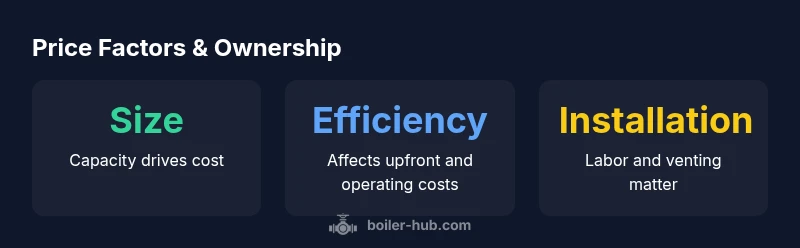
Several core factors determine the final price tag for Crown boilers. System size and output must align with your home’s heating load, which influences the unit’s required capacity. Efficiency, typically reflected in AFUE ratings, drives both upfront cost and long-term operating costs. Higher-efficiency, condensing models cost more initially but can lower annual energy bills. Fuel type (gas vs. oil) also shifts price and compatibility with your existing infrastructure. Installation complexity—such as ductwork modification, venting runs, and the need for an expansion tank or silica-based water treatment—can add to labor charges. Finally, regional permitting, inspection fees, and warranty terms subtly tilt overall expenditure. Boiler Hub’s analysis emphasizes collecting written quotes that itemize equipment, labor, and permits so you can compare apples to apples.
Price Tiers by Crown Boiler Series (Qualitative)
In practice, Crown offers a spectrum of options from compact, space-saving units to premium, high-efficiency condensing models. The price gaps typically reflect capacity, efficiency, and accessory hardware (like smart controls and zoning). A smaller, standard-efficiency model may be paired with basic controls and straightforward venting, while larger, high-efficiency units often require more robust venting solutions and advanced controls. When evaluating tiers, focus on how the equipment’s annual fuel use and service needs align with your home’s climate and occupancy. Boiler Hub notes that the smartest choice balances upfront cost with projected energy savings and reliable service.
Total Cost of Ownership Beyond the Sticker Price
Beyond the initial price, total cost of ownership includes installation labor, venting, piping, permits, and any required upgrades to the existing heating system. Elevated efficiency can reduce operating costs, offsetting higher upfront costs over time. Maintenance plans and local service availability are important; a low-cost installation is not a bargain if parts or service are scarce. Consider necessary add-ons such as expansion tanks, water treatment, and smart thermostats that can enhance performance and comfort. A thorough evaluation should project 5- to 10-year ownership costs to give a realistic view of value.
How to Get Accurate Crown Boiler Cost Estimates
The surest way to apply Crown boiler prices to your situation is a formal site survey followed by written, itemized quotes. Ask for a breakdown that separates equipment, labor, venting, permits, and any required modifications to the ductwork or boiler room. Compare apples to apples by ensuring each quote specifies the same model, efficiency level, and installed components. In addition, verify warranty terms and service expectations. Boiler Hub recommends negotiating bundled services (e.g., controls and zoning) to maximize long-term savings and ensure adequate coverage for maintenance.
Practical Steps to Take Before Purchasing
Before committing, gather at least three written quotes and compare the included components, warranties, and service commitments. Verify that the proposed unit matches the home’s heating load and climate requirements, and check for energy-saving features that align with long-term costs. Ask your installer to explain any hidden costs, such as flushing, refrigerants, or code upgrades. Finally, consider financing options or seasonal promotions that might soften upfront costs without compromising quality or safety.
Common Mistakes to Avoid
Avoid choosing a provider based solely on the lowest price. Cheaper quotes may omit essential components or long-term maintenance. Overlooking the installation quality, venting compatibility, and future service options can lead to poor performance or costly repairs. Also, be cautious of quotes that underestimate the size needed for your home, which can compromise comfort and efficiency.
Qualitative cost tiers for Crown boiler installations
| Model Type | Typical Installed Cost | Notes |
|---|---|---|
| Compact/Small-Capacity Crown boiler | varies by installation | Best for small spaces; consult energy ratings |
| Mid-range Crown boiler | varies by region | Energy savings may offset initial costs over time |
| Premium condensing model | varies by installation | Higher efficiency but installation complexity |
Questions & Answers
What factors influence Crown boiler prices?
Crown boiler prices are affected by boiler size, efficiency rating (AFUE), fuel type, warranty, and installation complexity. Regional labor costs and permit fees also play a role. Getting multiple, written quotes helps you compare apples to apples.
Prices depend on size, efficiency, and installation, plus regional costs. Get several quotes to compare.
Are Crown boilers worth the investment?
Crown boilers can offer strong energy efficiency and reliable performance, which lowers operating costs over time. The value depends on your home's size, climate, and usage, as well as maintenance. Compare initial price with long-term energy savings.
They can be a good value if you plan to stay long-term and size matches your home.
How long does installation typically take?
Installation duration depends on home layout, venting needs, and whether existing ductwork must be modified. A site survey provides a reliable timeline. Plan for a few days to complete, including inspections.
Most installs require a site survey first to estimate days needed.
Should I replace my boiler or upgrade components?
If your current boiler was unreliable, upgrading to a higher-efficiency Crown model often yields better energy savings. For older systems, replacement may be more cost-effective than piecemeal upgrades.
Upgrading is worth it if the current boiler is inefficient or unreliable.
What can I do to reduce upfront costs?
Ask for bundled quotes that include installation, venting, and controls. Consider seasonal promotions and financing options. Ensuring proper sizing reduces risk of expensive off-cycle service.
Shop around, compare quotes, and check financing options.
“When evaluating crown boiler prices, focus on total installed cost, efficiency, and service quality—the cheapest quote often costs more later.”
Key Points
- Always get multiple, written quotes
- Consider total cost of ownership, not just sticker price
- Higher efficiency can pay off over time
- Ensure proper sizing and installation practices
- Verify warranties and after-sales support