Water Tube Boiler vs Fire Tube Boiler: A Practical Comparison
Comprehensive comparison of water tube boiler vs fire tube boiler covering design, efficiency, maintenance, and cost to help homeowners and facility managers choose the right boiler type.


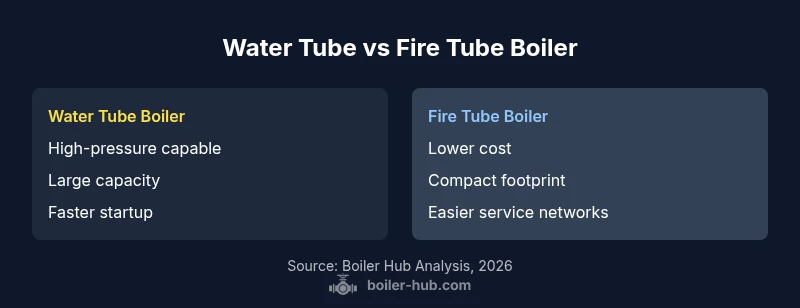
Water tube boilers handle higher pressures and larger steam production, while fire tube boilers are simpler, cheaper, and compact for smaller loads. If your project demands high capacity and quick response, a water tube model is usually preferred; for smaller plants or budget-conscious installations, fire tubes often win on upfront cost and ease of maintenance. This comparison from Boiler Hub clarifies key advantages and trade-offs.
Core Differences Between Water Tube and Fire Tube Boilers
The core distinction between water tube boiler vs fire tube boiler is where the water and combustion gases circulate. In water-tube boilers, water runs through slender tubes that are surrounded by hot flue gases, enabling high pressures, rapid steam generation, and large capacities. Fire-tube boilers route hot gases through tubes surrounded by water, delivering lower pressure with a simpler, robust construction. This fundamental difference drives all subsequent trade-offs in efficiency, maintenance, and installation. According to Boiler Hub, the decision often depends on required steam pressure, load variability, and space constraints. Water-tube systems shine in high-demand plants or facilities needing fast response to demand swings, while fire-tube configurations excel in smaller facilities with steady, moderate loads. The rest of this guide details how to map your needs to the appropriate boiler family, including sizing, control strategies, and lifecycle considerations.
How a Water Tube Boiler Works
Water tube boilers place water inside thin tubes that are surrounded by hot flue gases. The heat transfer through the tube walls causes water to convert into steam in the surrounding drums. This arrangement allows for high-pressure operation and rapid steam production, making water tube boilers ideal for facilities with variable demand and high duty cycles. Key components include the steam drum, water drum, burner, feedwater system, and complex circulation paths that ensure stable steam quality. In practice, a water-tube setup enables faster startup and more precise control, especially when combined with modern burners and advanced controls. When evaluating this option, consider the duty profile, fuel availability, and required steam pressures to determine if a water-tube solution aligns with your loads and space constraints.
How a Fire Tube Boiler Works
Fire-tube boilers route hot combustion gases through narrow tubes immersed in a surrounding water bath. The heat from the gases is transferred through the tube walls into the water, producing steam in the shell. This design is known for robustness, simplicity, and lower initial cost. Fire-tube boilers typically operate at lower pressures and are well-suited for steady, moderate loads with shorter maintenance intervals. Their compact footprint and extensive service networks make them popular in commercial facilities and small-to-mid scale industries. When sizing a fire-tube boiler, assess peak demand, available space, and the practicality of periodic inspections.
Key Performance Metrics for Boiler Types
Performance for water tube vs fire tube boilers hinges on several metrics: steam capacity, pressure rating, startup time, efficiency, and reliability under load changes. Water-tube designs often provide faster response to load and better efficiency at high demands, while fire-tube units tend to be more forgiving, with straightforward control schemes and broader service support. Efficiency improvements typically come from burner tuning, feedwater quality, and the implementation of advanced controls (modulating burners, economizers, and feedwater preheaters). For facilities with highly variable loads, quantify the duty cycle to compare how each design performs under ramp-up and ramp-down conditions.
Design and Construction: Tubing and Pressure Ratings
The tubing configuration defines a boiler’s pressure tolerance and maintenance needs. Water-tube boilers use numerous small-diameter tubes carrying water or steam, enabling high-pressure operation and rapid heat transfer. Fire-tube boilers rely on larger external water volumes with hot gases traveling through internal tubes. Material selection, joint design, and corrosion resistance are critical in both types, but water-tube systems demand more robust materials and fabrication quality to sustain higher pressures. In facilities with aggressive duty cycles, expect more sophisticated insulation, vibration control, and clearances to accommodate equipment expansion and maintenance access needs.
Practical Applications: Industry Sizing and Load Demands
Choosing between water-tube and fire-tube boilers often comes down to the application. Water-tube boilers are favored in industries requiring high-pressure steam and large capacity—think petrochemical plants, refineries, and power generation. Fire-tube boilers are common in manufacturing, food processing, and institutions with moderate steam demands and tighter budgets. Consider load variability, peak vs. base load, and future expansion when selecting a boiler type. A properly sized system reduces waste heat, improves reliability, and minimizes downtime.
Maintenance, Safety, and Reliability Considerations
Maintenance profiles differ notably between the two designs. Water-tube boilers require careful water treatment, precise control systems, and skilled technicians to monitor pressure management and tube integrity. Fire-tube boilers benefit from simpler maintenance routines and broader service networks, though they still need regular inspection of tubes, gaskets, and safety devices. Safety considerations include proper pressure relief, feedwater treatment, and burner safety interlocks. Routine testing, calibration, and adherence to local boiler codes are essential for reliability, regardless of the chosen design.
Costs, Efficiency, and Total Cost of Ownership
Initial costs for water-tube boilers are typically higher due to material quality, fabrication, and installation complexity. Fire-tube boilers generally cost less upfront and can be quicker to deploy. Over the lifecycle, efficiency gains, maintenance costs, and fuel prices drive the total cost of ownership. Water-tube systems may deliver better efficiency at high loads, while fire-tube systems can offer lower operating costs in steady, moderate-duty scenarios. Conduct a true total cost of ownership analysis that includes maintenance, downtime, and operator training when comparing options.
Decision Guide: Matching Your Needs to the Right Boiler Family
To determine the best option, map your facility’s duty cycle against boiler performance. Start with peak steam demand, required pressure, and startup time. Consider available space and staffing expertise for maintenance and operation. Use a sizing worksheet that accounts for load variability, feedwater quality, and fuel type. Finally, balance upfront cost with long-term operating costs and reliability. For many facilities, a phased approach—pilot testing or staged implementation—can reveal the most cost-effective choice for your specific application.
Comparison
| Feature | water tube boiler | fire tube boiler |
|---|---|---|
| Principal design | Water inside slender tubes; hot gases outside | Hot gases inside tubes; water outside |
| Pressure capacity | Higher potential pressures; suited for large-scale steam | Lower to moderate pressures; common for smaller loads |
| Footprint and weight | Typically larger footprint; heavier and more complex | More compact footprint; easier to install in tight spaces |
| Startup time / response | Faster response to load changes; rapid steam generation | Slower response; steadier operation for base loads |
| Maintenance complexity | More complex; requires skilled maintenance | Simpler maintenance; broad service networks |
| Initial cost | Higher upfront cost; installation complexity | Lower upfront cost; simpler installation |
| Best for | High-demand, high-capacity plants and refineries | Small to mid-size facilities with stable loads |
Advantages
- Helps clarify when to upsize or downsize steam capacity
- Promotes safer, more informed boiler system selection
- Highlights long-term operating costs and maintenance needs
- Guides balancing initial investment with lifecycle savings
The Bad
- Requires basic boiler theory to interpret effectively
- May oversimplify complex process constraints
- Final decision depends on exact duty cycle, fuel, and controls
Water tube boilers are preferred for high-pressure, large-capacity needs; fire tube boilers excel for smaller, cost-conscious operations.
Choose water tube when you need high steam output and fast response to load changes. Choose fire tube when upfront cost, simplicity, and compact footprint matter more, with moderate steam demands.
Questions & Answers
What is the main design difference between water-tube and fire-tube boilers?
Water-tube boilers place water inside slender tubes with hot gases outside, enabling high pressures and rapid steam production. Fire-tube boilers have hot gases inside tubes surrounded by water, resulting in simpler, lower-pressure operation. The choice depends on required pressure, capacity, and response to load changes.
Water-tube puts water in tubes, gas outside; fire-tubes do the opposite. The water-tube handles higher pressure and bigger loads; fire-tubes are simpler to operate.
Which boiler type is better for high-pressure steam and large capacity?
Water-tube boilers are better for high-pressure steam and large capacity, thanks to their heat transfer design and robust materials. Fire-tube boilers are typically limited to lower pressures and moderate loads.
If you need high pressure or large capacity, water-tube is usually the better choice; otherwise, fire-tube may suffice.
Which boiler is easier to install and maintain?
Fire-tube boilers are generally easier and cheaper to install and service due to simpler design and available service networks. Water-tube boilers require skilled installation and more robust safety systems.
Fire-tube units are usually easier to install and maintain; water-tube units demand specialized installation and maintenance.
How do operating costs compare between the two?
Operating costs depend on efficiency, fuel type, and load. Water-tube units can be more efficient at high outputs but have higher maintenance costs; fire-tube units often have lower upfront costs but may require more energy for larger loads.
Efficiency and fuel type matter; water-tube can be more efficient at larger loads, but maintenance costs are higher.
Are water-tube boilers more dangerous or require more safety measures?
Both types are safe when properly designed and maintained; water-tube systems operate at higher pressures, which requires stringent controls and training. Fire-tube boilers carry a different risk profile but are generally robust for many settings.
Both require proper safety practices; water-tube units demand strict pressure management.
What factors should I consider when sizing a boiler?
Consider load profile, peak demand, startup/shutdown cycles, feedwater quality, fuel type, and space constraints. Use a formal heat-duty calculation and consult equipment vendors.
Key factors: demand, variability, and space; use a formal sizing method.
Key Points
- Assess your load curve before selecting boiler type
- Prioritize high-pressure capability if required
- Consider space and installation constraints
- Factor in maintenance skill availability and service networks
- Match control strategy to the chosen boiler family