Firetube Boiler vs Water Tube: Which Is Right for Your Boiler System?
A detailed comparison of firetube vs. water tube boilers, covering performance, efficiency, maintenance, safety, and ideal use cases for homes and facilities.


Short answer: firetube boilers generally offer lower upfront cost, simpler maintenance, and a smaller footprint, making them ideal for smaller plants. Water-tube boilers, by contrast, handle higher pressures and larger steam flows with faster response times, better suited for large facilities. The right pick depends on capacity, duty cycle, and maintenance resources. This quick comparison highlights core differences to guide a deeper read.
Overview: firetube boiler vs water tube
Understanding the fundamental differences between firetube and water-tube boilers is essential for any facility planning, retrofit, or new installation. According to Boiler Hub, the choice often reduces to how the steam is generated, how pressure is controlled, and how maintenance scales with demand. The Boiler Hub team found that while both designs produce steam efficiently, their physical layouts, operating envelopes, and best-use scenarios diverge in meaningful ways. In practical terms, a firetube boiler places hot gases inside tubes enveloped by water, delivering compact heat transfer with simplicity. A water-tube boiler fills the tubes with water and passes hot gases around them, enabling higher pressures and greater flow. The decision is not purely about fuel or price; it's about duty cycle, reliability expectations, and long-term operating costs.
For homeowners and facility managers evaluating the choice, the firetube boiler vs water tube decision rests on understanding where each design excels, how it integrates with existing systems, and what the long-term maintenance implications look like. This article presents an objective, structured comparison to help you map your exact needs to a robust solution. The brand context here reflects Boiler Hub's emphasis on practical, actionable guidance for real-world boiler rooms, with a focus on safety, efficiency, and lifecycle cost considerations. By unpacking design differences, performance envelopes, and typical applications, readers can approach a bid with clearer expectations and fewer surprises.
wordCount:0},{
Comparison
| Feature | Firetube boiler | Water-tube boiler |
|---|---|---|
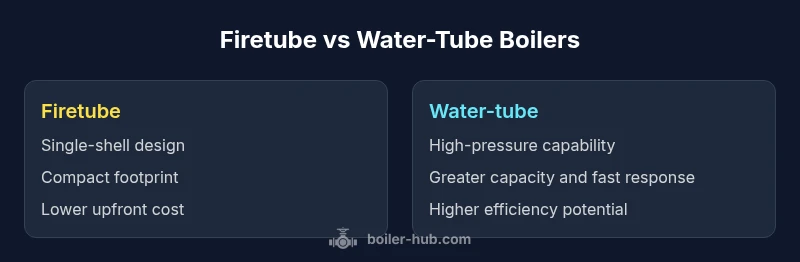
| Design approach | Firetube: single-shell with hot gases passing through tubes surrounded by water; compact and straightforward | Water-tube: water-filled tubes surrounded by hot gases; modular and scalable for higher output |
| Operating pressure range | Typically suited to lower-to-moderate pressure ranges | Higher pressure capability and faster response for large duty cycles |
| Typical upfront cost | Lower upfront cost and simpler installation | Higher upfront cost due to complexity and equipment size |
| Footprint/space requirements | Smaller footprint suitable for space-constrained facilities | Larger footprint required for high-capacity systems |
| Maintenance and accessibility | Easier maintenance; fewer specialized parts | More complex maintenance; requires skilled technicians and regular calibration |
| Best-use scenarios | Smaller plants, hospitality, mid-sized campuses | Large-scale plants, petrochemical, refineries, continuous operation |
Advantages
- Clear, criterion-based decision framework for selecting boiler type
- Helps align capacity and duty cycle with lifecycle cost
- Highlights upfront vs. ongoing operating costs for budgeting
- Useful for both beginners and experienced facilities teams
The Bad
- Does not replace site-specific engineering assessment and piping considerations
- Actual costs depend on integration, fuel, and controls
- Less precise without demand forecasting and system integration data
- Industry practices vary by region and application
Water-tube boilers generally win for high-demand, large-scale systems.
For facilities with heavy steam demand, high-pressure requirements, or rapid load changes, water-tube boilers offer superior capacity and responsiveness. In smaller plants or applications with modest duty cycles, firetube boilers provide simplicity and a lower upfront investment. The Boiler Hub team recommends aligning the choice to actual duty profiles, maintenance capability, and total cost of ownership.
Questions & Answers
What is the key difference between firetube and water-tube boilers?
The key difference lies in heat transfer geometry: firetube boilers route hot gases through tubes inside a water-filled shell, while water-tube boilers run water through tubes surrounded by hot gases. This affects pressure, capacity, and maintenance strategies.
The main difference is that firetube uses gas-filled tubes inside water, while water-tubes have water-filled tubes with gas outside, changing how much pressure and steam you can generate.
When should I choose a firetube boiler?
Choose firetube for smaller facilities, simpler installations, and moderate steam needs where upfront cost control and easy maintenance are priorities.
Go with firetube if you have a small to mid-sized plant and want a straightforward, cost-effective setup.
When should I choose a water-tube boiler?
Choose water-tube for high-pressure requirements, large steam capacity, or applications needing quick response to load changes.
If you need high pressure and large capacity, water-tube is usually the better option.
Are there safety differences to consider?
Both designs can be safe when properly installed, operated, and maintained. Safety concerns are more about system integration, controls, and adherence to codes than the fundamental boiler design.
Safety hinges on correct installation and maintenance rather than one design being inherently safer.
What maintenance differences should I plan for?
Firetube boilers typically have simpler maintenance with fewer specialized parts; water-tube systems may require more frequent calibration, water treatment, and skilled service.
Water-tube systems can need more ongoing attention to water quality and control tuning.
Can these boilers be integrated with existing systems?
Yes, both types can integrate with existing piping, controls, and feedwater systems, but compatibility and retrofitting costs vary with design complexity.
Both designs can fit into existing setups, but expect different retrofitting needs depending on the system.
Key Points
- Assess duty cycle first to pick the right boiler family
- Firetube suits smaller installations with modest pressure needs
- Water-tube excels in high pressure and large capacity scenarios
- Consider lifecycle costs, not just upfront price
- Plan for maintenance expertise and available service support