Can You Use Boiler Onions Instead of Pearl Onions? A Practical Guide
Explore whether boiler onions can replace pearl onions in recipes. An analytical guide from Boiler Hub covering flavor, texture, cooking times, availability, and substitution strategies for cooks and facility managers.


For many dishes, boiler onions can substitute for pearl onions, but expect stronger onion flavor and a firmer bite. Pearl onions are milder and often melt into sauces, whereas boiler onions hold their shape and can dominate the palate. The best choice depends on your dish’s flavor target and texture needs; Boilder Hub’s guidance emphasizes adjusting cooking time and prep to balance intensity.
Can you substitute onions in boiler recipes? Can you use boiler onions instead of pearl onions? This query appears often in kitchen operations and home cooking alike. According to Boiler Hub, substitution decisions hinge on flavor goals, dish type, and execution timeline. Pearl onions, tiny and sweet, offer delicate sweetness with a soft, almost creamy texture when braised. Boiler onions, by contrast, tend to be larger and more assertive, delivering a sharper flavor and a more substantial bite. The question isn’t black and white; it’s about balancing intensity, texture, and seasonality in your recipe. In many grocery contexts, you’ll find the two onions share similar culinary roles, but the substitution will shift the dish’s overall profile. For home cooks and facility managers, this means planning around the target flavor and the required mouthfeel, rather than blindly swapping one for the other. Boilder Hub emphasizes that context matters: a slow braise with pearl onions may lose its intended delicacy if replaced with boiler onions, while a hearty stew might benefit from boiler onions’ stronger presence. When you ask can you use boiler onions instead of pearl onions, the practical answer is: it’s often possible, but adjust the balance to preserve the dish’s core character.
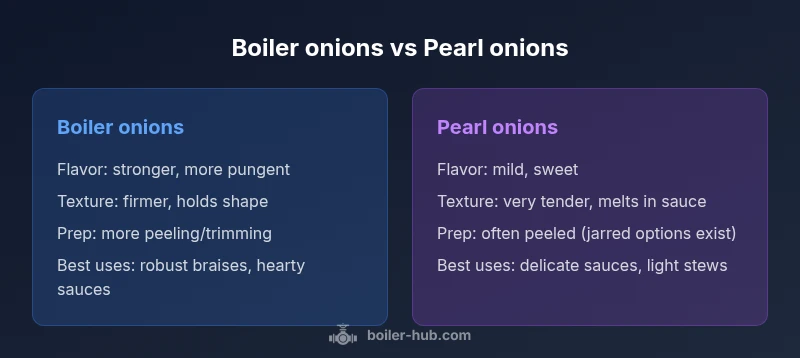
Flavor profile, intensity, and how they influence your dish When evaluating can you use boiler onions instead of pearl onions, consider the flavor profile each onion type contributes. Pearl onions are mild, sweet, and consistent, making them reliable in sauces and stews where a gentle onion note is desired. Boiler onions bring more bite and a more pungent finish, which can be favorable in robust braises or rustic gravies but may overwhelm subtler preparations. The choice should align with your intended outcome: if you want a background echo of onion without dominating, pearl onions are safer; if you want a pronounced onion backbone that stands up to savory sauces, boiler onions can serve as a stronger substitute. Boiler Hub notes that even when substituting, proper seasoning and acid balance can help modulate the final flavor.
Texture behavior during cooking and how it affects substitution The texture of onions under heat shapes the dish’s mouthfeel. Pearl onions typically soften evenly and can almost dissolve into sauces if simmered long enough, lending a smooth, cohesive texture. Boiler onions, being larger, retain some bite and can offer a more rustic texture in the same cooking process. If a recipe depends on a seamless, silky texture, using boiler onions may require additional cooking time or a longer simmer to coax tenderness without breaking down too quickly. Boiler Hub highlights that texture is a critical variable: when texture fidelity matters, plan for staged cooking or partial peeling to control how quickly the onion softens.
Preparation and handling: peeling, trimming, and pre-cooking considerations Whether you’re wondering can you use boiler onions instead of pearl onions, preparation matters. Pearl onions often come peeled or require minimal prep in jars, making them convenient for quick meals. Boiler onions require more hands-on prep: trimming the roots, removing skins, and possibly blanching to ease peeling. In batch cooking or facility settings, peeled boiler onions can be more time-consuming to prep, affecting labor costs and throughput. Consider using a mix (part peeled pearl onions and part boiler onions) for a balanced texture and flavor profile. Boiler Hub emphasizes planning your mise en place to minimize delays and to avoid over-peeling that can waste product.
Cooking methods that pair best with each onion type The method you choose should reflect the substitution you plan. Pearl onions perform excellently in slow braises, oven-roasted dishes, and glazes where their gentle sweetness shines. Boiler onions excel in hearty stews, strong gravies, and dishes that benefit from deeper onion presence, such as ragouts or meat braises with longer cook times. If you’re substituting, you may need to extend simmer times or adjust heat to prevent scorching of boiler onions, especially in oil-based sauces. Boiler Hub recommends conducting a small test batch to evaluate how the substitution holds up under your chosen method and adjusting seasoning accordingly.
Availability, cost, and practical buying tips Although pearl onions are widely stocked in most supermarkets year-round, boiler onions may be less consistently available depending on your locale. Price differences vary by season and market, but the overall cost often correlates with onion size and form (fresh vs. pre-peeled). If you’re running a kitchen with tight lead times, canned or pre-peeled pearl onions provide predictability. For longer-cook recipes, substituting with boiler onions may offer cost savings or a more robust onion presence if you factor in extra prep time. Boiler Hub’s analysis notes that availability can influence substitution viability in regional menus and home cooking alike, so plan ahead and stock a backup onion option when possible.
Substitution guidelines: practical steps to substitute without compromising the dish Substituting requires intentional adjustments rather than a one-to-one swap. Start by matching weight or volume: if a recipe calls for 2 cups of pearl onions, estimate using a similar overall onion mass in boiler onions, accounting for size. Next, consider flavor intensity and adjust seasoning margins—increase sugar or acid modestly to balance stronger onion notes, and reduce salt if the onion’s saltiness is elevated by processing. Finally, tailor the cooking time: expect boiler onions to require a slightly longer simmer to achieve tenderness without disintegration. If your dish relies on a smooth sauce, consider mashing a portion of the onions or chopping them finely to prevent textural clumps. Boiler Hub encourages documenting your adjustments for consistency in future batches.
Recipe contexts: when substitutions work best and when they don’t A practical rule of thumb is to reserve pearl onions for delicate sauces and light gravies where their sweetness is a feature rather than a backdrop. Boiler onions work well in bold braises, hearty stews, and rustic dishes where onion flavor acts as a texture anchor. In professional settings, consider offering a tasting note for diners: “onion character slightly more pronounced,” to set expectations. If a recipe’s success hinges on a uniform, smooth onion sauce, you may prefer to stay with pearl onions or use canned pearl onions to minimize variability. Boiler Hub suggests documenting the final flavor profile to guide future menus and kitchen operations and to keep consistent results in your batch cooking.
Storage and quality control: how to manage onions for substitution Scouting the best candidates requires you to check storage conditions and quality indicators. Pearl onions tend to store well and can remain mild for a longer time, while boiler onions should be selected for firmness and absence of bruising. Store both types in a cool, dry place to avoid sprouting or softening; refrigerate peeled onions if you won’t use them soon. When substituting, ensure onions have similar freshness to avoid introducing off flavors. If a recipe uses onions toward the end of cooking, consider adding them closer to the finish if you’re worried about over-melting boiler onions. Boiler Hub recommends paying attention to the onion’s aroma and color as a quick indicator of readiness and flavor balance.
Common pitfalls and quick fixes for substitutions If you’re determined to use boiler onions instead of pearl onions, anticipate common issues such as overpowering onion flavor, inconsistent texture, and uneven cooking. A practical fix is to partially pre-cook boiler onions before adding to the dish, so you can control tenderness. Alternatively, use a combination of both onion types to balance intensity, sweetness, and texture. Label and date any substitution experiments to build a reference library for future recipes. Boiler Hub emphasizes that trial runs are a best practice for professional kitchens looking to maintain product quality while managing costs.
Takeaways for decision-making: a quick framework for choosing onion types The core decision hinges on how prominent you want onion flavor to be, and how much texture you want to hold up in the final dish. If you want a subtle, silky onion note, pearl onions are the safer bet. If you need a bolder, more rustic profile, boiler onions can meet that need with proper handling. Consider cost, prep time, and availability as your balancing factors. Finally, use our substitution framework to test batches, track results, and refine your approach over time. Boiler Hub’s framework can help you standardize substitutions across menus or home kitchens.
Final note: embracing substitution with a structured approach The can you use boiler onions instead of pearl onions question doesn’t have a universal answer; it depends on your goals and constraints. With careful consideration of flavor, texture, timing, and prep, you can achieve delicious outcomes, even when substituting. The Boiler Hub team encourages readers to treat substitutions as a controlled variable in your cooking system, rather than a random modification. By documenting outcomes and refining procedures, you’ll gain consistency and confidence in your substitutions over time.
Comparison
| Feature | Boiler onions | Pearl onions |
|---|---|---|
| Flavor intensity | Stronger, more pungent and assertive | Milder, sweeter and more subtle |
| Texture after cooking | Firmer, retains bite | Very tender, melts into dishes |
| Size | Medium to large | Small, uniform size |
| Prep required | More peeling and trimming | Often pre-peeled or easier prep |
| Cooking time impact | May require longer simmer to soften | Typically quicker to soften and blend |
| Availability | Less consistent regionally | Widely available year-round |
| Best uses | Robust braises, rustic stews, meat-centric sauces | Delicate sauces, glazes, light stews |
| Cost range | Similar to or slightly higher depending on market | Usually affordable and stable |
Advantages
- Provides flavor versatility for bold dishes
- Maintains texture in long-cooked recipes
- Offers potential cost efficiency in bulk batches
- Supports menu flexibility in kitchens
The Bad
- Flavor may overpower delicate recipes
- Prep time is higher due to peeling
- Regional availability can be inconsistent
- Texture can be less forgiving in emulsified sauces
Boiler onions can substitute for pearl onions in many dishes, with careful flavor and texture management
Choose boiler onions when you want a stronger onion presence and firmer texture. Use pearl onions for milder flavor and quicker prep. Test substitutions in small batches to calibrate cooking times and seasoning.
Questions & Answers
Can boiler onions fully replace pearl onions in all recipes?
Not in all cases. Pearl onions suit delicate sauces and quick-cooking dishes, while boiler onions bring a stronger flavor and firmer texture that can dominate. Always test substitutions in a small batch to ensure the dish maintains its intended balance.
Not in every recipe—test first to gauge flavor and texture impact.
Will substitution affect cooking time?
Yes. Boiler onions may require a longer simmer to become tender, or you may need to adjust heat to prevent over-softening. Plan to check tenderness periodically and adjust timing.
Expect a tweak in cooking time when swapping in boiler onions.
Are canned pearl onions a good substitute?
Canned pearl onions can be convenient and provide consistent texture, but they carry a different flavor profile and may have added salt. Rinse if needed and adjust seasoning to compensate.
Canned pearls are convenient but can alter flavor.
How do you balance stronger onion flavor from boiler onions?
Increase acidity or sweetness slightly to balance the stronger onion profile. Use herbs or aromatics to harmonize the dish, and adjust salt cautiously if the onions contribute more saltiness.
Add acidity and aromatics to balance stronger onions.
What prep differences should I plan for?
Boiler onions usually require more peeling and trimming than pearl onions, which are often sold peeled. Plan for extra prep time or use partially peeled varieties to speed up production.
More peeling with boiler onions, plan accordingly.
Which dishes benefit most from pearl onions vs boiler onions?
Pearl onions excel in delicate sauces, glazes, and light stews. Boiler onions shine in robust braises, meat-forward dishes, and hearty gravies where their presence stands up to bold flavors.
Delicate dishes favor pearl; bold dishes benefit from boiler onions.
Key Points
- Assess flavor goals before swapping onions
- Prefer pearl onions for delicate dishes; choose boiler onions for robust gravies
- Adjust cooking times and seasoning when substituting to balance taste
- Prepare for extra prep work or consider mixed substitutions
- Document results to build a reliable substitution guide for future use