Pearl Onions vs Boiler Onions: A Comprehensive Comparison
Compare pearl onions and boiler onions to choose the right variety for stews, braises, and roasts. Learn flavor, texture, prep, and storage tips with insights from Boiler Hub.


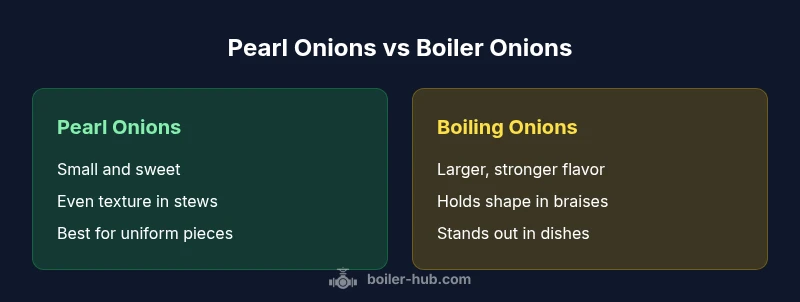
Pearl onions are tiny, sweet, and hold their shape in braises; boiler onions (often called boiling onions) are larger with a stronger bite and softer texture when fully cooked. For most long-simmered dishes, pearl onions give uniform texture and milder sweetness, while boiler onions add a bolder onion presence. Both store well in a cool, dry place.
Understanding the Terminology: Pearl Onions and Boiler Onions
In culinary contexts, you will often see references to pearl onions and boiling onions when a recipe calls for small onions. Pearl onions are the small, globe-shaped onions sold in many markets and are prized for their sweet, mild flavor and their ability to hold shape during long cooking. Boiler onions—more commonly described as boiling or boiling-onion varieties—tend to be larger, with a sharper edge to their flavor that mellows with time in warm, moist heat. The terminology can vary by region, which is why many professional kitchens prefer to specify the size and type (for example, “pearl onions, peeled” or “small white onions”). According to Boiler Hub, understanding these distinctions helps avoid mis-purchases and recipe failures, especially in professional kitchens where consistency matters. This section lays the groundwork for why these two onion types behave differently in cooking and why those differences matter for your boiler room to kitchen workflows.
In the broader field of culinary science, the term “onion variety” is broader than just pearl vs boiler. However, for home cooks and facility kitchens alike, the practical takeaway is simple: size, sweetness, and texture drive the choice. Pearl onions shine in dishes where you want uniform pieces that melt softly into sauces, while boiler onions provide a sturdier bite and a more pronounced onion note that remains detectable even after hours of simmering. The Boiler Hub team highlights these practical behavioral traits to help you plan menus with confidence and to support reliable batch cooking in kitchens of all sizes.
Comparison
| Feature | Pearl onions | Boiler onions (boiling onions) |
|---|---|---|
| Flavor profile | Sweet, mild, delicate | Sharper, more pungent when raw; mellows with cooking |
| Texture after cooking | Very tender, nearly creamy when fully softened | Holds shape better, with a pronounced onion bite that softens more slowly |
| Typical size | Very small, about 1–2 cm in diameter | Larger, about 2–4 cm in diameter |
| Best uses | Stews, braises, sauces needing uniform onion pieces | Dishes needing stronger onion presence or quicker softening |
| Cooking time impact | Shorter to reach tenderness; cooks quickly in small pieces | Longer to soften; holds up well in long braises |
Advantages
- Helps cooks achieve consistent texture in dishes requiring small, uniform pieces
- Provides a milder sweetness that blends smoothly into sauces
- Gives kitchen planners predictable outcomes for menus and batch cooking
- Reduces risk of oversized onion pieces ruining presentation
The Bad
- Availability can vary by season and region
- Confusion in terminology may lead to mis-purchases without clear labeling
- Substituting one type for the other can shift flavor balance in a recipe
Pearl onions are the more versatile choice for most recipes, offering uniform texture and sweetness, while boiler onions excel when a stronger onion presence is desired or when quicker softening is needed.
Choose pearl onions for consistency and mild flavor in stews and sauces. Use boiler onions when you want a bolder onion note or faster transformation in braises; in some dishes, a combination may provide the best balance.
Questions & Answers
What exactly distinguishes pearl onions from boiler onions?
Pearl onions are small, sweet, and hold their shape well during simmering, producing a uniform texture. Boiler onions are larger, with a more robust bite that softens differently with heat. The two terms can be regional; clear labeling helps ensure you’re choosing the right type for your recipe.
Pearl onions are small and sweet; boiler onions are larger with a stronger bite. Check the label to avoid mixing them up.
Can I substitute one type for the other in a recipe?
Yes, you can substitute, but expect changes in texture and sweetness. Pearl onions give uniform tenderness, while boiler onions add more bite. If a recipe relies on identical pieces, substitution may require adjusting cooking times or adding sugar to balance flavor.
You can substitute, but the texture and flavor balance will shift. Plan for different cooking times.
Which onion type is best for long-simmered stews?
For long-simmered stews, pearl onions are generally preferred for even texture and sweetness, unless a stronger onion punch is specifically desired. In some regional recipes, a mix of both types can create layered flavor without overpowering the dish.
Pearl onions are usually the go-to for even texture in stews.
How do I peel pearl onions quickly?
Peel pearl onions by blanching briefly and then shocking in cold water, which loosens the skins for easy removal. A quick pre-peel soak can also help in large batches. This method minimizes prep time in busy kitchens.
Blanch briefly to loosen skins, then peel. It speeds up batch prep.
Are there nutritional differences between these onions?
Both onion types offer similar nutritional benefits, including fiber and micronutrients, with minor variances due to size and concentration of certain compounds. In practical terms, choose based on flavor and texture needs rather than nutrition alone.
Both are healthy; differences are minor and mainly affect flavor and texture.
Does storage affect sweetness or texture?
Storage conditions can affect overall quality. Refrigeration slows aging and helps retain texture for longer, while cool, dark pantry storage preserves shelf life for dry onions. Minimal exposure to moisture is key to maintaining quality for either type.
Keep onions dry and cool; moisture can affect texture and shelf life.
Key Points
- Choose pearl onions for even cooking and mild sweetness
- Use boiler onions for stronger onion flavor and quicker softening
- Match onion type to dish: stews/braises vs roasts
- Peel and prep onions properly to minimize cooking time
- Store both varieties in a cool, dry place for shelf stability