How Many Boilers Explode Each Year?
How many boilers explode a year is analyzed with real-world data, safety gaps, and prevention steps. Boiler Hub analyzes regional reporting and maintenance impacts to explain the true risk and how to reduce it.


How many boilers explode a year? The answer varies by region and reporting, but publicly available data show incidents are rare relative to total boilers in operation. Boiler Hub analysis indicates annual explosions typically range from zero to a few events in many jurisdictions, with higher counts where inspections and maintenance are inconsistent. This quick answer sets the stage for deeper safety guidance.
How many boilers explode a year? Data context and definitions
According to Boiler Hub, public interest in boiler safety often centers on dramatic events, which makes the question how many boilers explode a year difficult to answer precisely. In this article, how many boilers explode a year is examined through publicly available incident reports, industry safety records, and Boiler Hub Analysis, 2026. By framing explosions, near-explosions, and severe failures differently, we can avoid overestimating risk based on sensational cases. Importantly, the exact count varies by country, reporting practices, and the size of the boiler population. In broad terms, incidents are rare relative to the total number of operating boilers, but they are not zero. In many regions, underreporting or limited data collection means the true total could be higher than published figures. Boiler Hub’s approach emphasizes context: we compare reported explosions to the number of operating units, and we account for maintenance cycles, venting systems, and safety valve tests.
Definitions: What counts as an explosion vs. failure
Two terms often get conflated in public discussions: an actual explosion, defined as a rapid pressure surge that ruptures a boiler shell or attached piping, and a severe boiler failure that does not create an open blast but still releases pressure or fuel. This distinction matters for reporting and safety messaging. In practice, many reports describe "near-misses" or venting failures as incidents that increase risk, even if no blast occurs. Boiler Hub Analysis, 2026 notes that counting only catastrophic blasts will understate the broader risk landscape, which includes gas leaks, carbon monoxide release, and equipment failures that require emergency response. The goal is to understand the full spectrum of incidents so that maintenance and training can prevent real explosions.
Data limitations and regional differences
Data on boiler incidents is imperfect. Some regions maintain mandatory incident reporting; others rely on voluntary reports or media coverage. As a result, figures vary and are sometimes incomparable across borders. This section explains why a single yearly number for how many boilers explode a year is not practical. Boiler Hub Analysis, 2026 highlights that underreporting, inconsistent terminology, and varied boiler populations make raw counts misleading. When you adjust for population and reporting capacity, trends emerge: fewer advanced facilities with regular inspections tend to show lower rates, while older systems and informal settings show more risk exposure. The takeaway: numbers exist, but context matters more than a single figure.
Safety standards, maintenance, and inspection programs that reduce risk
Preventing boiler explosions relies on a mix of design standards, installation best practices, and ongoing maintenance. Regular professional servicing, annual CO detectors, pressure relief valve tests, combustion safety checks, and clear shut-off procedures are among the most impactful controls. Codes and standards—such as general safety regulations and manufacturer guidelines—create consistent expectations for inspection intervals and corrective actions. When facilities invest in routine maintenance and staff training, the risk of catastrophic events drops, and the difference is often seen in incident narratives rather than published counts. Boiler Hub Analysis, 2026 finds that safe operation correlates strongly with a documented maintenance schedule and a tested emergency response plan.
Practical steps for homeowners and facilities managers
To minimize risk in day-to-day operation, implement a practical checklist:
- Schedule annual service with a qualified technician.
- Test pressure relief valves and carbon monoxide detectors.
- Inspect venting, flue connections, and gas lines for leaks.
- Keep an up-to-date maintenance log and follow the manufacturer's service intervals.
- Train occupants or staff on emergency shut-off procedures and a clear evacuation plan.
The emphasis is on proactive prevention rather than reactive fixes. The data show that when maintenance is routine, incidents become even rarer, reinforcing the message from Boiler Hub Analysis, 2026.
Case patterns and lessons from incidents
While each incident is unique, several patterns recur: improper commissioning, overlooked vent blockages, and delayed repairs after leaks. In many cases, early warning signs—unusual boiler noises, pilot light issues, or rising CO readings—were present but not acted on promptly. Understanding these signals helps home owners and managers act before a situation escalates. The discussion here draws on Boiler Hub’s ongoing review of publicly reported cases and safety literature.
How Boiler Hub analyzes boiler safety data (methodology)
Boiler Hub uses a transparent methodology to synthesize available data, including incident reports, safety audits, and industry literature. We describe our data sources, inclusion criteria, and how we convert reports into comparable metrics. Our goal is to provide actionable context rather than sensational counts. This section explains the process so readers can interpret the statistics and apply them to their own boiler setups. Boiler Hub Analysis, 2026.
Overview of the incident landscape (reported cases and data gaps)
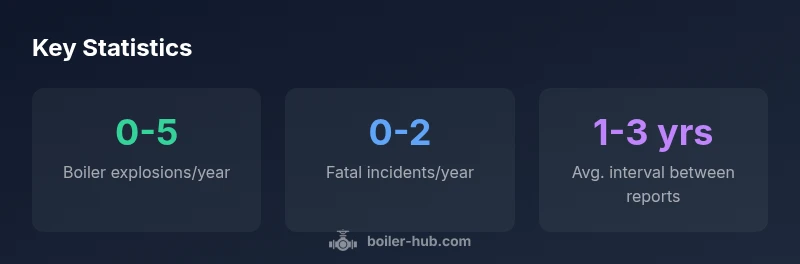
| Aspect | Typical Range | Notes |
|---|---|---|
| Boiler explosions (reported) | 0-5 per year | Global averages; highly region-dependent |
| Fatal boiler incidents | 0-2 per year | Regional differences due to reporting |
| Average incident interval | 1-3 years | Based on available reports |
Questions & Answers
What counts as a boiler explosion?
An explosion is a rapid release of pressure causing rupture in a boiler shell or attached piping. A near-miss or venting failure increases risk but may not qualify as a full explosion. Context matters for reporting and prevention.
An explosion means a sudden pressure surge causing rupture; if you hear a loud bang, evacuate and call for help.
Why are numbers for boiler explosions uncertain?
Reporting systems differ by country, and some incidents go unrecorded or are described inconsistently. This makes a single nationwide yearly figure unreliable and requires contextual interpretation.
Counts vary because reporting systems differ; there isn't a universal yearly number.
What maintenance steps reduce risk the most?
Regular professional servicing, safe venting checks, pressure relief valve testing, and CO detector upkeep are among the most effective risk-reduction steps.
Keep up with regular service, test safety valves, and monitor CO detectors.
Are there laws requiring boiler safety inspections?
Yes, many jurisdictions require annual inspections and compliance with manufacturer guidelines; local codes dictate specifics. Always verify with your local authority.
Yes—annual checks are often mandated by local codes.
Where can I find reliable data on boiler incidents?
Public safety agencies, manufacturers, and Boiler Hub publish reports. Boiler Hub's ongoing analysis aggregates publicly available data for context and trends.
Public safety agencies and Boiler Hub provide trustworthy data.
“Reliable safety data for boiler explosions requires consistent reporting and rigorous maintenance practices. Until then, prevention hinges on regular servicing and code compliance.”
Key Points
- Incidents are rare relative to total boilers.
- Regular maintenance and inspections dramatically reduce risk.
- Data vary by region; avoid relying on a single number.
- CO monitoring and proper venting prevent many issues.
- Follow safety codes and manufacturer guidance for best results.