Do You Need a Boiler With Solar Panels? A Practical Guide
Explore whether a boiler is necessary when installing solar panels. Learn how solar thermal and PV systems interact with boilers, design options, costs, and maintenance tips from Boiler Hub.


Do you need a boiler with solar panels? Not always. Solar panels can reduce or replace some heating needs, but most homes still rely on a boiler or heat pump for cloudy days and peak demand. The right setup depends on climate, hot-water use, system efficiency, and available incentives, as well as maintenance costs.
Do you need a boiler with solar panels? A clear understanding starts here
According to Boiler Hub, the first question homeowners and facility managers should ask is what role solar panels will play in the heating system. Solar technologies can directly heat water, supplement space heating, or power electric components of a heating system. The key is to align expectations with climate, hot-water demand, and existing equipment. A boiler may still be part of the equation, but it doesn’t have to be the only source of heat. This guide helps you map out whether you need a boiler, how solar integration works, and what design options fit different homes. By framing your goals—lower bills, reduced emissions, or greater reliability—you can choose a path that minimizes risk and maximizes comfort.
Bold note: Solar systems are site-specific; performance hinges on weather patterns, shading, and insulation quality.** The Boiler Hub team emphasizes that a well-planned hybrid can dramatically reduce dependence on fossil fuels while preserving reliability.**
Tools & Materials
- Solar thermal collectors (flat-plate or evacuated-tube)(Choose based on climate, available roof space, and budget. Evacuated-tube collectors generally perform better in colder, cloudier conditions.)
- Solar PV panels (optional)(Can power electric boilers, heat pumps, or hot-water pumps; most homes use PV alongside thermal for comprehensive coverage.)
- Solar controller/diverter valve(Directs heat transfer to storage or back to the boiler as needed.)
- Storage tank (solar thermal)(Thermal storage helps balance daily heat production and demand.)
- Heat exchanger(Fluids in the solar loop may require a heat exchanger to protect boiler water chemistry.)
- Boiler compatible with solar integration (modulating/condensing)**(Must be able to modulate output and accept solar heat as a supplementary source.)
- Piping (PEX or copper) and fittings(Insulate exposed runs to minimize heat loss; ensure proper slope for drainage.)
- Glycol or non-freezing heat-transfer fluid(Used in closed solar loops to prevent freezing in cold climates.)
- Insulation materials(Pipe insulation and storage tank insulation to maximize efficiency.)
- Mounting hardware and fasteners(Roof or wall mounting kit rated for the chosen collector type.)
- Permits and inspection documents(Check local regulations and incentives; may require professional installation.)
Steps
Estimated time: 2-5 days
- 1
Define goals and baseline energy use
Start by listing goals (lower utility bills, reduced emissions, independence from grid power) and review last 12 months of hot-water and space-heating energy use. This sets a target for what solar integration should achieve and helps size components appropriately.
Tip: Bring utility bills and current boiler spec sheets to the planning session. - 2
Assess site viability and compatibility
Evaluate roof space, orientation, shading, and existing heating equipment. Verify that the boiler can accept solar input and that the overall system will fit within local code and space constraints.
Tip: Shading of even a small area can dramatically reduce solar output; consider winter sun angles. - 3
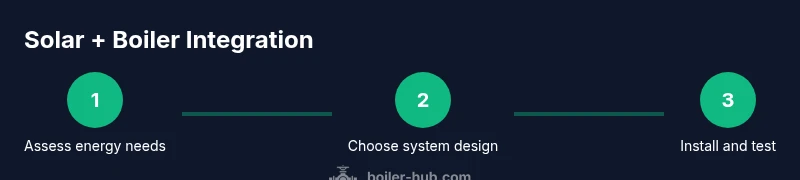
Choose system design (thermal vs PV-assisted)
Decide between solar thermal with a storage tank or PV-assisted systems that power an electric boiler or heat pump. Hybrid designs combine both approaches for reliability across seasons.
Tip: Thermal storage provides consistent heat even on cloudy days; PV systems excel in sunny periods. - 4
Engage a qualified installer for design and permits
Work with a licensed contractor to finalize the system layout, select components, and submit permits. They’ll confirm compatibility with your existing boiler and ensure safety compliance.
Tip: Get multiple quotes and verify warranties and service plans. - 5
Install solar collectors and plumbing
Mount collectors, route the solar loop, and install the heat exchanger and storage tank. Ensure proper insulation and leak testing before charging the system with fluid.
Tip: Follow manufacturer guidelines for refrigerant-free glycol and avoid cross-contamination with boiler water. - 6
Integrate controls and commission the system
Connect the diverter valve, temperature sensors, and boiler controls. Run a full commissioning sequence to balance heat production with demand and verify safety interlocks.
Tip: Set conservative initial temperature targets and adjust after a few weeks of operation. - 7
Educate occupants and schedule maintenance
Explain how the system operates, how to interpret performance data, and when to call for service. Plan periodic maintenance and fluid top-offs as needed.
Tip: Record performance metrics to track savings and identify underperforming components. - 8
Review performance and optimize
After a full heating season, analyze operating costs, energy savings, and comfort levels. Refine settings or consider adding PV capacity if needed.
Tip: Seasonal optimization can yield substantial gains without extra equipment.
Questions & Answers
Do solar panels completely replace a boiler, or only supplement it?
Most setups use solar as a supplement that reduces boiler firing during sunny periods. In colder seasons or cloudy days, the boiler still provides reliable heating. The goal is to lower energy use and emissions while maintaining comfort.
Solar usually supplements a boiler, cutting fuel use; a boiler still helps on cloudy days.
Can I install solar panels without changing my boiler?
Yes, many homes keep their existing boiler and add solar to share the load. The integration varies by boiler type and controls, but a compatible system can reduce fuel consumption without replacing the boiler.
You can often keep your boiler and add solar; compatibility depends on the boiler and controls.
What if I have electric heating—can solar panels work with that?
Solar PV can power electric boilers or heat pumps, enabling a solar-first strategy. This approach is common where gas is not available or preferred, but it depends on electricity rate structures and system design.
Solar PV works well with electric heating like boilers or heat pumps, but check cost and utility rules.
Is solar heating worth the investment in a moderate climate?
In moderate climates, solar can still reduce heating loads and hot-water costs if paired with an efficient boiler or heat pump. Economic viability depends on local incentives, installation costs, and energy prices.
Even in moderate climates, solar can cut costs if paired with a good system and incentives.
What maintenance does a solar-boiler system need?
Regular checks of fluid levels, leaks, and controller settings help preserve performance. Descale and antifreeze maintenance may be necessary in hard water areas or extreme climates.
Keep an eye on fluid levels and controller settings for best results.
Are there incentives or rebates for solar-boiler installations?
Many regions offer incentives such as tax credits, rebates, or grants for solar integrations. Check with local utility programs and national energy agencies for current programs and eligibility.
There are often rebates or incentives—check local programs before buying.
Watch Video
Key Points
- Assess whether solar should be thermal, PV-assisted, or hybrid.
- Size systems based on both demand and climate, not just roof space.
- Hybrid designs increase reliability across seasons and weather.
- Plan permits, warranties, and maintenance from day one.