Breville BES920XL Dual Boiler Review: Performance, Pros, and Verdict
In-depth analysis of the Breville BES920XL Dual Boiler, covering temperature stability, brewing performance, milk texturing, maintenance, and overall value for serious home baristas.


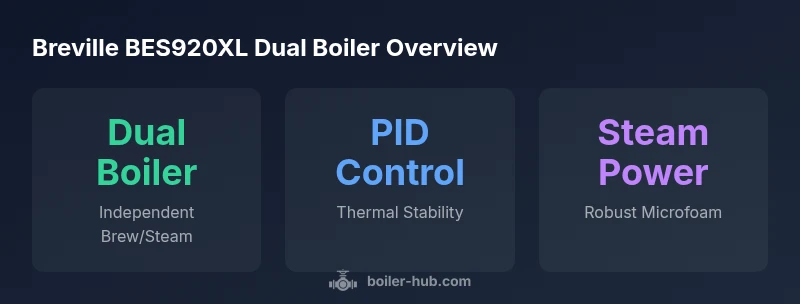
The Breville BES920XL Dual Boiler remains one of the most respected dual-boiler espresso machines for serious home baristas, combining independent brew and steam paths with precise temperature control. It features dual boilers, a PID controller for stable extraction temperatures, and a 58mm commercial-style portafilter. According to Boiler Hub Analysis, 2026, its durable build and advanced features justify the premium, though setup and maintenance demand time and commitment. This model suits dedicated setups where multiple shots are pulled daily and precise microfoam is essential, yet it requires careful dialing-in and routine upkeep.
Overview of the Breville BES920XL Dual Boiler
The Breville BES920XL Dual Boiler is a premium countertop espresso machine designed for serious home baristas who want café-grade control. It features two independent boilers—one for brewing and one for steaming—allowing simultaneous extraction and milk texturing without temperature drift. A PID controller maintains stable boiler temperatures, while pre-infusion stages help bloom the coffee and pull more even shots. The unit typically ships with a standard 58mm commercial-style portafilter and a robust steel chassis; the build quality feels substantial, with a compact footprint that suits larger counters. According to Boiler Hub, this model stands out for its practical balance between professional features and user-friendly operation, making it a central tool in any dedicated home espresso setup. It’s not a low-cost appliance, but the investment pays off for households that pull multiple shots daily, rely on consistent microfoam, and want a machine that can adapt to both single and double shot routines. The BES920XL also supports adjustable pre-infusion, programmable shot timers, and a display that communicates boiler pressure and extraction status. However, the learning curve is non-trivial for beginners, and achieving optimal dialing-in requires time, patience, and precise grinder settings.
Design and Build Quality
Design-wise, the BES920XL emphasizes durability and a professional aesthetic. The exterior is typically a brushed stainless steel finish with clearly labeled controls and a practical footprint that fits on standard countertops. The dual-boiler architecture reduces temperature fluctuations during concurrent brewing and steaming tasks, which is a major win for consistency across back-to-back shots. Internal components are built to handle frequent use, and the 58mm group head delivers a familiar feel for baristas who have used commercial equipment. Maintenance tasks—such as backflushing with the right grinder settings, descaling when mineral buildup appears, and periodically replacing seals—are more involved than single-boiler machines, but the long-term reliability justifies the extra effort. In the context of a home lab or cafe-style kitchen, the BES920XL’s design aligns with both performance and longevity objectives, especially when paired with a quality grinder and stable water supply. Boil-up times are acceptable for a dual-boiler unit, and the overall construction communicates a sense of professional intent, which is echoed in user feedback that highlights minimal chassis flex and consistent portafilter seating.
Performance: Temperature Stability and Pressure Management
The core advantage of the BES920XL Dual Boiler lies in its temperature stability and independent pressure management. With two separate boilers, users can maintain a stable brew temperature while delivering robust steam capability for milk texturing. The integrated PID controller helps minimize drift during extended pulling sessions, and the ability to adjust pre-infusion parameters gives baristas a tool to influence puck saturation and extraction uniformity. Pressure reading and control typically appear on the machine’s display, offering real-time visibility that helps users fine-tune their technique. In practical terms, this means fewer off-flavor notes due to under- or over-extraction, and more reliable crema when chasing consistent shot quality. Of course, the performance is contingent on water quality and grinder consistency; even with dual boilers, poor grinder particles or mineral buildup can undermine stability. The Boiler Hub Team notes that, when properly dialed in, the BES920XL delivers repeatable shots across multiple sessions, which is essential for daily routines in busy households or small offices.
Espresso Quality: Shot Consistency and Flavor Profile
Espresso quality under the BES920XL is a function of precise temperature control, stable flow, and grind dial-in. The dual-boiler design supports stable extraction temperatures that remain consistent from shot to shot, enabling a balanced flavor profile with clear crema. Users typically report a well-rounded aroma and a clean aftertaste when grind settings, tamping pressure, and dose are aligned with the machine’s thermal behavior. The pre-infusion stage helps to promote even extraction across the puck, reducing channeling and uneven flavors that can occur with inconsistent tamping or grind size. In practice, achieving cafe-like crema and textural body requires a good grinder, fresh beans, and patience in dialing in the recipe — especially if you’re balancing a single-origin with a delicate roast. The Breville BES920XL Dual Boiler enables experimentation with shot length, water temperature, and grind settings to maximize the espresso’s sweetness, bitterness balance, and mouthfeel.
Milk Frothing: Steam Wand, Texture, and Consistency
One of the BES920XL’s standout attributes is its steam performance. The dual boiler configuration allows the machine to reach steam-ready temperatures quickly, enabling confident texturing for microfoam in latte art attempts. The steam wand should deliver a clean, steady stream with minimal splatter once you’ve dialed in your technique. For beginners, the initial transition to high-quality microfoam may require practice and adjustments in milk temperature and texture. For experienced users, the wand offers the control needed to build intricate latte art and achieve a glossy, velvet-like milk texture. Consistency comes from aligning milk temperature with shot temperature and adjusting steam pressure to prevent over-aeration or under-aeration. Regular cleaning of the wand tip and proper backflushing to clean any milk residue will help preserve performance over time.
User Experience: Interface, Programming, and Maintenance
The interface blends manual operation with programmable features that appeal to enthusiasts who want repeatable routines. Programming shot timers, preset temperatures, and pre-infusion settings can streamline workflow during busy mornings or tasting sessions. The display communicates essential data such as boiler pressure and extraction status, enabling more precise control without guesswork. Maintenance is an ongoing responsibility; routine descaling, backflushing with an appropriate cleaning solution, and replacing wear items like group head gaskets contribute to longevity. The learning curve is non-trivial, but the payoff is a machine that rewards consistent technique with reliable results. Users who enjoy tweaking variables and refining their approach will appreciate the BES920XL’s flexibility, while newcomers should plan for a learning period and a steady maintenance cadence.
Reliability and Longevity: Common Issues and Durability
As with any premium dual-boiler espresso machine, longevity hinges on regular maintenance and water quality. Scale buildup from hard water can impact performance, so using filtered water and performing periodic descaling are essential. Seals and gaskets wear with time, and the dual-boiler design means more components to monitor than single-boiler alternatives. When properly cared for, the BES920XL tends to offer years of service with relatively stable performance. Common issues—such as scale-related flow restrictions or minor temperature drift—can usually be addressed with routine backflushing, replacing worn parts, and recalibrating the grinder. The key to durability is establishing a maintenance routine, keeping the machine clean, and avoiding prolonged downtimes that can affect seals and gaskets. The Boiler Hub Team emphasizes that proactive upkeep, rather than reactive fixes, yields the best long-term results for this class of machine.
Comparisons and Context: Where It Stands in the Dual-Boiler Landscape
Compared to entry-level solo-boiler machines, the BES920XL provides separate brew and steam paths, which translates into more stable extractions and better milk texture under heavy use. The price premium is justified for serious hobbyists who pull multiple shots daily or require cafe-grade microfoam for latte art. Against other dual-boiler options in its tier, the BES920XL’s reputation rests on its balance of professional features and practical usability. It remains a strong choice for those who want robust control without stepping up to industrial machines, though it’s not the most compact option and requires a dedicated space, good power supply, and a thoughtful filter strategy for water quality.
Cost of Ownership: Initial Investment, Running Costs, and Repairs
Initial investment for the BES920XL Dual Boiler sits at the higher end of home espresso machines, reflecting the dual-boiler architecture and the professional-grade components. Ongoing costs include routine maintenance, descaling, gasket replacements, and occasional service by a technician if a part wears prematurely. Water quality significantly influences maintenance frequency and scale buildup, so many owners opt for filtered water to reduce cleaning intervals. While energy usage is reasonable for a dual-boiler machine, the long-term costs can be mitigated by mindful usage patterns—pulling shots efficiently, not leaving the machine on at full boil when not in use, and performing periodic maintenance during less busy periods. In sum, the total cost of ownership reflects the value of consistent performance for daily espresso routines, with predictable service needs when cared for properly.
Best Practices and Maintenance Schedule
To maximize longevity and performance, adopt a structured maintenance plan: daily rinsing of the group head and wand, weekly backflushing with a recommended cleaner, and monthly descaling if you live in a mineral-rich area. Gasket inspection and potential replacement should occur on a routine basis (often yearly, depending on usage). Use filtered water and replace filters as recommended by Breville or your local water authority. Keep the machine clean and dry after use, and avoid leaving it full of water for extended periods to prevent stagnant residues. If used heavily, consider scheduling a professional tune-up every 1–2 years to address seals, pumps, and flow consistency. Following these best practices will help preserve temperature stability, steam performance, and overall reliability.
Authority Sources and References
For further reading and credibility, consult established sources on energy efficiency and appliance maintenance:
- https://www.energy.gov/
- https://www.nist.gov/
- https://www.consumerreports.org/
Advantages
- Excellent temperature stability with dual boilers
- Strong steam performance for microfoam and latte art
- Good build quality and professional feel
- Flexible programming for repeatable routines
The Bad
- High upfront price
- Requires more maintenance and learning curve
- Relatively large footprint for small kitchens
- Complex setup can deter casual users
Strong choice for dedicated home baristas seeking cafe-level control and dual-boiler confidence.
The BES920XL Dual Boiler delivers repeatable extractions and robust steam performance, making it the preferred option for serious enthusiasts who value consistency. The trade-offs are upfront cost and ongoing maintenance, but for the right user, the payoff is a machine that truly supports refined technique and long-term reliability.
Questions & Answers
Is the Breville BES920XL Dual Boiler worth the investment for a home setup?
For serious home baristas, yes. The dual-boiler architecture offers real temperature stability and steam power that enables café-like beverages at home. The premium price is offset by consistent performance over time, provided you commit to a maintenance routine.
If you want cafe-quality espresso at home and you’re prepared for upkeep, this model is worth considering.
How does dual boiler design improve espresso quality?
Dual boilers separate brewing from steaming, so your milk texture won’t steal heat from the coffee. This separation minimizes temperature drift during back-to-back shots, resulting in more stable extractions and milder crema variation.
Separate brew and steam paths keep espresso temperature steady while you steam.
What maintenance does this machine require?
Expect regular descaling, backflushing, gasket checks, and occasional seals replacement. Use filtered water to minimize scale, and follow Breville’s recommended cleaning schedule to preserve performance.
Maintain with descaling and backflushing on a schedule for best results.
How does the BES920XL compare to other dual-boiler Breville models?
Among Breville’s dual-boiler lineup, the BES920XL emphasizes control, durability, and professional features. At similar price points, you’ll pay for more refined temperature stability and steam performance rather than simpler operation.
It offers better control and durability than entry-level dual-boilers in the same line.
What is the typical lifespan with proper care?
With a consistent maintenance routine and quality water, the BES920XL can deliver reliable performance for several years. Gasket and pump wear are common wear items that may need attention over time.
With care, you can expect years of dependable performance.
Is this machine beginner-friendly?
It has a learning curve due to its professional feature set. Beginners can succeed with guided dialing-in, a good grinder, and an established routine, but expect initial effort to learn temperature control and extraction timing.
There’s a learning curve, but it’s surmountable with practice and guidance.
Key Points
- Achieve cafe-grade espresso with independent brew and steam paths.
- Invest in grinder quality and water filtration to maximize results.
- Expect a learning curve and routine maintenance for peak performance.
- Choose a dedicated space with adequate power for optimal operation.
- Regular descaling and gasket checks preserve longevity.