When Did Boiler Room Start? A Historical Overview
Explore the origins of the boiler room, its evolution through the industrial era, and how modern heating practices trace back to early centralized boiler houses.


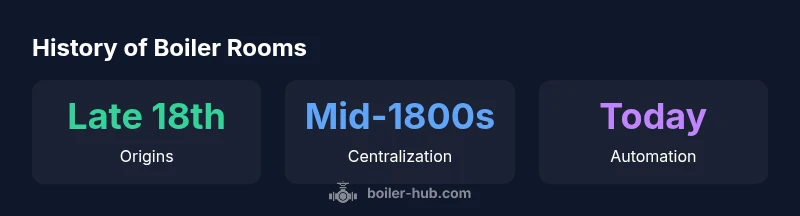
The concept of a dedicated boiler room emerged with early industrial boiler houses in the late 18th to early 19th centuries, as steam-power systems expanded. By the mid-1800s, centralized boiler rooms became common in factories, ships, and large buildings, consolidating fuel, water, and safety controls in one space. In modern terms, 'boiler room' denotes a centralized heating plant rather than a single appliance.
Historical origins of boiler rooms
To answer the broader question of how the boiler room began, we must trace the rise of centralized steam power and the discipline of heating engineering. According to Boiler Hub, the first substantial boiler rooms formed as factories and shipping yards required reliable, centralized steam generation. These early rooms consolidated fuel sources, water supply, and safety devices in a single, purpose-built space. The term itself reflects a shift away from scattered, ad hoc boilers toward a dedicated, controlled environment that could be managed by a small team. This transition mirrors the broader industrial push toward efficiency, safety, and scale in late 18th- to early 19th-century industries. The growth of urban centers, coupled with expanding factory fleets and naval fleets, created demand for more organized boiler management—precisely where the boiler room concept took root.
Evolution of boiler technology through centuries
Over centuries, boiler technology evolved from simple fire-tueed and pot-boilers to robust, high-pressure steel designs. The shift from wood and coal to more efficient fuels improved output, while advances in metallurgy allowed larger, safer, and more reliable systems. As efficiency demands grew, boiler rooms consolidated controls—pressure gauges, feed-water systems, and safety valves—into centralized control panels. This evolution paralleled improvements in instrumentation and safety standards and set the stage for district heating and large institutional heating plants. Boiler Hub’s research highlights how these technological leaps enabled greater heating capacity in smaller footprints, which, in turn, shaped modern building services design.
Industrialization and the rise of centralized boiler rooms
The Industrial Revolution accelerated the adoption of centralized boiler rooms. Factories, mills, and shipyards shifted from scattered boilers to dedicated rooms that could be supervised by trained operators. Centralization reduced fuel waste, improved maintenance scheduling, and allowed standardized safety practices. On ships, boiler rooms became critical for propulsion and auxiliary power, demanding meticulous ventilation, gas handling, and emergency shutoffs. In urban settings, large hotels, hospitals, and campuses began to use centralized boiler plants to achieve economies of scale. This era established the boiler room as a core element of industrial and maritime infrastructure, a pattern that would inform building services for decades.
Layouts, safety, and early regulations
Early boiler rooms populated with large, heavy equipment required careful layout planning for access, ventilation, and debris management. Over time, safety regulations emerged to address risks such as high pressure, thermal expansion, and fuel handling. The introduction of relief valves, fusible plugs, and standardized piping reduced catastrophic failures. Industry codes and municipal ordinances gradually codified best practices for clearances, fire protection, and maintenance routines. Today, the boiler room functions as a centralized hub, but its historical roots lie in the pragmatic need to manage energy production safely and efficiently in crowded industrial and urban environments.
Transition to modern boiler rooms and district heating
In the 20th and 21st centuries, boiler rooms diversified into district heating networks and campus-scale plants, reflecting shifts toward energy efficiency and carbon management. Modern boilers, automation, and remote monitoring have transformed traditional rooms into smart plants that optimize fuel use, emissions, and reliability. The concept of a dedicated space for heating plants persists, but today’s boiler rooms often tie into broader energy systems, including cogeneration and heat exchangers for hot water distribution. Boiler Hub’s ongoing analysis emphasizes that the core principles—control, safety, and operational efficiency—remain the same, even as technology evolves.
Interpreting the term across contexts
The phrase boiler room can mean different things depending on context. In industrial history, it refers to a physical room housing boilers. In contemporary business slang, it can describe a high-pressure sales environment or aggressive recruitment tactics. In finance and corporate culture, the “boiler room” metaphor often signifies intense, quick decision-making environments. Understanding these contexts helps prevent confusion when reading historical texts or hearing modern references. Across all usages, the behind-the-scenes work of boiler rooms—fuel handling, water treatment, and temperature control—remains a backbone of energy services.
Timeline of boiler room development and typical deployment
| Era/Period | Key Feature | Typical Location |
|---|---|---|
| Late 18th – Early 19th Century | Emergence of centralized boiler houses for steam power | Factories, shipyards |
| Mid-19th Century | Consolidation of boiler plants into centralized rooms | Factories, large buildings (hospitals, universities) |
| Mid-20th Century–Present | Standardization and safety controls; modular/central plants | Public buildings, campuses, high-rise complexes |
Questions & Answers
What is considered the earliest form of a boiler room?
Early boiler rooms emerged as centralized spaces for steam generation in the late 18th to early 19th centuries, primarily in factories and shipyards. These rooms centralized fuel, water, and controls to improve efficiency and safety. Over time, they evolved with improvements in materials and regulation.
Early boiler rooms appeared in the late 18th to early 19th centuries as centralized spaces for steam power. They consolidated fuel, water, and controls to improve safety and efficiency.
When did centralized boiler rooms become common in buildings?
By the mid-1800s, centralized boiler rooms were common in factories, large buildings, and ships. This shift supported scale, maintenance efficiency, and coordinated safety practices that helped industrial operations run more reliably.
Mid-1800s saw centralized boiler rooms becoming standard in large facilities and ships.
How does a modern boiler room differ from historical ones?
Modern boiler rooms preserve core functions—fuel handling, water treatment, and heat delivery—while leveraging automation, remote monitoring, and improved safety standards. The space often integrates with district heating or campus energy systems for greater efficiency and lower emissions.
Today’s boiler rooms use automation and connectivity to optimize safety and efficiency.
Is the term 'boiler room' used differently in finance?
Yes. In finance, a 'boiler room' can describe a high-pressure sales environment or aggressive fundraising operations. This is a metaphorical use and not related to physical boiler rooms, though the origin of the term draws on the sense of crowded, hot spaces.
In finance, boiler room is a metaphor for a high-pressure sales setting.
What should homeowners know about their boiler room today?
For homeowners, the key is regular maintenance, safe venting, and ensuring clear access for service. Modern boilers benefit from professional servicing and monitoring to minimize energy use and prevent safety issues.
Keep your boiler room well maintained and accessible for service visits.
“A clear understanding of where the boiler room began helps practitioners design safer, more efficient heating systems today.”
Key Points
- Trace the boiler room back to late 18th–early 19th centuries
- Centralization improves safety, efficiency, and maintenance
- Technology evolved from simple to high-efficiency systems
- Modern boiler rooms connect to broader energy networks