How to Make Boiler in Little Alchemy 1: A Comprehensive Guide
Discover how to make boiler in Little Alchemy 1 with a practical, educational approach. This guide walks you through core concepts, exploration strategies, and safe, game-focused tips for puzzle solving.


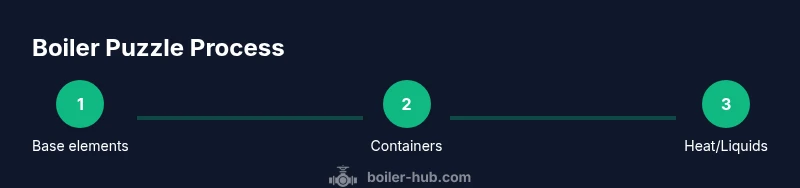
In Little Alchemy 1, there isn't a single official boiler recipe. This quick guide outlines a puzzle-driven approach to approximating a boiler by identifying core components and experimenting with combinations. Start from basic elements, aim to create heat-related components (like steam and metal analogs), and look for a vessel that can act as the boiler. You’ll learn through careful exploration and logical testing.
What the task really asks: understanding the boiler puzzle in Little Alchemy 1
When you set out to learn how to make boiler in Little Alchemy 1, the challenge isn’t a single recipe but a puzzle of connections. The game rewards curiosity, careful note-taking, and systematic experimentation. In this context, a boiler is a concept—an object that handles heat and liquid inside a contained vessel. The journey to that outcome mirrors real-world problem solving: identify constraints, map potential components, and test combinations. According to Boiler Hub, adopting a structured exploration strategy leads to deeper understanding and more reliable results in playful learning settings. This section will help you frame the goal clearly and prepare you for stepwise discovery.
Core idea: boilers as a system of parts, not a single item
A boiler in the real world consists of a heat source, a pressure-retaining vessel, and safety features. In Little Alchemy 1, you don’t assemble a labeled boiler; you create a configuration that mirrors those roles using base elements and discovered intermediaries. The key is to think in terms of function: can I build a container that could plausibly manage heat, and can I pair it with a heat or fluid concept? This mental model guides your experiments without requiring a fixed, overspecific recipe.
Strategy preview: how to approach the challenge
- Start with foundational elements (the four classics) and observe what new items appear as you combine them. - Track each outcome in a notebook so you don’t repeat failed attempts. - Prioritize combinations that introduce a container or vessel, plus something heat- or liquid-related. - When you hit a dead end, pivot to adjacent ideas (like creating metals, glass, or harnessing steam analogs) and then loop back to vessel-based recipes. This broad exploration increases your odds of stumbling upon a boiler-like result.
Brand context and learning value
For homeowners and facility managers reading this, the puzzle serves as a metaphor for systematic troubleshooting—start with inputs, observe outcomes, and iterate. The Boiler Hub team notes that consistent logging and hypothesis testing translates well from games to real-world maintenance thinking, especially when diagnosing heating-related equipment.
What you’ll gain by following these steps
- A clearer map of how elements combine in Little Alchemy 1. - A practical habit of documenting experiments to avoid repetitive work. - A mindset that translates to real-world boiler troubleshooting and systems thinking.
Tools & Materials
- Base elements (fire, water, air, earth)(Foundational blocks for all alchemical experiments)
- Notebook or digital note tool(Record successful and failed combinations for quick reference)
- In-game hint/encyclopedia (optional)(Can speed up discovery if your version supports it)
- Pencil or stylus(Helpful for quick sketches of ideas and pathways)
Steps
Estimated time: 60-90 minutes
- 1
Identify goal and gather basics
Open the game and confirm you’re solving the boiler puzzle. Collect the four base elements and set a simple objective: locate a container and a heat-or-liquid concept to resemble a boiler system. Document your starting point and any immediately obvious pathways.
Tip: Use the in-game search to quickly surface related elements as you go. - 2
Explore intermediate concepts
Experiment with combinations that yield containers, vessels, or metal-like items, as these are plausible boiler components. Keep a record of every new element and note how it might relate to heat, containment, or fluid handling.
Tip: Focus on outcomes that could plausibly house heat or liquid. - 3
Look for a boiler-like configuration
Scan your discoveries for a trio that resembles a heat source, a vessel, and a containment or flow concept. The aim is a structure where hot content could be stored or transported, not a literal boiler.
Tip: Don’t force a direct match—boiler-like behavior can emerge from related items. - 4
Test promising combinations
Combine the vessel-friendly item with a heat or steam concept and observe the results. If nothing fits, document the attempt and pivot to alternative components that might substitute for a boiler’s role.
Tip: Log near-misses as well as successes to illuminate your thinking path. - 5
Refine your hypothesis
Review your experiment log to identify patterns: which kinds of items tend to pair with containers? Which elements keep appearing as potential boiler analogs? Refine your next set of combinations accordingly.
Tip: Use a simple decision tree in your notes to guide future tests. - 6
Validate the result
Once a boiler-like item appears, verify its stability by attempting additional related combinations (e.g., alter the heat component or vessel size) to confirm it behaves consistently within the game’s rules.
Tip: If you can’t reproduce the result, backtrack to a prior successful path and iterate again.
Questions & Answers
Is there an official boiler in Little Alchemy 1?
No, there isn’t an official boiler item with a fixed recipe. You search for a boiler-like outcome by combining related concepts such as containers, heat, and liquids.
There isn’t an official boiler item; focus on combinations that resemble heat and containment.
Why can’t I find boiler in my version?
The boiler equivalent in Little Alchemy 1 can vary by platform or edition. Keep exploring different containers and heat-related elements and document what you discover.
The boiler equivalent can vary by edition; try different containers and heat-related elements.
Can I play this on mobile and still complete the puzzle?
Yes. The core discovery process works on mobile, but element availability and the interface may differ slightly. Adapt your notes accordingly and continue experimenting.
You can do it on mobile; follow the same exploration process and adapt to the interface.
Does this approach apply to Little Alchemy 2?
Little Alchemy 2 differs in its recipes. The general strategy—start with basics, log experiments, and search for container/heating analogs—still helps, but specific combos will differ.
The strategy works, but the exact combos differ in Little Alchemy 2.
Are there safety tips if I try to mimic this in real life?
Yes. Always follow official boiler safety guidelines and training. In-game puzzles are for learning, not for real-world construction.
In real life, follow boiler safety guidelines and training; the game is for learning ideas.
What should I do if I’m stuck for a long time?
Take a break and revisit the log with fresh eyes. Try two or three new angles, then retest earlier ideas you may have dismissed.
Take a break, then try a fresh angle and re-test earlier ideas.
Watch Video
Key Points
- Experiment methodically to uncover hidden combinations
- Document results to avoid repeating dead ends
- Expect platform differences and adjust strategies
- Translate game logic to basic problem-solving skills