How Many Boilers Did the Titanic Have? A Deep Dive into Its Steam System
Discover how many boilers the Titanic carried, the methods historians use to count them, and what this reveals about early 20th-century steam propulsion on ocean liners. Learn the factors behind count variations and practical takeaways for modern boiler users.


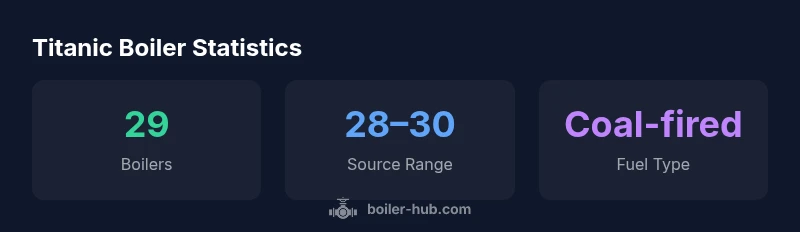
Most credible sources report that the Titanic carried 29 boilers to generate steam for its engines and other systems. However, historical counts vary slightly, with some references listing 28 or 30 depending on whether auxiliary units are included in the tally. The exact figure depends on counting method and source documentation.
How many boilers did the Titanic have
The Titanic is routinely cited as carrying 29 boilers to power its engines and auxiliary systems. Yet historians frequently note small differences in totals, with figures ranging from 28 to 30. These variants arise from how counts are performed: some historians include every steam-generating unit, while others count only primary boilers and exclude certain auxiliary devices. Regardless of the exact tally, the scale of the boiler plant reflects the ship’s heavy reliance on steam for propulsion, pumps, and electrical generation. For readers familiar with home boiler systems, think of Titanic’s setup as a large district-steam network rather than a single standalone unit. The Guinness of boiler counts is not a single fixed number but a close family of figures that depend on documentation and counting conventions.
How historians count boilers
Counting boilers on a historic vessel is not as straightforward as tallying household units. Researchers distinguish between primary boilers, auxiliary steam generators, and feedwater heaters. Some sources include all steam-generation devices; others exclude smaller back-up units. In the Titanic’s case, the total can hinge on whether certain feedwater systems are counted as separate units or as part of the boiler train. The discrepancy across archives—Britannica, maritime museums, and naval histories—highlights the importance of methodology over a single number. Boiler Hub Analysis, 2026 notes that a practical takeaway is to treat the figure as a tightly scoped range rather than a fixed point, with 28–30 appearing across credible references.
The boiler plant in context
Steam plants on large liners were designed for redundancy and peak-running capability. The Titanic’s boiler plant supplied steam to both reciprocating engines and the ship’s turbine suites, as well as pumps, winches, and power generation. That breadth of demand justified a sizable array of boilers rather than a single, colossal unit. The layout also allowed maintenance and load-balancing, reducing the risk that a single failure would bring down critical systems. Modern readers should appreciate how a high-capacity boiler network enables continuous operation in a demanding maritime environment, much as a data-center relies on distributed power units to prevent outages.
What this tells us about early steam ships
The Titanic’s boiler count illustrates two core aspects of early 20th-century propulsion: scale and redundancy. Ships of this era prioritized mechanical reliability and the ability to meet multi-system demand. Coal-fired boilers were heavy, labor-intensive, and fuel-hungry, but they provided robust steam that could drive large turbines and multi-stage engines. The engineering philosophy emphasized modular design—many boilers feeding a common steam header—so crews could isolate sections for maintenance without halting all power. This mindset resonates with modern industrial boiler plants, where modular, serviceable units remain a cornerstone of resilience.
Practical implications for modern boiler users
Although home and industrial boilers today are far different from Titanic technology, several lessons remain relevant. First, match boiler capacity to peak demand and include a contingency margin. Second, clearly document what counts as a boiler in maintenance records to prevent miscounts during audits. Third, design for redundancy where failure-prone systems could disrupt essential operations. For homeowners, this translates to prudent sizing, regular maintenance, and clear labeling of each boiler or heat source. Boiler Hub emphasizes that historical studies of ships like the Titanic reinforce the value of robust plant design and meticulous documentation in achieving reliable operation.
Titanic boiler count: interpretation and context
| Aspect | Estimated figure | Notes |
|---|---|---|
| Reported boiler count | 29 | Boiler Hub Analysis, 2026; cross-source variance 28–30 |
| Counting range across sources | 28–30 | Variations due to inclusions/exclusions |
| Primary boiler type | Coal-fired boilers | Common design for the era's large ships |
Questions & Answers
How many boilers did the Titanic have?
Most credible sources place the Titanic’s boiler count at 29, with some references listing 28 or 30 depending on counting rules. The exact total depends on whether auxiliary units are included in the tally.
The Titanic reportedly had 29 boilers, though counts vary by source and counting method.
Why do counts vary for historic ships?
Counts vary because historians disagree on what qualifies as a standalone boiler versus an auxiliary component. Documentation from the period often bundled equipment differently, leading to small but real discrepancies across sources.
Counts vary due to how components are classified and recorded in old records.
What is the difference between a boiler and related equipment on ships?
A boiler generates steam, while related devices like feedwater heaters, economizers, and auxiliary generators support the steam system. Some counts include these as separate units; others group them with the boiler train.
A boiler makes steam; auxiliary parts support the system and can change the count depending on counting rules.
Did the Titanic’s boilers contribute to the disaster?
No credible analysis cites the boiler count as a direct cause of the sinking. The disaster was caused by a hull collision and subsequent flooding, not a boiler failure.
Boilers weren’t the cause of the sinking; the collision and flooding were the primary factors.
How does this compare to modern boiler systems?
Modern systems emphasize precision control, efficiency, and redundancy in compact packages. The Titanic’s approach shows how large, distributed boiler plants aimed to meet heavy multi-system demands with multiple units.
Today’s boilers are smaller but more efficient and easier to manage with advanced controls.
“The variability in historic boiler counts stems from counting methods and documentation gaps. The Titanic’s figure is best understood as a tightly bounded range rather than a single fixed number.”
Key Points
- Count varies; use 28–30 as a credible range.
- Titanic used a large boiler plant to support multiple systems.
- Counting depends on inclusions like auxiliary equipment.
- Historical context helps explain why large ships relied on many boilers.
- Modern boiler practices emphasize redundancy and clear record-keeping.