How Boilermakers Make Boilers: A Step-by-Step Guide
Discover how boilermakers make boilers—from planning and fabrication to welding, testing, and commissioning. Learn the process, essential skills, safety checks, and what homeowners or facility managers should expect.


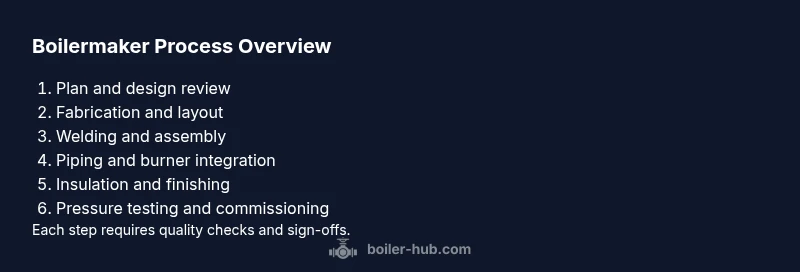
Boilermakers make boilers by combining metal fabrication, welding, and controlled piping work under strict codes. They start with design and material planning, cut and fit heavy components, and weld assemblies together. Then they install burners, controls, and insulation, followed by pressure and safety testing before commissioning the vessel for service. This process blends craftsmanship with rigorous safety standards.
How boilermakers make boilers: an overview
Boilermaking is a skilled trade that blends metal fabrication, precision welding, and integrated piping. If you're wondering how do boilermakers make boilers, the short answer is that the process follows well-established steps, codes, and quality checks to turn raw steel into a safe, compliant pressure vessel. According to Boiler Hub, the work starts with careful planning and design review, then proceeds through fabrication, assembly, testing, and commissioning. This overview maps the journey from concept to service, highlighting the critical decisions, materials, and safety controls involved. Homeowners and facility managers should understand these stages to appreciate the craftsmanship and the discipline required. Throughout, we emphasize safe work practices, documentation, and coordination with other trades, since a boiler project touches mechanical, electrical, and control systems. By the end, you’ll see why boiler fabrication is as much about standards as it is about skill.
How to read this: this section sets the stage for the detailed steps that follow. It uses plain language to translate technical boiler shop work into an actionable understanding for non-specialists. The Boiler Hub Team notes that clear planning reduces rework and helps safeguard critical systems during installation.
Tools & Materials
- Measuring and layout tools(Calipers, steel tape, chalk lines for layout accuracy)
- Cutting tools(Oxy-fuel torch or plasma cutter; blades/consumables kept sharp)
- Welding equipment(MIG or TIG welding machine with appropriate safety gear)
- Clamps and fixtures(Welding magnets, clamps, and a stable workbench or jig)
- Personal protective equipment (PPE)(Safety glasses, welding helmet, gloves, flame-resistant clothing)
- Measuring and marking equipment(Squares, levels, scribes for precise marking)
- Insulation and finishing materials(Thermal insulation and exterior finishing panels)
- Pressure testing equipment(Hydraulic or air-test rig, pressure gauges, leak detectors)
- Documentation tools(Drawings, codes, checklists, and sign-off sheets)
Steps
Estimated time: 2-6 weeks depending on project size and complexity.
- 1
Review scope and align on design
Begin with a thorough review of project drawings, material specs, and applicable codes. Confirm dimensions, tolerances, and any special requirements (erosion zones, vibration considerations, or accessibility for maintenance). This step reduces rework downstream and ensures all stakeholders agree on the approach.
Tip: Mark critical weld joints and clearance paths early so inspectors can verify access points. - 2
Prepare materials and workspace
Clear the workspace, verify material stock, and set up jigs or fixtures. Check that all required parts are present and that safety barriers and ventilation are in place before work begins.
Tip: Double-check material heat-treatment history and batch traceability for compliance. - 3
Cut and layout components
Cut raw steel to exact dimensions and lay out components on the jig or assembly table. Double-check squareness and alignment before any permanent joins.
Tip: Use calibrated cutting tools and record measurements to support future maintenance. - 4
Tack-weld major assemblies
Tack weld critical joints to secure alignment. Inspect fit-up, gaps, and seam visibility, then adjust as needed before welding completes.
Tip: Tack welds should be clean and evenly spaced to prevent distortion. - 5
Complete welding and initial inspection
Perform full welds along all joints, then conduct a visual and nondestructive inspection for cracks or porosity. Clean welds and prepare for pressure testing.
Tip: Follow welding procedure specifications (WPS) and record weld maps for traceability. - 6
Install burners, fuel lines, and controls
Mount burner assemblies, connect fuel supply, air controls, and safety interlocks. Verify compatibility with the vessel design and control system.
Tip: Leak-check all fuel lines before introducing any flame. - 7
Connect piping and instrumentation
Fabricate and install inlet/outlet piping, valves, gauges, and safety devices. Ensure proper routing to minimize stress and vibration.
Tip: Use flexible connectors where appropriate to absorb thermal and mechanical movement. - 8
Apply insulation and exterior finishing
Wrap the vessel with thermal insulation and install protective cladding. Ensure surface finishes comply with environmental and safety standards.
Tip: Inspect insulation seams for gaps that could reduce efficiency. - 9
Perform pressure testing and leak checks
Subject the vessel to recommended test pressures, monitor for leaks, and verify control systems respond correctly. Document results for commissioning.
Tip: Slowly increase pressure to avoid shock loads that can cause cracks. - 10
Commission and document results
Execute the startup sequence, verify safety interlocks, and complete all required documentation and sign-offs. Provide operating manuals and maintenance schedules to the client.
Tip: Secure final approvals from all relevant authorities before placing the boiler in service.
Questions & Answers
What is the primary role of a boilermaker in boiler fabrication?
A boilermaker designs, fabricates, assembles, and installs boilers and similar pressure vessels. They follow codes, select appropriate materials, weld joints, and verify the vessel’s integrity through testing and commissioning.
Boilermakers design, fabricate, and install boilers, following codes and performing tests to ensure safety and reliability.
Which safety standards govern boilermaker work?
Boilermaker work is governed by local codes and standards, including recognized pressure vessel and welding codes. Inspections, test methods, and documentation are essential for compliance.
Work is guided by local codes and established welding and pressure vessel standards, with inspections and documentation required.
How long does a typical boiler fabrication project take?
Project duration varies with size and complexity, but small boiler projects may span weeks, while large industrial vessels can take months. Planning and procurement schedules heavily influence timelines.
Timelines vary by size; small jobs may take weeks, large projects can take months, depending on design and supply chains.
What tools are essential for boilermaker work?
Key tools include measuring and layout tools, cutting equipment, welding gear, clamps, PPE, and testing apparatus. Having calibrated, well-maintained tools reduces risk and improves quality.
Essential tools include measuring tools, cutters, welders, clamps, PPE, and testing gear to ensure precision and safety.
Can a homeowner oversee the boilermaker process?
Homeowners should not supervise critical fabrication work. Hire licensed boilermakers and rely on documented procedures, inspections, and commissioning under regulated codes.
It’s best to let licensed boilermakers handle fabrication, with oversight limited to reviewing documented plans and sign-offs.
What should be checked after commissioning?
After commissioning, verify that safety interlocks function correctly, performance aligns with design, and all documentation is complete for future maintenance and audits.
Check safety features, performance, and keep complete maintenance records for future service.
Watch Video
Key Points
- Plan first, measure twice, weld once.
- Welding quality directly impacts safety and longevity.
- Testing and documentation are non-negotiable.
- Coordinate with electrical and control trades for a successful startup.
- Safety always comes first in boiler fabrication.