Milk in a Boiler: Safe Practices and Alternatives
Learn if you can put milk in a boiler, why it’s unsafe, and safer ways to heat milk. Boiler Hub explains risks, maintenance tips, and clear steps to prevent dairy mishaps in home heating systems.


Milk in a boiler is not safe. Boilers heat water for heating or domestic use, not dairy. Milk can foam, foul heat exchangers, and create deposits that reduce efficiency or cause pressure issues. If dairy contacts the system, shut off power, drain, rinse with clean water, and contact a qualified technician for cleaning and inspection.
Milk and Boilers: The safety reality
Many homeowners ask, can you put milk in a boiler? The short answer is no. This question touches on the different purposes of boilers in homes: space heating, hot water supply, and, in some cases, indirect heating for radiant systems. According to Boiler Hub, introducing dairy into a boiler or its connected piping is outside normal operation and can void warranties. A boiler is designed to circulate water at high temperatures to deliver warmth or hot water, not to process food or dairy. Dairy products can leave behind sticky residues, encourage microbial growth if water temperature is not enough to sterilize, and cause foaming that interferes with sensors and safety devices. It’s essential to understand that dairy belongs in separate appliances (stovetop pots, milk frothers, electric milk warmers), not in the central heating loop or domestic hot water system. This guidance is part of best practices for household boiler maintenance and safety.
Boiler Hub’s guidance also emphasizes that dairy spills can affect warranty terms and lead to costly damage if not handled correctly. Homeowners and facility managers should treat the boiler as a dedicated heating and hot-water system, not a culinary appliance. Recognizing the distinction helps prevent unnecessary repairs and preserves indoor air quality and system longevity. When in doubt, consult your boiler manual and a licensed technician before attempting any intervention beyond basic safety shutoffs.
Why dairy poses risks in boilers
Milk is an emulsion containing fats, proteins, and sugars that behave differently when heated compared to water. When milk enters a boiler, it can foam as it heats, creating vapor and scum that transports milk solids into vents, sensors, and heat exchangers. Over time, milk residues may dry and stick to the interior surfaces, reducing heat transfer efficiency and triggering nuisance alarms. In extreme cases, dairy deposits can trap heat and escalate pressure, potentially stressing pressure relief valves or seals. Dairy exposure can also encourage bacterial growth if residual dairy remains after shutdown, which is undesirable for potable hot water and can pose health risks. Because of these factors, most manufacturers explicitly warn against inserting liquids other than water into boiler loops. Regular boiler maintenance should focus on preventing contamination, not introducing food substances into the system.
From a safety and efficiency perspective, dairy residues can alter flow paths and create hotspots that stress components. Even if you only have a small spill, the cumulative effect over time can reduce performance, shorten equipment life, and complicate future service calls. Homeowners should also consider that dairy residues may affect air vents, condensate lines, and condensate valves, leading to leaks or backups. The bottom line: anything other than water belongs outside the boiler circuit.
For facilities with interlinked heating and hot-water networks, contamination can propagate beyond a single loop, affecting household comfort and system reliability. In short, dairy should never be used as a substitute liquid in boiler loops, and proper separation of culinary activities from heating equipment is essential for long-term safety and efficiency.
How milk can affect different boiler types
Different boiler configurations respond differently to contamination. In combination boilers, the domestic hot water circuit shares heat exchangers with the central heating loop, so dairy contamination can affect both circuits. In vented system boilers, deposits can settle in the expansion tank or feed pipes. In oil/gas boilers, residues may bypass treatment and reach the vent or flue, creating odors or corrosion risk. Regardless of type, dairy is not intended as a fuel or heat-transfer medium and should never be used to 'boost' performance. If milk enters, immediate action reduces risk.
System boilers rely on sealed circuits; any dairy intrusion can alter flow rates and sensor readings, potentially triggering lockouts. Regular maintenance becomes more complex when dairy is involved, and professionals may need to perform chemical cleaning or descaling to restore full function. Radiant floors and hot-water cylinders, if connected to the same system, can also experience indirect effects from dairy contaminants. The safest approach is prevention and swift containment of any accidental spill.
What to do if milk enters your boiler
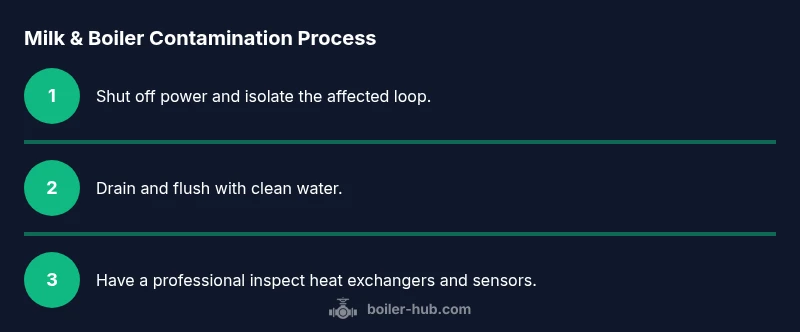
Immediate actions:
- Stop the boiler and, if safe, disconnect power.
- Isolate the affected zone to prevent diffusion into the whole system.
- Open the drain valve to flush the circuit with clean water.
- Collect and dispose of dairy solution in a proper waste container.
- Rinse accessible surfaces with clean water and wipe dry.
- Do not operate the boiler again until a professional inspects the system.
Rationale: Dairy residues can reach heat exchangers and sensors; quick flushing minimizes deposits. Always consult the manual before attempting descaling; use manufacturer-approved cleaners only. If you notice unusual odors, steam, or pressure alarms, shut down entirely and call a service technician.
Safe alternatives for heating milk
For heating milk, use dedicated culinary appliances rather than the boiler system:
- Stovetop pots with steady heat and constant stirring
- Electric milk warmers or frothers designed for dairy
- Microwave methods with short intervals and stirring
Using these appliances reduces the risk of dairy-related damage to home heating equipment and keeps your central system functioning efficiently. If you need hot water for other uses, continue to rely on your boiler as designed and reserve milk heating to separate devices. The key is to separate culinary tasks from heating infrastructure to avoid cross-contamination.
Maintenance and inspection after a spill
After any dairy spill, even if you think you cleaned thoroughly, arrange a professional inspection. A trained technician will:
- Check heat exchangers, sensors, and vents for dairy residue
- Inspect the condensate line, expansion tank, and piping for deposits
- Flush and, if necessary, descale the system using manufacturer-approved methods
- Verify pressure, temperature, and safety valves are functioning correctly
- Document any repairs or replacements for warranty records
Proactive documentation helps maintain warranty coverage and ensures the system operates within safe parameters. Regular, dairy-free operation reduces maintenance costs over time and preserves indoor air quality.
Common myths about milk and boilers debunked
Myth: Milk can improve boiler performance by providing extra lubrication. Fact: Dairy is not a lubricant and can clog or gum up moving parts, increasing wear and risk of failure. Myth: A quick rinse is enough to remove all residues. Fact: Milk often leaves sticky residues that require thorough flushing and possible chemical cleaning by a professional. Myth: Heating milk in the boiler saves time. Fact: Using dairy in the boiler disrupts safety systems and increases downtime for cleaning and maintenance. Myth: Dairy exposure is harmless if it’s accidental. Fact: Hidden residues can lead to corrosion, deposits, and compromised safety if not addressed properly.
Practical best practices to prevent dairy mishaps
- Keep dairy away from areas containing heating equipment; designate separate containers and utensils for milk handling.
- Clearly label rooms and cabinets containing dairy and heating equipment to reduce cross-use.
- Train household members or staff on proper boiler usage and the risks of dairy contamination.
- Schedule regular boiler maintenance with a licensed technician and document any spills for post-incident checks.
- If you run a kitchen near a boiler, ensure proper separation and use splash guards to minimize splash risk.
- Always follow manufacturer guidance regarding what liquids may contact the boiler or associated piping.
Tools & Materials
- Boiler manual(Keep for model-specific guidance and service intervals)
- Protective gloves(Nitrile or rubber for handling spills safely)
- Soft brush(Non-metallic bristles to avoid scratching surfaces)
- Mild dish soap(For exterior cleaning and wiping surfaces)
- Clean water supply(To rinse system surfaces after spill)
- Absorbent towels or rags(Pads spills and dries surfaces)
- Bucket(Optional for collecting rinse water)
- Descaler (manufacturer-approved)(Only if manual permits and performed by pro)
Steps
Estimated time: Total time: 45-60 minutes
- 1
Shut off the boiler and power
If it is safe to reach the controls, switch the boiler to the off position and disconnect power to prevent any further circulation of dairy-contaminated water.
Tip: Never bypass safety switches; if in doubt, call a professional. - 2
Isolate the affected loop
Close any valves that separate the dairy-affected circuit from the rest of the system to prevent cross-contamination.
Tip: Use your boiler schematic to identify the correct valves before acting. - 3
Drain the circuit
Open the drain valve or service valve to flush the system with clean water, starting from the lowest point and working upward to push out residues.
Tip: Collect runoff in a container and dispose of dairy waste according to local regulations. - 4
Rinse and wipe surfaces
Rinse accessible heat-exchanger surfaces, vents, and visible piping with clean water; wipe down exterior panels and any spill-prone areas.
Tip: Avoid abrasive cleaners that could damage coatings. - 5
Inspect for residues
Check for remaining dairy residues and monitor for any unusual odors, foaming, or pressure changes after flushing.
Tip: If signs persist, do not restart the boiler; call a technician for a thorough check. - 6
Reassemble and test
After cleaning, reassemble any panels and run a diagnostic test with the boiler in safe mode under supervision.
Tip: If the manual requires, perform a system purge and vent check before regular use. - 7
Consult a professional
Schedule a service call for a complete evaluation of heat exchangers, sensors, and safety devices to ensure safety and efficiency.
Tip: Keep a service log for warranty and future repairs.
Questions & Answers
Can milk damage a boiler, and how fast does it happen?
Yes, milk can cause foam, deposits, and residue buildup that worsen heat transfer and may trigger safety issues. The damage risk increases with prolonged exposure or multiple spills that aren’t properly flushed.
Milk can damage a boiler by leaving sticky deposits and causing deposits or foam that affect performance.
What should I do immediately if I spill milk into the boiler area?
Shut off power if safe, drain the affected circuit, flush with clean water, and contact a licensed technician for inspection and cleaning.
Turn off the boiler if you can safely reach the controls, drain, and seek professional inspection.
Is it okay to use milk to prime the boiler for better heating?
No. Milk is not a suitable or safe liquid for boilers and can void warranties and cause damage.
Milk should never be used to prime or operate a boiler.
Will dairy spills void my boiler warranty?
Many manufacturers warn against dairy in boiler loops; consult your manual and your installer to understand warranty implications.
Check your manual; dairy contamination can affect warranty terms.
What alternatives exist for heating milk safely at home?
Use dedicated dairy appliances like stovetop pans, milk frothers, or microwave methods designed for dairy.
Heat milk with a kettle or dedicated dairy appliance, not the boiler.
How often should I have my boiler inspected after a spill?
Schedule a service visit to verify heat exchangers and sensors are free of dairy residues and functioning properly.
Get a professional check after any spill to ensure safety and efficiency.
Watch Video
Key Points
- Do not put milk in boilers
- Milk spills require rapid containment and professional cleaning
- Use dedicated milk-heating appliances
- Follow manufacturer guidelines for cleaners and servicing
- Keep dairy distant from heating equipment to prevent contamination