Can you leave a combi boiler on when water is off? Practical guidance
Discover whether a combi boiler can stay on with no water, the risks involved, and a clear, step-by-step restart plan once water returns. Boiler Hub explains safe practices for homeowners and facility managers.


Can you leave a combi boiler on when water is off? In most cases, you should not run the boiler with a dry water supply. Power may stay on, but continuing to heat with no water risks damage and unsafe pressure. Follow the steps below to safely verify and reset after water returns.
Why leaving a combi boiler on with no water is risky
According to Boiler Hub, running a combi boiler when the water supply is interrupted creates several hidden risks. With no cold feed to a combi boiler, the heat exchanger can overheat, pumps can run dry, and the pressure relief valve may trip unpredictably. In some cases, mineral scale and deposits can form more quickly due to stalling, and repeated dry running shortens the life of the heat exchanger and seals. If the boiler continues to operate without water, the system can generate dangerous steam pockets and potentially trigger emergency shutoffs or gas/flare faults. The safe approach is to isolate the boiler from any power or water connection when you know the feed is off, then re-evaluate once water returns. By preventing dry running, you protect the boiler internals, reduce repair costs, and maintain safe operation in your home or building. Boiler Hub's analysis highlights that prevention beats repair when it comes to wet-only vs. dry running events.
Key safety concerns to check before restarting
Before you attempt to power the boiler again, walk through a checklist to ensure safety and avoid common mistakes. Verify that the main water supply has returned and that all taps in the property run clean water without unusual noises. Inspect visible pipes for leaks or frost damage (in cold weather). Check the boiler's fault codes on the display and ensure the pressure gauge shows a normal range (typically 1-2 bar). Look for signs of corrosion, rust, or pooled water around the boiler cabinet. If you notice any gas smell or suspect a flue issue, do not restart; evacuate and call your supplier or a licensed technician. If your system uses a system block valve, confirm it is fully open before re-energizing the boiler. Damp or humid areas near electrical components should be dry and free from water exposure.
Understanding what happens inside a combi boiler when water is off
A combi boiler provides hot water and central heating directly from the mains. When the water supply is interrupted, the boiler cannot absorb heat effectively, and the pump may run dry, increasing wear on seals and gaskets. The heat exchanger relies on a continuous flow to transfer heat safely; without water, overheating can occur, triggering high-limit sensors or pressure relief mechanisms. Modern boilers include safety features designed to prevent a dangerous scenario, such as automatic shutoffs if pressure spikes or no-flow conditions are detected. Repeated dry running accelerates component wear and can lead to leaks or failed valves. Understanding these dynamics helps homeowners recognize why simply leaving the boiler on is not a risk-free option, and why a controlled restart after water returns is essential.
When you should power down the boiler and isolate water supply
If you suspect a water outage or notice any abnormal condition, switch off the boiler using the main power switch or control panel, and isolate the water supply with the appropriate valve. This prevents further dry running and reduces pressure on the system. Allow a few minutes for any residual pressure to dissipate, then inspect for obvious leaks or damage. Do not attempt to restart while the system is under abnormal pressure or if you smell gas. In many homes, the correct sequence is power down, close the water isolation valve, wait briefly, and then proceed with a careful assessment once water is restored.
Restart considerations and the importance of controlled re-energization
Restarting after water returns should be deliberate, not rushed. Begin by verifying the water supply is fully restored and that taps run clean water. Check the boiler pressure, aim for the typical 1-2 bar range, and gently bleed radiators to remove trapped air if needed. Re-energize the boiler in a controlled manner, watch the ignition sequence, and be alert for fault codes on the display. If ignition fails or fault codes appear, power down again and consult the manual or a qualified technician. A cautious approach minimizes the risk of post-restart faults and protects system longevity.
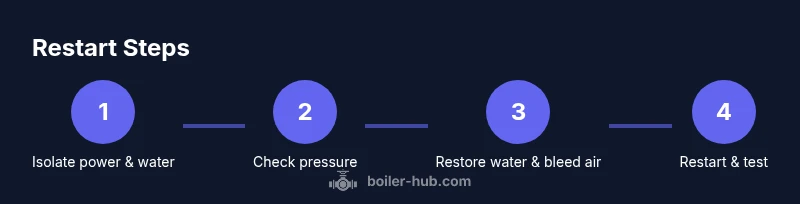
Step-by-step restart procedure (summary)
This summary aligns with the detailed STEP-BY-STEP instructions below. It emphasizes safety, correct pressure, and verification of operation after restart. Do not skip any safety checks, and ensure you have access to the boiler’s manual during the process.
Common mistakes to avoid
Common mistakes include restarting without restoring water supply, not checking pressure, skipping air bleeding, ignoring fault codes, and attempting a DIY fix when gas smells or obvious damage is present. These missteps can cause further damage or unsafe conditions. Always verify the system is dry and safe before energizing again, and never bypass safety devices. If in doubt, contact a licensed technician for professional support.
Quick checks after water restoration
After water returns and the boiler is restarted, verify that hot water and heating respond promptly, listen for unusual noises, and check the pressure gauge over a 10-minute period. If you notice fluctuations in pressure or inconsistent delivery of hot water, stop and recheck the water supply and air bleed steps. A stable start typically indicates a safe restart and reliable operation moving forward.
How Boiler Hub approaches this issue
Boiler Hub emphasizes prevention and safe restarting practices. By documenting common failure points and safety considerations, we guide homeowners and facilities managers through a methodical restart process that minimizes risks and extends boiler life. Our advice focuses on clear steps, thorough checks, and seeking professional help when needed.
AUTHORITY SOURCES
- https://www.osha.gov
- https://www.energy.gov
- https://www.nfpa.org
FAQ
This section provides quick answers to common questions about running a combi boiler with no water, restarting after water restoration, and safety considerations for DIY maintenance.
Tools & Materials
- Boiler service manual(Keep it on hand for model-specific guidance and safety instructions.)
- Shut-off isolation valve key or lever(Essential to isolate water supply safely.)
- Wrench set (adjustable)(For valve and fitting adjustments.)
- Flat-head screwdriver(Used for certain panel screws or limits.)
- Safety gloves(Protect hands from hot surfaces and sharp edges.)
- Towels or a bucket(Contain minor spills and protect floors.)
- Flashlight(Better visibility in cramped boiler rooms.)
- Digital pressure gauge or boiler manual reference(Useful if you need to recheck the system pressure accurately.)
Steps
Estimated time: 45-75 minutes
- 1
Stop power and isolate water
Switch off the boiler at the control panel or wall switch. Locate the water isolation valve and close it slowly to prevent a pressure spike. Confirm there is no active water flow in the system.
Tip: Take a photo of valve positions for reference, and ensure the area is dry. - 2
Check boiler pressure
Look at the pressure gauge; if it reads below normal (around 1 bar or less), do not restart until pressure is recovered by reintroducing water carefully.
Tip: If you see 0-0.5 bar, refrain from powering up—refill per the manual. - 3
Inspect for leaks and damage
Visually inspect all inlet/outlet pipes, the flue area, and the boiler cabinet for signs of water leakage or corrosion. Do not proceed if you detect a gas leak or significant damage.
Tip: Use a flashlight to inspect hard-to-see corners; address any leaks before continuing. - 4
Restore water supply gradually
Open the isolation valve slowly and allow the system to fill. Monitor the gauge and taps for a steady flow. Do not rush the fill; overheating can occur if water enters too quickly.
Tip: Bleed air from radiators if you hear gurgling sounds once the system begins to fill. - 5
Bleed air and equalize pressure
One by one, bleed air from radiators and domestic taps until a steady, quiet flow of water is achieved. Recheck the boiler pressure; adjust as needed to bring it within the normal range (roughly 1-2 bar).
Tip: Have a cloth ready to catch water and avoid spills. - 6
Re-energize and monitor ignition
Turn the boiler back on and watch the ignition sequence. If it fails, power cycle briefly and retry. Note any fault codes on the display for reference.
Tip: If fault codes appear, record them before taking further action. - 7
Test hot water and heating
With water restored, run hot water from taps and then engage the heating to ensure normal operation. Observe temperature stability and listen for unusual noises.
Tip: Let the system stabilize for several minutes and re-check pressure during operation. - 8
When in doubt, call a professional
If you detect gas smells, persistent leaks, abnormal noises, or the boiler fails to restart after several attempts, contact a licensed technician.
Tip: Boiler Hub can help locate trusted service providers in your area.
Questions & Answers
Can running a combi boiler without water cause damage?
Yes. Running a combi boiler with no water can cause overheating, component wear, and safety valve triggering. Always shut down and verify water supply before restarting.
Yes. Running a combi boiler without water can cause overheating and damage; shut it down and verify water supply before restarting.
What should I do immediately if water is off while the boiler is on?
End the run by turning off the boiler, isolate the water supply, and inspect for leaks or damage. Do not restart until water is restored and conditions are safe.
If water is off while the boiler is on, switch it off, isolate water, and inspect before restarting.
How do I safely restart after water returns?
Confirm water supply, check pressure (1-2 bar), bleed air from radiators, then power the boiler back on and monitor for a successful ignition.
After water returns, check pressure, bleed air, then restart and monitor.
Will safety devices shut the boiler off automatically?
Yes. Modern boilers include high-limit and no-flow protections that can shut down if abnormal conditions are detected. If this happens, power down and seek service.
Yes, safety devices can shut the boiler off if conditions are unsafe; contact a technician if it occurs.
Is it safe to DIY fixes if I am unsure?
If you are unsure about gas, pressure, or electrical aspects, it is safer to call a licensed boiler technician.
If you're unsure about any step, it's safer to call a pro.
What are signs of a post-dry-run problem?
Unusual banging, leaking, loss of pressure, or failure to ignite after restoration are signs you should stop and consult a professional.
Watch for banging, leaks, or failure to ignite; if you see these, call a pro.
Watch Video
Key Points
- Never run a combi boiler without water; risk of damage exists.
- Isolate power and water before any inspection after a water outage.
- Check pressure and bleed air as part of a safe restart.
- Follow steps carefully; call a pro for persistent issues.
- Record fault codes for faster service.